Monday, November 14, 2011

Pulp Fantasy Library: Nifft the Lean

Michael Shea first came to the attention of the world of fantasy literature in 1974, when he wrote A Quest for Simbilis, a novel that began its existence as a pastiche of The Eyes of the Overworld but was actually granted status as an authorized sequel by Jack Vance himself. Though eventually displaced and de-canonized by the appearance of Cugel's Saga, A Quest for Simbilis was nevertheless well received, establishing Shea as a master of description and mood. Despite this early success, aside from a few short stories, Shea didn't produce another novel for nearly a decade, until Nifft the Lean appeared in 1982.

Nifft the Lean is not set in the Dying Earth, but there's no denying that there are more than a few connections between it and Vance's famous setting. For one, it's setting seems to be a world that may or may not be a future version of the Earth, eons after the fall of our current civilization, after magic, gods, and demons -- or at least seemingly magical, god-like, and demon-like things -- have returned. For another, the book's eponymous protagonist is a ne'er-do-well on the make. Also like The Dying Earth, Nifft the Lean isn't really a novel so much as a collection of four short stories. Granted, each of these short stories features Nifft in another adventure, but each can be read independently of the others and there is no overarching story connecting them.

I suppose one could make the argument that the book is really a picaresque novel, especially since Shea presents these short stories as a series of reminiscences by a friend of Nifft, a scholar by the name of Shag Margold. Margold speaks in a pedantic, persnickety fashion as befits his role and reports to the reader that Nifft is dead and thus the stories that follow are his recollections of his friend's adventures, as told to him by Nifft himself and others, which is why they are told in the first person. This admission allows Shea to spin what might very well be tall tales rather than the unalloyed truth, which, given the nature of a couple of the book's integral stories, would explain a lot. Furthermore, Margold stresses that he was not present during any of these adventures and has had to rely solely on others for accounts of what occurred.

The first story in the collection concerns Nifft's attempt to bring a living man into the underworld at the behest of the spirit of the lover whom the man has betrayed. In return, Nifft has been promised the key to a wizard's mansion, where untold wealth is said to lie. To win his reward is no easy task. The second story involves a journey into a dangerous swamp in order to harvest black swamp pearls that grow on the bodies of deadly polyps native to the morass. Naturally, Nifft has a plan designed to make acquiring the pearls easier for him. The third story sees Nifft and his companion being falsely arrested and, in order to escape the penalties imposed on them for their "crimes," must rescue son of a rich man, who has been abducted by an inhabitant of the Demon Sea. This story is by far the longest in the book and it shows, dragging on to the point of tedium in places. The fourth and final story involves Nifft in an attempt to save a city from the collapse of a nearby mountain whose foundations have been weakened due to over-mining.

Nifft the Lean is an uneven book, but it's still a fairly engaging one. As I noted above, Michael Shea possesses a superb command of description and mood. His characters and, to a lesser extent, his plots are a bit shallow, or at least more straightforward than one might expect of an author whose debut novel was a sequel to The Eyes of the Overworld. Shea is no Vance but I think he can favorably be compared to Clark Ashton Smith, whose best tales achieve their brilliance more by the evocation of a mood than by tight plotting or deep characterization. That's not to say that Nifft the Lean is purely an exercise in mood creation, because all of its integral stories are fairly satisfying pulp tales, despite their flaws. Moreover, Shea has a very vivid imagination: his inhuman monsters and otherworlds are memorably weird, which makes this book well worth a read by any fan of fantasy literature. Shea may be no Vance but he nevertheless offers more of interest than many more well known fantasy authors, particularly if your tastes tend toward the dark and outré.

Saturday, November 12, 2011

D&D and the Old School Renaissance

Every now and again, it's useful to remind ourselves of a couple of facts about the history of our hobby:

First, Dungeons & Dragons, by virtue of its being the foundational game of our hobby, has always commanded the largest number of roleplayers. This remains true even today. No other tabletop RPG has ever come close to the popularity of D&D at its height.

Second, Dungeons & Dragons, by virtue of its age, has a significant advantage over even its oldest rivals in terms of making its name nearly synonymous with "roleplaying game" in the mind of many people, including gamers who know well there are plenty of other RPGs.

Third, Dungeons & Dragons, by virtue of its being fantasy, is extremely open-ended in nature, making it a lot easier to accommodate a wide variety of not just content but also styles of play.

Given this, is it really any wonder that D&D has such pride of place in the old school gaming world? I'm regularly baffled by the periodic kvetching about how old school gamers are only interested in D&D, because I think it can fairly truthfully be said that the interest of old schoolers in D&D is no greater than that of most gamers in D&D. Indeed, I'd even venture to say that old schoolers, particularly those actively involved in this amorphous thing we call the old school renaissance, are probably more likely to talk about and play lesser known RPGs from the past than are most gamers.

Even a cursory examination of old school blogs and forums would show that their denizens evince far more genuine interest in hoary games like Boot Hill, Gamma World, Stormbringer, and Empire of the Petal Throne (to cite just a few examples off the top of my head) than does the general gaming population. Does such interest come close to rivaling that in D&D? Not by a long such, but, again, I would argue forcefully that's that true of the hobby as a whole and always has been.

Dungeons & Dragons and its derivatives was, is, and probably always shall be the 800-lb. gorilla of our hobby. D&D was the first published RPG ever and has had nearly 40 years to ensconce itself as the king of the hill. Even taking into account the game's rocky history, particularly in the '90s, no other RPG has ever displaced it in this role -- however much some might wish it were otherwise.

Friday, November 11, 2011

Open Friday: Dungeon Maps

When I first started playing D&D, there seemed to be an unspoken rule that published dungeon maps had to fit on one or possibly two 8.5" x 11" pages. I have a hard time remembering any modules that included maps larger than that, though there undoubtedly were some that escape me right now. With the dawn of the Electrum Age and then the Silver Age, dungeon maps became much more complicated. Not only were they frequently isometric, but they were just as frequently printed as posters. This made them unwieldy to use at the table, at least me, which is why, for all that I drooled over them in the abstract, I found that, in practice, they were less than ideal.

Which brings me to today's question. I've been giving some thought to the best presentation of Dwimmermount's maps for use by outsiders. Being a megadungeon, some of its levels are large and sprawling, while others are smaller and more compact. How to present these maps? Poster-sized pages sprang immediately to mind, but I remember only too well how hard such things were to use in actual play. On the other hand, printing a 100-room level on a single page would necessitate shrinking it down to a fairly small size, which might prove equally difficult to use.

So, assuming that money were no object, what would you recommend as the best way to present Dwimmermount's maps -- or indeed any megadungeon's -- in printed form? What would you find best facilitated speedy and enjoyable play at the table?

Thursday, November 10, 2011

The Articles of Dragon: "The Astral Plane"

A Dragon article written by Roger E. Moore and with an introduction by E. Gary Gygax, where he states that "it is about as 'official' as is possible at this time?" For my 13 year-old self, this was as good as an article could get. Appearing in issue #67 (November 1982), "The Astral Plane" was a massive effort on the part of Moore to provide comprehensive rules for adventuring on the Astral Plane. It included discussions of astral encounters, astral travel, the Psychic Wind, movement, combat, and alterations to spells and magic items. There was also an accompanying adventure called "Fedifensor" (written by Allen Rogers) intended to be used in conjunction with Moore's rules. Taken together, it was very impressive package that solidified my sense that, aside from Gary Gygax, Roger E. Moore was one of a handful of Dragon writers whose stuff I could safely assume would be good.

We didn't do a lot of plane hopping in my old AD&D campaigns. I do recall a few visits to the Nine Hells and the Abyss and I suspect the characters did so by means of the Astral Plane on at least one occasion, but, if so, these trips weren't particularly memorable. Ultimately, that's the main problem with "The Astral Plane" -- even with all the clever rules modifications that Moore came up with, the place is still deadly dull. That's not Moore's fault, because he was trying to work within the parameters laid down by AD&D up till that point and those parameters paint a rather uninspiring picture. Sure, the Githyanki hang out on the Astral Plane, but, other than that, what else makes this place cool? Why would anyone want to go there for any length of time? "The Astral Plane" doesn't answer that question and nothing in the AD&D books at the time provided a better answer.

That said, I did like the fact that Moore postulates that other planes will operate according to different laws than those of the Prime Material. That's something I strong advocate and think is essential to the feeling of "We're not in Kansas anymore" other planes should evoke. I also think, as was true in Queen of the Demonweb Pits, that "The Astral Plane" goes overboard in the level of specificity about how character abilities, spells, and magic items operate differently, but that's a criticism of implementation not of concept. So, in retrospect, I still like this article a great deal, even if I wouldn't use it as written in any game I am running now. It's still a great idea mine and a useful foundation for an approach to handling weird otherworlds in your D&D campaign.

Wednesday, November 9, 2011

Retrospective: Star Ace

Between 1984 and 1986, there was not one but two roleplaying game companies located in Walworth County, Wisconsin. The more famous of the two was, of course, TSR, publisher of Dungeons & Dragons, whose offices were in Lake Geneva. The other was Pacesetter, which operated out of nearby Delavan, a mere 12 miles away. Geographic proximity wasn't the only thing that united TSR and Pacesetter. Much of Pacesetter's staff consisted of once and future TSR employees and freelancers, such as Mark Acres, Troy Denning, Andria Hayday, Carl Smith, Garry Spiegle, Stephen D. Sullivan, and Michael Williams.

Consequently, Pacesetter's products often had a "TSR-but-not" feel to them, whether that was intentional or not I cannot say. Regardless, Pacesetter's arrival on the RPG scene caused quite a splash, at least in my gaming group, where we gleefully picked up its products with an eye toward adding them to our repertoire of games. What we found is that Pacesetter games fell into two categories: fun-if-not-inspired and clever-but-half-baked. The first category included Chill and Timemaster, while the second category included Sandman and the topic of today's post, Star Ace.

By all rights, we should have loved Star Ace, which was a sci-fi goulash game whose setting seemed determined to answer the question of "what would happen if the Empire and the Federation came to blows?" Set in the 36th century (I believe -- the game's timeline is a little vague), Star Ace postulates two human-descended interstellar states at war with one another: the Empire and the Federal Alliance. The Empire is, as you'd expect, a vast feudal tyranny, while the Alliance is a beleaguered democracy. Player characters are assumed to be members of "Star Teams," which are quasi-independent special operations who travel about an area of space between the two rival states called "the Wilderness Region." There, Star Teams are expected to engage in covert action against the Empire on behalf of the Alliance. It's a decent enough set-up, if somewhat clichéd.

 Star Ace uses the same Action Table system as Chill and other Pacesetter games of the period (which is the same system used in Goblinoid's new Rotworld, too). It's a serviceable enough system but nothing remarkable -- at least we didn't find it so back in the day. Character generation is a mixture random rolls (for ability scores) and choice (for skill and "order" selection). In the basic game, there are four races you can choose to play: humans, crystal clones (Vulcans, more or less), Kleibor (bear men), and Traka (a humanoid trickster species). Players also select an "order" for their character. Orders are occupational specialties within the Star Teams, each named after a suit of the card deck. Spades are weapons specialists, Hearts are tech specialists, Clubs are noetic (i.e. psychic) specialists, and Diamonds are jacks-of-all-trades (i.e. thieves/rogues). As characters gain experience, they gain access to more and higher-level skills appropriate to their order, as well as rank within the Star Team organization, with the pinnacle being (of course) the rank of Ace.

If what I've described above sounds a bit silly, that's because it is. One of the big difficulties Star Ace had was that its various elements didn't quite cohere into a whole. Individually, many of its ideas were quite workable, but, taken together, they felt disparate, like an overly chunky stew made from leftovers. This feeling wasn't helped by the fact that Star Ace's aliens were probably among the least imaginative I've seen in a SF RPG. They make the forehead people of Star Trek seem inspired by comparison. I'm pretty sure, though, that this was by design on Pacesetter's part. The game is quite explicit about the fact that it's intended to be a swashbuckling space opera game rather than a treatise on exobiology and theoretical physics. That's fair enough, but I think, as both Space Opera and Star Frontiers showed, it's possible to shamelessly rip-off literary and cinematic sci-fi with style, a feat Star Ace never quite managed. Still, I sometimes think that, with a little work, Star Ace could be salvaged into something more memorable and as fun to play as Chill was.

Tuesday, November 8, 2011

The Articles of Dragon: "Should They Have an Edge?"

Issue #66 of Dragon (October 1982) featured paired articles that each attempted to answer the question "Should They Have an Edge?" -- the "they" in question being clerics. John Sapienza's article answered in the affirmative, while Bruce Humphrey's replied in the negative. The question of the cleric's weapons selection is a very old one. I'd not be the least bit surprised to discover that there were groups that opted for a wider selection of weapons almost immediately upon reading the LBBs back in 1974. That's why I consider clerical weapons to be one of the great fault lines of D&D fandom, along with alignment and demihuman level limits. It's a topic about which a lot of gamers have not just a strongly held opinion but one to whose rightness they believe they can sway others through "logical" argument.

In his article, Sapienza provides a pretty good snapshot of the various arguments used to suggest that limiting clerics to non-edged weapons is ludicrous. In particular, he stresses that, as a roleplaying game, D&D needs to be open to societies other than those colored by implicit Christianity. For Sapienza, it makes no sense for a cleric of, say, Odin or Ares, to be prevented from wielding weapons strongly associated with their patron deities. That said, he recognizes the fact that, if there are no restrictions on a cleric's weapons use, then the class quickly eclipses the fighter as the all-around best combatant. This is a very good point and one strongly rooted in OD&D, where in the LBBs anyway, there are comparatively few magic weapons a cleric can use and magic swords are by far and away the most powerful enchanted weapons.

What Sapienza proposes is class-based weapon damage, an idea that's been kicked around the OSR for several years now. Sapienza divides characters up into fighters, semi-fighters, and non-fighters. How much damage a weapon deals is based not on the weapon itself but on the class that wields it. Thus, while a cleric -- a semi-fighter -- can wield a sword, he does only 1d6 damage with it rather than the 1d8 of fighters (or, for that matter, the 1d4 of non-fighters, like magic-users). It's an interesting approach that shows cognizance of the fact that eliminating weapon restrictions takes away some of the fighter's uniqueness.

Humphrey, on the other hand, relies almost entirely on roleplaying considerations to justify his defense of limiting clerics to blunt weapons. He spends some time examining what the game's restrictions suggest about the psychologies of the various classes. It's thus a variation on the "D&D is Always Right" principle, I've sometimes alluded to -- the notion that, rather than assume that some aspect of the game you don't like is wrong and therefore must be corrected, it's often better to ponder just why that aspect is the way it is. Unfortunately, in Humphrey's case, I don't think the principle serves him very well, as he stretches it too far, making unsubstantiated assertions about the "impurity" of blood and how even evil clerics ought to stay clear of it outside of ritual circumstances.

The one idea Humphrey does have that I like is one that I employ in my Dwimmermount campaign. Humphrey points out that the mace is a rod of office, a regal symbol that indicates the cleric has been granted power in this world by his divine patron. Thus, the wielding of the mace is a reminder, both to outsiders and to the cleric himself, of his role as a vicar for his deity. The Thulian Great Church had a similar mindset, which is how I justify the use of maces by Lawful clerics in my game world. (Neutral clerics -- i.e. druids -- and Chaotic anti-clerics have no such restrictions).

What I find interesting about these paired articles is that, while I am predisposed to agree with Humphrey, I think Sapienza's article is better argued and presented. His answer to this perennial question is an elegant one, even if it's not one I'd ever adopt, while Humphrey comes across as largely handwaving away the question. Still, I always enjoyed paired articles like this in Dragon and will no doubt point out others in this vein in future installments of this series.

Monday, November 7, 2011

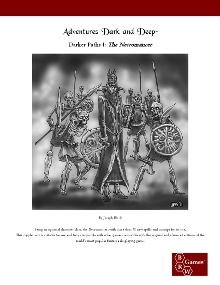
REVIEW: Darker Paths I: The Necromancer

If you're an old school gamer, especially if you're preferences tend toward fantasy roleplaying, the last few years have produced a wealth of new material, much of it every bit as good as what we got back in the day. For some, though, it's an embarrassment of riches and they've found it hard to keep up with the steady stream of old school games, supplements, and adventures. That's perfectly understandable -- I, too, find it difficult to stay current -- but it's also unfortunate, because it often means that worthy offerings are overlooked.

A good example of such an overlooked offering is Joseph Bloch's Adventures Dark and Deep. ADD, as you might guess from its acronym, is a fantasy RPG inspired by Advanced Dungeons & Dragons. More specifically than that, it's a speculative RPG intended to provide one possible answer to the question, "What might AD&D's second edition have looked like if Gary Gygax had remained at TSR to complete the project himself?" Answering that question is certainly a huge undertaking and some might even think a quixotic one, but Bloch demonstrated a great command of both first edition AD&D and, perhaps more importantly, Gygax's public statements on how he intended to revise that game for a new edition. The end result is a game that I think does justice to the "what if?" question posed above.

Darker Paths I: The Necromancer is a 24-page PDF supplement to ADD, providing a new sub-class of the mage. The necromancer is, of course, restricted to evil aligned characters, as well as to humans and dark elves. This will limit its appeal to many players, though evil PCs are a longstanding tradition of the hobby. Even if the sub-class sees little use by players, it's still quite useful to the referee in creating adversaries to use in adventures. As written, the necromancer functions much like an ordinary mage; its two primary differences are its ability to affect (i.e. turn or control) the undead and its unique spell list.

That unique spell list encompasses nearly 100 spells, most of them original to this product. With so many new spells, it's fair to say that they take up the vast majority of The Necromancer's word count. I didn't personally find that to be a problem, since I thought many of these spells were quite clever and I'll be gleefully swiping them for Dwimmermount's own version of the necromancer. More impressive, though, is the way that these spells feel very much like they were products of post-Unearthed Arcana AD&D. Moreso than the spells in the Players Handbook, the spells of Unearthed Arcana have long struck me as being imbued with a specific flavor that undoubtedly stems from Gygax's peculiar take on fantasy. Some of that same peculiarity is on display here, too, in spells with names like funeral shroud, empty tomb, conqueror worm, and span of the mayfly. It's a great collection of new spells and well worth the $5.00 cost of the PDF, even if you play something other than ADD (or AD&D or OSRIC).

Darker Paths I: The Necromancer is a well-done and useful product. It's definitely a niche product, primarily of interest to old school fantasy gamers looking to expand their repertoire of magic spells and the classes that can wield them. If you're among that number, you'll greatly enjoy what Joseph Bloch has produced here.

Presentation: 7 out of 10
Creativity: 8 out of 10
Utility: 7 out of 10

Buy This If: You can't get enough new sub-classes and spells or you're looking for a well-done necromancer class to use with your class-and-level fantasy RPG.
Don't Buy This If: You've got more than enough spells and sub-classes or would rather that necromancers not be treated as a unique class.

Crom the Barbarian!

Numbered amongst Gardner Fox's many comic writings is a sword-and-sorcery tale called "Crom the Barbarian!," which appeared in the June 1950 issue of Out of This World. The story borrows heavily (and shamelessly) from Robert E. Howard's Hyborian Age for ideas and names, so it's not exactly a work of art. Still, it's one of the earliest S&S comics in existence and I thought others might get a kick out of it. Here's the first page:
You can see scans of the whole story here, in this thread at the official Conan forums, where poster Theaganes made them available. "Crom the Barbarian!" is in the public domain, too, so if anyone out there is looking for a hot property to base their next old school RPG on, feel free to make use of this one.

Pulp Fantasy Library: The Sword of the Sorcerer

Gardner Fox is a name that doesn't get mentioned very often by pulp fantasy aficionados these days, which is odd considering both how much he wrote and how influential his writings were. Fox may be better remembered in the comics world, where he was responsible for creating (or re-imagining) not only some of its best loved characters but also some of its key concepts . Among Fox's many contributions to comics are: Sandman (the original one, not the angsty Neil Gaiman version), The Flash, Hawkman, Dr. Fate, the Justice Society and Justice League of America, and the very idea of a multiverse of parallel worlds, as well as many others too numerous to mention (though you should feel free to do so in the comments below).

Fox was a energetic polymath, who wrote widely over five decades, from the 1930s to the 1980s, with some of his work even appearing in the pages of Dragon. And while his comics work is not only better known but better regarded, I think it criminal that his swords-and-sorcery work is mostly forgotten. Take, for example, his character of Kothar, who made his debut in a 1969 collection entitled, Kothar, Barbarian Swordsman, one of whose stories, "The Sword of the Sorcerer," I'll be discussing in this entry. On first glance, one might reasonably assume that Kothar is just another Conan knock-off, and it's true that there are many similarities between Robert E. Howard's Cimmerian and Fox's own barbaric protagonist. Upon reading these tales, though, what one soon discovers is that there's more than a touch of Vance's The Dying Earth or Smith's tales of Zothique in the Kothar yarns, too. Kothar, Barbarian Swordsman begins with a prolog, which purports to be an excerpt from The Lord Histories of Satoram Mandamor, a Nemedian Chronicles-like framing device that sets the scene:
The Universe is old. Old!

For ten billion years the stars of this, our galaxy, hurtled outward across the gulfs of space. For another billion years they hung suspended at the apex of their expansion.

During the past three billion years, now that the universe is contracting instead of expanding, those stars, dim and faint with age, have been collapsing in upon themselves, rushing headlong back to their beginnings and their ultimate destruction.

In time, there will be no Time.

Ages ago, as the legends say, the race of Man knew those stars and all their planets, named and visited them, and left on those planetary surfaces vast cities, great monuments to mankind's own greatness. Once, uncounted millennia before, an empire of Man was spread throughout the universe. This empire died more than a billion years ago, after which man himself sank into a state of barbarism.

Here and there on a planet man has occupied can be seen a bit of stonework which he left behind him as a reminder of past glory, or a few rocks of what had been a mighty megopolis, even some chunks of marble as a memento of forgotten art masterpieces. The rust and erosion of eon upon eon has bitten deep into mankind's creations.

Today, wherever man can be found on the planets of the dying star-suns, the very shapes of the continents on which he lives bear little resemblance to those he knew two billion years before. The oceans cover his cities, the desert sands his tombs and temples, while the fierce north wind ruffles vegetation that earlier man had never seen.

Today, man is a barbarian in a barbaric world. Man has reverted back to the childhood of his earliest years. He has forgotten his heritage, he has made new gods to replace the old. Man has outlived his glory.

And yet—to some men and women who live in the sunset years of the race has been given a power unknown to those men of an earlier age, yet a power famed and feared in the legendry of his people. For there are wizards and warlocks, sorcerers and witches in these days, and their spells and incantations are known to work malignant miracles.

There are also warriors, fighting men whose swords earn them fame and fortune, men inured to hardship and a way of life totally alien to the men of an earlier day. One such warrior was Kothar, cast up by the sea in the northlands of his world, a sellsword and a mercenary, a wencher after the women of his day, a freebooter and a thief, at times, whose sword Frostfire was a magic sword.

This is his saga…
This isn't the stuff of great literature, I won't deny, but there's nevertheless a certain raw power in it that I find appealing. Apparently Gary Gygax did as well, since, reading through "The Sword of the Sorcerer," there are a number of cases where one can see ideas that were lifted from it and incorporated into Dungeons & Dragons. Chief among these is that of an undead wizard called a lich. In Fox's story, Kothar is exploring an ancient tomb that turns out to be the final resting place of a lich named Afgorkon, whose countenance sends lesser men fleeing in fear. As it turns out, Afgorkon has been awaiting Kothar -- or at least someone like him -- to undertake a task for him.

This task is the destruction of a witch-queen and, to aid him in this, he gives to Kothar a magic sword called Frostfire. After he completes this task, Frostfire is Kothar's to keep as his fee, so long as he forsakes all other wealth, a condition Kothar considers no great burden seeing as he owns nothing but his armor and his weapon. And with that the barbarian sets off in a series of journeys that take him from one place to another as he strives to do as Afgorkon commanded him, even as he must grapple with new information that suggests he wasn't told the whole truth by the undead sorcerer.

As I said, "The Sword of the Sorcerer" is not great literature. Indeed, it comes across as more than a little ham-fisted at times, almost descending into parody. Yet, Fox's great strength as a writer as his ideas and those ideas are potent enough that I find it difficult not to enjoy the adventures of Kothar. The mixture of fantasy and science fictional elements with Howardian action in a Dying Earth-style setting is fun, a bit like a slightly more grown-up version of Thundarr the Barbarian -- but only slightly. And in my book that's a good thing.

Friday, November 4, 2011

Open Friday: Mispronunciations

There can be no question that gaming (along with Jack Vance and H.P. Lovecraft) expanded the vocabulary of my younger self, introducing me to a large number of words and expressions I'd never come across in any other context. Of course, since they were unfamiliar to me, I often didn't know to pronounce these words. In some cases, my mispronunciations persisted for years until I was corrected by someone more knowledgeable than I. Of these, the mispronunciation I remember most clearly is Gygax's name for dark elves -- drow -- which I mistakenly rhymed with "row" rather than "cow." I also recall mispronouncing the Call of Cthulhu profession of "dilettante." How embarrassing ...

So, what are your most shameful gaming-derived mispronunciations?