Tuesday, February 8, 2022

White Dwarf: Issue #26

Issue #26 of White Dwarf (August/September 1981) features a cover by Ian McCaig, an artist well known for his contributions to movies and album covers. Ian Livingstone's editorial floats the idea of the White Dwarf's becoming a monthly periodical but also expresses concern that doing so might affect its overall quality. To ensure this doesn't happen, he needs more regular contributors, particularly for games like D&D, Traveller, and RuneQuest (three games I strongly associate with WD, particularly the latter two). It will be interesting, from a historical point of view, to see how soon his call for new writers has any effect on the magazine's content.

The issue kicks off with a remarkable article by Marcus L. Rowland entitled "The DM's Guide to the Galaxy." Subtitled "Space Travel in D&D," Rowland sketches out the broad outline of what space travel might look like in Dungeons & Dragons, drawing on existing rules for inspiration and insights into the nature of space in a universe where magic works. Having long been a fan of the concept of fantasy space travel, this article pleased me, though I wish it had been longer and more fully fleshed out.

"Open Box" tackles four new game products, starting with Games Workshop's own Apocalypse, a game previously entitled The Warlord, which involves the struggle between small empires in post-apocalyptic Europe. The reviewer gives the game a 9 out of 10, which may well be justified, but the fact that the review appears in a Games Workshop periodical makes me question his objectivity. Also reviewed are High Guard for Traveller (also 9 out of 10), Expedition to the Barrier Peaks (9 out of 10), and Knights of Camelot (a mere 7 out of 10). 

Part II of Roger Musson's "The Dungeon Architect" focuses on the architectural features of a dungeon, starting with often forgotten elements like verticality and transit. Musson makes the very good point that dungeons exist in three dimensions; yet, many referees fail to take into account height and depth. Likewise, he draws attention to rapid means of getting in and out of the dungeon, such as teleport systems and the like. I find such considerations fascinating, since they're clearly reflective of an earlier, megadungeon-centric style of play that had already begun to fade by the time I entered the hobby. The logistics of a dungeon "expedition" were much less onerous in my youth, so it's good to be reminded of the way things were played before me. Musson rounds out the article with an examination of what he calls "vindictive" features, such as traps, one-way doors, etc.

"Jump Drive Problems" is a collection of short submissions on this topic for use with Traveller. They're a follow-up to the original article on this subject, which appeared in issue #24. Meanwhile, "Lizard Men as Player Characters" by Roger E. Moore and Michael Brown is exactly what its title suggests: providing guidelines for making this reptilian race available for players of AD&D (and even references Quag Keep in support of the idea). "Amber to Red" by Neil Cheyne is a Traveller scenario, the winner of a competition sponsored by the magazine. The scenario involves the hijacking of a starship, with the players taking the roles either of the hijackers or the defenders. It's a perfectly serviceable adventure, complete with starship deckplans, but nothing special in my opinion.

Part IV of Lewis Pulsipher's "An Introduction to Dungeons & Dragons" turns its attention to fighters and thieves. Pulsipher has a lot more to say about the latter than the former. He stresses the flexibility of the thief class and its many potential roles in a party. Frontline fighting, however, is not one of them and repeatedly emphasizes the need to "think thievishly" when playing the class – good advice. "Treasure Chest" continues to offer a grab-bag of new magic items, like the potion of quiet spell casting (which eliminates the need for a verbal component when imbibed) and the assassin's toolkit (filled with all manner of nasty aids to murder). Finally, "Fiend Factory" presents a collection of new humanoid monsters, like shadow goblins and winter kobolds. It's not the column's best installment, though its inclusion of proposed collective nouns for D&D monsters is fun (a confusion of umber hulks, a heard of ear seekers, and a fraction of halflings being some of the best ones).

Issue #26 is a solid, workmanlike effort – nothing special but nevertheless filled with entertaining and occasionally thought-provoking material. As I keep saying in these posts, White Dwarf is inching ever closer to resembling the magazine I remember from my youth (which isn't surprising, since my first issue was #32). It's a worthy alternative to Dragon, both in terms of its focus and, more importantly, perspective.

Monday, February 7, 2022

A Radical Proposal

I've lately been thinking about ability scores – the actual numbers associated with any given ability – and how they might be made to serve a more direct purpose in OD&D and games derivative of it. This has led me down some strange paths, some of which I'll probably start sharing over the coming weeks. For the moment, though, I want to present one of the more radical of them, pertaining to Constitution and the generation of hit points.

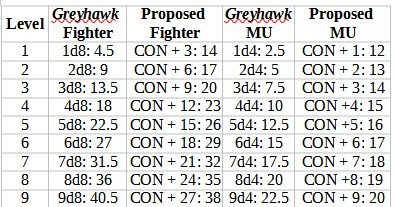
My idea, partly inspired by Basic Role-Playing, is that a newly generated character starts the campaign with a number of hit points equal to his Constitution score plus a fixed amount based on his class (the fixed amount is gained at every level, including first). This is obviously a huge change, since it would make 1st-level characters vastly more durable (even with a below average CON score) than standard OD&D characters. Over time, though, the numbers would even out, so that, by 6th or 7th level, the totals would be quite similar on average. To see what I mean, let's compare the average hit points of a Supplement I fighter and magic-user with 11 Constitution to their equivalents under this new system I've imagined.
This obviously represents a huge shift in thinking, not simply because of the increased durability of low to mid-level characters, but also because hit point increases are now fixed (+3 per level for formerly d8 hit dice, +2 per level for d6, and +1 per level for d4). This makes a high Constitution an extremely valuable asset, particularly at 1st level. On the other hand, hit points are kept much lower overall. Under Supplement I, a fighter with 18 Constitution and maximum rolls could have almost 100 hit points at 9th level, whereas, under this proposal, a fighter with the same CON would have less than half that. 

Naturally, for the proposal to work, there'd have to be a similar shift in the way that monster hit points were calculated, as well as possibly the damage ranges of weapons. Not having tested this, I don't yet have any way of knowing how this would play out or what sorts of unforeseen consequences might emerge from its adoption. At the moment, it's just an idle thought stemming from my desire to see the numerical scores of abilities in OD&D have more meaning beyond being an index on a chart. 

Minarian Legends

Between issues #34 (February 1980) and #57 (January 1982) of Dragon magazine, there appeared a series of articles written by Glenn Rahman entitled "Minarian Legends." The series elaborated upon the setting of the Divine Right boardgame published by TSR, with the apparent goal that the setting – called Minaria – might be used for Dungeons & Dragons adventures and campaigns. Interestingly, these consist almost entirely background information, accompanied by wonderful artwork by Kenneth Rahman, rather than any new rules or game mechanics. In any case, the articles are truly delightful and only make me more regretful that I've never been able to locate a copy of Divine Right at anything approaching a reasonable price.

Pulp Fantasy Library: The Scarlet Citadel

I've never made any secret of my ambivalence toward the 1982 Conan the Barbarian movie of John Milius, even though this is heresy in some quarters. Yet, for all that ambivalence, one of its images, that of an aged Conan, seated upon a throne, after he "became a king by his own hand," endures in my imagination. 

Partly, I think, this is because I find myself wanting to know more about Conan's time as king of Aquilonia. The character's first appearance, in the story "The Phoenix on the Sword," features him as already king and is generally considered one of Robert E. Howard's best tales of the Cimmerian. When I first read the story (which I thought I'd already written about, an oversight I'll have to correct soon), I was really struck by the picture it paints of a middle-aged Conan, forced to deal with political intrigue despite his preference for a straight-up fight. That's a rich vein to be mined for storytelling and I've thought more about the idea than is probably justified.

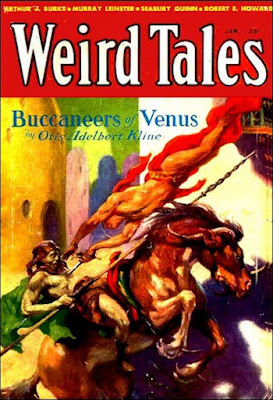
Besides "The Phoenix on the Sword," Howard wrote another tale of King Conan entitled "The Scarlet Citadel," which appeared in the January 1933 issue of Weird Tales. There are a number of similarities between the two stories, but there are also enough differences to keep them distinct. "The Scarlet Citadel" begins with Conan leading the knights of Aquilonia in battle in neighboring Ophir.

That day Conan, king of Aquilonia, had seen the pick of his chivalry cut to pieces, smashed and hammered to bits, and swept into eternity. With five thousand knights he had crossed the south-eastern border of Aquilonia and ridden into the grassy meadows of Ophir, to find his former ally, King Amalrus of Ophir, drawn up against him with the hosts of Strabonus, king of Koth. Too late had he seen the trap. All that a man might do he had done with his five thousand cavalrymen against the thirty thousand knights, archers and spearmen of the conspirators.

Amalrus, we later learn, had lured Conan into Ophir under the pretext of requesting aid from Conan against Koth, which had supposedly invaded. Ever the loyal ally, Conan rushed to Ophir's aid, apparently never considering the possibility that the call for help was but a stratagem for luring him away from Aquilonia. The mastermind of this plan is "the lean vulture Tsotha-lanti," a sorcerer "clad only in silken robes, his great black eyes glittering from a face that was like that of a bird of prey."

Of this Kothian wizard dark tales were told; tousle-headed women in northern and western villages frightened children with his name, and rebellious slaves were brought to abased submission quicker than by the lash, with the threat of being sold to him. Men said that he had a whole library of dark works bound in skin flayed from living human victims, and that in the nameless pits below the hill whereon his palace sat, he trafficked with the powers of darkness, trading screaming girl slaves for unholy secrets. He was the real ruler of Koth. 

How's that for the introduction of a villain? Equally impressive is his first encounter with Conan, after the Aquilonians have been defeated and the Cimmerian is the only one among them left alive.

"I offer you life, Conan," said Tsotha, a cruel mirth bubbling at the back of his voice.

"I give you death, wizard," snarled the king, and backed by iron muscles and ferocious hate the great sword swung in a stroke meant to shear Tsotha's lean torso in half. But even as the hosts cried out, the wizard stepped in, too quick for the eye to follow, and apparently merely laid an open hand on Conan's left forearm, from the ridged muscles of which the mail had been hacked away. The whistling blade veered from its arc and the mailed giant crashed heavily to earth, to lie motionless. Tsotha laughed silently.

"Take him up and fear not; the lion's fangs are drawn." 

Tsotha-lanti used a ring with a poisoned needle embedded in its underside to incapacitate Conan. Thus temporarily paralyzed, the Cimmerian is brought to as a prisoner to the titular Scarlet Citadel. There, the three conspirators, including the faithless Amalrus, make plain their intentions.

"Our desires are spoken quickly, king of Aquilonia," said Tsotha. "It is our wish to extend our empire."

"And so you want to swine my kingdom," rasped Conan.

"What are you but an adventurer, seizing the crown to which you had no more claim than any other wandering barbarian?" parried Amalrus. "We are prepared to offer you suitable compensation –"

"Compensation!" It was a gust of deep laughter from Conan's mighty chest.

"The price of infamy and treachery! I am barbarian, so I shall sell my kingdom and its people for life and your filthy gold? Ha! How did you come to your crowns, you and that black-faced pig beside you? Your fathers did the fighting and the suffering and handed their crowns to you on golden platters. What you inherited without lifting a finger – except to poison a few brothers – I fought for.

"You sit on satin and guzzle wine the people sweat for, and talk of divine rights of sovereignty – bah! I climbed out of the abysss of naked barbarians to the throne and in that climb I spilt my blood as freely as I spilt that of others. If either of us has the right to rule men, by Crom, it is I! How have you proved yourselves my superiors?"

It's a terrific exchange, filled with passion and indignation. I have little doubt that Howard poured more than a little of himself into it, with his disdain for the "high and mighty" who looked down on men of modest means such as himself. The anger behind it is palpable and suffuses the rest of the story, as Conan eventually frees himself from captivity and then sets about avenging himself upon those who would steal his throne and immiserate his people. 

"The Scarlet Citadel" is a fine pulp fantasy yarn, one that shows off not just the writing skills of Robert E. Howard but also the virtues of Conan as king of Aquilonia. Re-reading it, I found myself once again yearning for more stories of this sort, stories that show the kind of ruler Conan had become and what he was willing to do for the people of Aquilonia, whose lot he had improved by his reign. Even so, "The Scarlet Citadel" is a good read and one I highly recommend. It may well be one of Howard's best tales of Conan.

Saturday, February 5, 2022

Grognard's Grimoire: Ashalakat

Ashalakat (Blood Creeper)

The ashalakat is a 4'-long monstrosity possessing a flat, translucent body and eight strong tentacles. The beast is an aggressive predator that subsists entirely on blood. Its preferred habitat is dark and moist, such as the middle reaches of the Vaults beneath Nalu Hesh.

AC 7 [12], HD 5+1** (23hp), Att 8 × tentacles (1d3), 1 × bite (1d3 + blood drain) THAC0 16 [+3], MV 120’ (40’), SV D12 V13 P14 B15 S16 (2), ML 9, XP 575, NA 1d4 (1d4), TT B

  • Blood drain: Attaches to victim on a successful hit, doing 1d4 automatic damage per round.
  • Detaching: Must be killed.
  • If victim dies: Detaches and finds a dark place to digest.
  • Constriction: Tentacles grab and constrict after a hit. 1d3 automatic damage per round. 
  • Severing tentacles: Requires a hit that inflicts 3 or more damage.
  • Cling: Can move along walls and ceilings.
An ashalakat by Zhu Bajiee

Friday, February 4, 2022

Go For It!

Here's an advertisement for Boot Hill I'd never seen before. It appeared in issue #40 of Dragon (August 1980).

Raising Questions about Raising the Dead

In a comment to yesterday's post about my ongoing House of Worms Empire of the Petal Throne campaign, I was asked why I balked at giving player characters' access to spells like raise dead, when the game itself allows them? That's a very good question and I'm glad it was asked, because it made me explore my feelings on the matter a bit more.

In original Dungeons & Dragons, raise dead is a 5th-level cleric spell, the highest level of such spells available prior to the publication of Greyhawk. The earliest a player character can gain access to this spell is 7th level (50,000 experience points). The spell is described thusly:

The Cleric simply points his finger, utters the incantation, and the dead person is raised. This spell works with men, elves, and dwarves only. For each level the Cleric has progressed beyond the 8th, the time limit for resurrection extends another four days. Thus, an 8th level Cleric can raise a body dead up to four days, a 9th level Cleric can raise a body dead up to eight days, and so on. Naturally, if the character's Constitution was weak, the spell will not bring him back to life. In any event raised characters must spend two game weeks time recuperating from the ordeal.

 Greyhawk introduces two new spell levels for clerics, 6th and 7th, with the latter including the spell raise dead fully that is functionally identical to its 5th-level counterpart, except that "no rest or recuperation is required thereafter." This spell first becomes available at 17th level, which I suspect effectively put out of easy reach of most player characters.

The Empire of the Petal Throne equivalent is revivify, the highest level "priestly skill" in the game. At level 1, EPT characters begin with 2 to 5 abilities chosen from a chart. How many of these abilities an individual character gets is randomly determined, That said, revivify is available to a priest no sooner than level 8 (120,000) and no later than level 11 (440,000). Bear in mind, too, the XP penalties the game employs to slow progression, starting at level 4. This is significantly later than in OD&D by any metric.

The description of revivify is as follows:

Depending on the character's constitution (Cf. Sec. 413 above), this spell restores one slain human or intelligent nonhuman to life. A newly revived being cannot engage in fighting for a period of one week. This spell must be used within one week of the being's death; otherwise he or she cannot be revived. Usable once a week by persons of eighth level or below; usable once a day by those above eighth level.

It's fascinating to note the mechanical similarities and differences, which are no surprise, given that EPT's rules were heavily inspired by those of OD&D. What I think is most notable, though, is how much more difficult it would be for an Empire of the Petal Throne player character to gain access to revivify, compared to raise dead in Dungeons & Dragons. I suspect this is intentional, as one M.A.R. Barker's early criticisms of D&D was that the game's rules were devoid of any social context, seemingly existing in a societal vacuum. Tékumel is, in part, an answer to that perceived vacuum, grounding its mechanics in a social structure so that there are consequences and stakes to the implications of the rules.

Ultimately, I think my unease with raise dead rests somewhere in this vicinity. It's both too readily available to player characters – 50,000 XP isn't all that much in OD&D, even after the Greyhawk changes – and without any larger context. Mind you, that's a problem with D&D generally, though I understand that many, not without reason, don't see this as a problem per se but rather a kind of design agnosticism. That's fair, I think, but it does little to answer my own concerns, except perhaps to say, "If you don't like it in your campaign, change it." 

In the case of the House of Worms campaign, I haven't changed anything with regard to the revivify spell. None of the priest characters in the group is yet high enough level to cast the spell. Likewise, the two instances of resurrection to occur didn't involve the spell but instead near-miraculous events outside the control of the players. Rather, they were orchestrated by me as the referee, because I saw an opportunity to use a character's death(s) to do something interesting in the campaign. That's the crux of it for me: I don't actually object to the idea of raising a character from the dead, even multiple times. What I object to is the reduction of this event to something ordinary, something that can happen at the beck and call of player characters. If a character is to rise from the dead, I want it to be special.

If that makes me a hypocrite or inconsistent, I'll own that. It certainly wouldn't be the first time I've talked out of both sides of my mouth and likely won't be the last.

Thursday, February 3, 2022

Real-life Clerics: TSR Hobbies Needs You

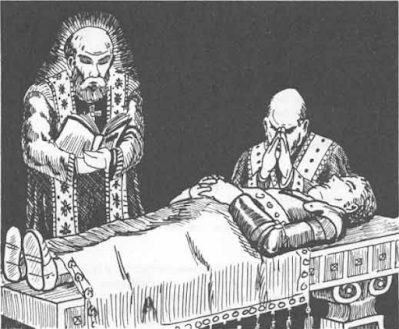
This notice appeared in issue #40 of Dragon (August 1980). I can only assume that this was part of a public relations campaign in the aftermath of the James Dallas Egbert disappearance the previous August, which first brought Dungeons & Dragons to national attention in the USA. 

Search for the Emperor's Treasure

Tom Wham is an underappreciated game designer in my opinion. While several of his designs, like The Awful Green Things from Outer Space, are quite well known and rightly celebrated, his games that appeared in the pages of Dragon magazine are often overlooked (though, admittedly, Snit's Revenge, is an example of a design that appeared first in Dragon). I remember playing several of them with my friends, like King of the Tabletop and Elefant Hunt, and having a great time.

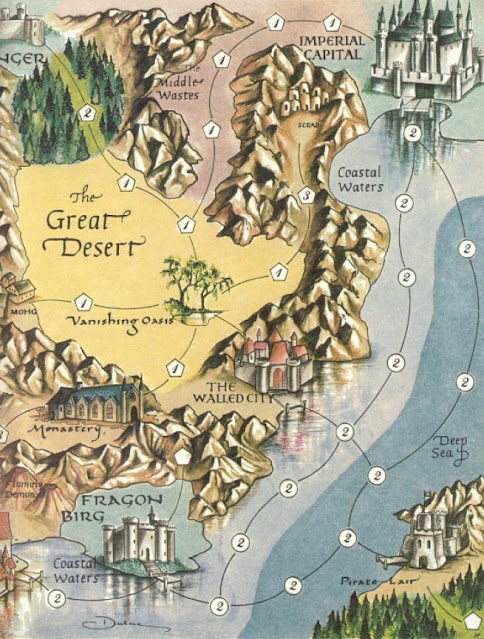
Remembering this recently, I started looking into other designs of Wham's that I might not have encountered. In doing so, I came across Search for the Emperor's Treasure, which appeared in issue #51 of Dragon (July 1981). Since I've yet to play it, I can't comment on the game itself. One aspect of it that stood out even on a cursory examination was its accompanying map, drawn by none other than Darlene. It's absolutely lovely, like the maps of many fantasy boardgames from those days, makes me think it might make for the basis of a good campaign setting. 

Enjoy!

Death, Resurrection, and the Fear of Fish

I've mentioned before that one of the longstanding player characters in my House of Worms Empire of the Petal Throne campaign, Aíthfo hiZnáyu, recently died as a result of an instant death critical hit. I've also mentioned that this unexpected turn of events was soon followed by the equally unexpected resurrection of Aíthfo by means unknown to the players (including Aíthfo's own player). However, it's not unknown to me, as the referee. While I had not planned that Aíthfo would die – the dice have their own ideas, after all –  I quite quickly came up with a way to make use of his death to develop further my own particular take on M.A.R. Barker's world of Tékumel, as well as to advance the continually unfolding events of the larger campaign.

Strictly speaking, I didn't need to do this and I expect that many diehard old school referees would likely balk at the idea of restoring a player character to life so soon after his demise. More than that, Aíthfo's resurrection required no effort on the part of his comrades, who had decided in the immediate aftermath of his death to seek out some means of reversing it at the next large settlement they encountered. Why rush things? Why not simply wait and see wait happened? Indeed, why not actively thwart the efforts of the other PCs to find a method of raising Aíthfo from the dead? Was I not being "soft" in blunting the cruel whims of fate?

These are all fair questions. I actually have a great deal of sympathy for those who feel that resurrection and similar spells undermine important aspects of gameplay (for RPGs are games and, at least in part, games of chance). In principle, I remain committed to not only the idea but the ideal of random, meaningless player character death, even for PCs of longstanding like Aíthfo. I'm firmly of the opinion that, if you don't want player characters to die in this fashion, why roll dice at all? For success to have any meaning, there must be the real chance of failure, up to and including the death of a player character.

In this particular case, though, there were two factors that pushed me toward bringing back Aíthfo as I did. The first and most pressing was that Aíthfo had died once before and been brought back to life. His original resurrection was a blessing in disguise for the campaign, as it gave me the chance to explore the religion and worldview of the Naqsái people whom the PCs had only just begun to understand. The other players were just as determined as to resurrect Aíthfo from his second death and that didn't sit well with me. Either I'd have to block their attempts at every turn, which felt heavy-handed, or they'd ultimately succeed, which I think would have suggested character death was, at best, a mere obstacle to be overcome rather than a significant event in the campaign.

The second factor is that there were still aspects of Tékumel I wanted to get the chance to explore, specifically the nature of the gods and their involvement in mortal affairs. I began to touch on this during the time of Aíthfo's original resurrection and had been looking for an opportunity to continue to do so. His second death seemed the perfect opportunity and I decided to seize it. Coupled with my unease at allowing Aíthfo to be raised from the dead simply because the rules of Empire of the Petal Throne allow it, I feel like this was a reasonable approach to the problem at hand.

Of course, not everything has gone as expected. Yes, Aíthfo is alive again, but there's something clearly off about him. In last week's session, our 255th, he expressed an aversion to fish. This aversion was born out of the sense that fish can't be trusted: they're everywhere in the sea and they were following him. He, therefore, refused to get on the sea vessel the characters were using to travel to the Isle of Sweet Gentility (aka the Isle of Ghosts), because it would bring him closer to the fish he now feared. Only swift thinking by Znayáshu, who offered Aíthfo a "magical" bone of fish warding – an ordinary cat bone that he had in his divination bag – convinced him to board the ship and continue their journey westward along the coast of the Achgé Peninsula.

Aíthfo's ichthyophobia is a consequence of his resurrection – and a clue as to its nature. No one has yet figured out what it means or what it might presage, but there will be consequences in the weeks to come. Since hitting upon the idea behind all this, I feel much less uncomfortable with bringing Aíthfo back from the dead than I might otherwise have. There's a real benefit to the overall campaign, not just to the player characters. Plus, it makes better sense within the world of the campaign; it has meaning. For me, that's far more important than any other consideration.