Showing posts with label clerics. Show all posts

Tuesday, November 18, 2025

REPOST: The Articles of Dragon: "Clerics Live by Other Rules"

Over the years, I've given the thief a lot of flak, but it's actually the cleric who fits in least well with the literary origins of D&D. The cleric looks not to pulp fantasies for its inspiration but to medieval Catholicism by way of Hammer horror films and, while I have a great fondness for the class, there's no question that it isn't a perfect fit for the world D&D implicitly describes. I'm not alone in thinking this, which is why the cleric is probably the class that gets reinvented the most (though the thief might be a close second).

Every edition of D&D has put its own stamp on the cleric, in the process rendering the class more incoherent than it was to start. Gary Gygax contributed further to this mess in his article "Clerics Live by Other Rules," which appeared in issue #92 (December 1984) of Dragon. To be fair, Gary's article is actually pretty good, but it laid the seeds for much mischief later. His intention was to suggest that individual referees, for the purposes of fleshing out their campaign settings, could change the rules under which clerics (and, by extension, druids) operate, either restricting their opportunities or expanding them (or, preferably, both).

In the article, Gygax gives an example of a sect worshiping the woodland deity Ehlonna, from his Greyhawk campaign setting. Owing to tragic events in the past, this sect operates differently than others of its kind, having a unique selection of spells, armor, and weapons, in addition to having certain ritual taboos placed upon them. Thus, for example, they're not allowed to use fire-based spells of any kind, but clerics, after proving themselves – gaining levels – can wield broadswords and druids can wear elfin chain.

Normally, I loathe this kind of stuff, in large part because I think it contributes further to the dilution of what the cleric class is – and it's already pretty diluted as it is. What makes Gygax's approach work, though, is that a) it's solidly grounded in the setting and b) he's limiting these changes to a particular sect, not establishing it as a baseline. That's how I think things like this ought to be done. Unfortunately, players (and later designers) didn't care for these nuances, instead using them as a template for "fixing" the cleric class. This led, in my opinion, to a variety of changes over the years that have rendered the cleric one of the least coherent classes, both mechanically and as an archetype. But I'm pretty sure I'm in the minority in feeling this way.

Interestingly, Gygax himself warns against taking what he wrote in this article as an official, universal change. In his concluding paragraph, he says some very sensible things:
Now when you hear someone, DM or player, mentioning something about "unknown" cleric spells or similar difficulties, don't panic. It could well be a cleverly planned campaign where difference and the unexpected are desirable -- and who can fault that?! Perhaps you might wish to try it in your own campaign, too. A cautionary word is necessary, however, for there is a problem with such variations. Unless the full and complete details of the differences are known to other DMs, they might well not wish to have clerics or druids of such nature participating in their games. This is their right, and skepticism on their part is justified. Players of these clerics and druids must be forewarned that such characters might be "one-campaign-only" adventurers who are not welcome elsewhere
It's good advice, but it's also, I think, advice rooted in an older style of play that was already on its way to dying out by the time this article was published. Campaign hopping of the sort Gary envisions was already rare in the early '80s when I was most deeply immersed in the hobby and I have a hard time imagining that it was any more widespread on the cusp of 1985. Ironically, the advent of the Net and online play make well lead to a resurgence of the Old Ways in this regard, in which case Gary's advice might well prove useful again.

Tuesday, June 24, 2025

REPOST: The Articles of Dragon: "Special Skills, Special Thrills"

Of all the iconic classes of D&D, the cleric is the one that sticks out like a sore thumb. Whereas the fighting man, the magic-user, and even the thief are all pretty broad archetypes easily -- and non-mechanically -- re-imagined in a variety of different ways, the cleric is a very specific type of character. With his heavy armor, non-edged weapons, Biblical magic, and power over the undead, the cleric is not a generic class, recalling a crusading knight by way of Van Helsing. There's thus a distinctly Christian air to the cleric class, an air that increasingly seemed at odds with the game itself, which, as time went on, distanced itself from its earlier implicit Christianity and embraced an ahistorical form of polytheism instead.

For that reason, there were growing cries among some gamers to "fix" the cleric. In this context "fix" means change to make it less tied to a particular religion, in this case a particular religion the game itself had eschewed. The first time I recall seeing an "official" answer to these cries was in Deities & Demigods, where it's noted that the clerics of certain deities had different armor and/or weapon restrictions than "standard" clerics. A few even got special abilities reflective of their divine patron. This idea was later expanded upon by Gary Gygax himself in his "Deities & Demigods of The World of Greyhawk" series of articles, which I credit with giving widespread attention to this idea. I know that, after those articles appeared, lots of my fellow gamers wanted to follow Gary's lead and tailor their cleric characters to the deities they served, an idea that AD&D more formally adopted with 2e in 1989.

In issue #85 (May 1984) of Dragon, Roger E. Moore wrote an article entitled "Special Skills, Special Thrills" that also addressed this topic. Moore specifically cites Gary's articles as his inspiration and sets about providing unique abilities for clerics of several major pantheons. These pantheons are Egyptian, Elven, Norse, Ogrish, and Orcish – a rather strange mix! Of course, Moore intends these to be used only as examples to inspire individual referees. Likewise, he leaves open the question of just how to balance these additional abilities with a cleric's default ones. He notes that Gygax assessed a 5-15% XP penalty to such clerics, but does not wholeheartedly endorse that method himself, suggesting that other more roleplaying-oriented solutions (ritual demands, quests, etc.) might work just as well.

Like a lot of gamers at the time, I was very enamored of the idea of granting unique abilities to clerics based on their patron deity. Nowadays, I'm not so keen on the idea, in part because I think the desire for such only underlines the "odd man out" quality of the cleric class. Moreover, nearly every example of a "specialty cleric" (or priest, as D&D II called them) still retains too much of the baseline cleric to be coherent. Why, for example, would a god of war be able to turn the undead? Why should almost any cleric wear heavy armor and be the second-best combatant of all the classes? The cleric class, even with tweaks, is so tied to a medieval Christian society and worldview that it seems bizarre to me to use it as the basis for a "generic" priest class. Far better, I think, would be to have individual classes for priests of each religion or, in keeping with swords-and-sorcery, jettison the class entirely.

Tuesday, April 16, 2024

Polyhedron: Issue #22

Issue #22 of Polyhedron (March 1985) features an interesting piece of artwork by Joseph Pillsbury. I say "interesting" not solely for the subject matter of the piece – a downed spacecraft – but because Pillsbury is an artist I mostly remember for his humorous comics in the "Dragon Mirth" section of Dragon. I can't recall his having done any "serious" artwork before, but it's always possible I've overlooked his wider contributions to the hobby.

Penny Petticord's "News from HQ" has two items worthy of note. The first is an announcement that Polyhedron is actively seeking submissions from readers. Petticord states that "only a few members" have thus far been making submissions and she'd like to change that. I wish I'd paid more attention to this at the time, because I made several submissions to Dragon while I was in high school and all were rejected. I might have had a better shot with Polyhedron, given the dearth of submissions. Secondly, Petticord warns readers that the next issue will a "special April Fool" issue, so "don't believe anything you read" in its pages. Fair enough!

This issue also features a large letters page, with multiple letters written in response to Roger E. Moore's "Women in Role Playing" essay from issue #20, While not all of the letters were critical, many of them were, largely because the readers felt that Moore had "belittled" or otherwise failed to understand female gamers. Though Moore apologizes for any unintended offense, he nevertheless stands by what he wrote, noting that it's an important topic in need of more frank discussion. Some things never change, I guess. 

Gary Gygax returns to this issue, writing yet again about marlgoyles and their reproduction. He provides AD&D stats for every stage of the creature's growth from hatchling to mature. It's baffling to me, but it's definitely in keeping the naturalism that's a hallmark of his worldbuilding. He also provides stats for a "monster" that was somehow left out of Monster Manual II – amazons. Amazons, in Gygax's vision, are a female-dominated society of barbarians, with menfolk in secondary or support roles. Beyond that, he doesn't have much more to say about them, which I found a little disappointing, because they're a great fantasy concept worthy of inclusion in D&D.

Frank Mentzer's "Spelling Bee" focuses on druid spells and abilities. Interestingly, Mentzer concern this time seems more focused on reining in druid abilities (like shapechange) that he thinks can be easily abused rather than on finding new and creative ways to make use of them. "The RPGA Network Tournament Ranking System" article is not especially interesting in itself, at least to me. However, the accompanying ranked list of RPGA judges and players is. Gary Gygax, for example, is the only Level 10 Judge, just as Frank Mentzer is the only Level 9. There are no Level 8 or 7 Judges and only one Level 6 (Bob Blake). The names on both lists include quite a number of people who either were at the time or would later be associated with TSR or the wider RPG world. It's a fascinating window on a particular time in both the hobby and the industry.

"In the Black Hours" is an AD&D adventure for levels 6–9 by David Cook. The scenario is unusual in a couple of ways, starting with its lengthy backstory about a high-level mage who learned the true name of the demon lord Juiblex and, in order to protect himself, was eventually forced to imprison the demon with a magical crown. That crown has now come into the possession of a merchant who wishes to protect it from would-be thieves (employed by Juiblex's demonic underlings who wish to free him). The characters are hired by the crown's present owner to protect it over the course of the night when he believes the thieves will make their attempt. There's a lot going on here and the basic structure of the adventure – mounting a defense against waves of attackers – seems well suited to a tournament set-up. If anyone ever played this scenario (or one like it), I'd be very curious to hear how it went.

"Away with Words" by Frank Mentzer is a 26-word multiple choice quiz that challenges the reader's knowledge of High Gygaxian words. It's a fun enough little diversion, though less hard now, thanks to the ubiquity of online dictionaries. "Unofficial New Spells for Clerics" by Jon Pickens does exactly what it says: offers a dozen new spells for use by clerics. Most of these spells are connected in some way to existing magic items, like the staff of striking or necklace of adaptation, filling in gaps in the spell list that, logically, should exist. While that certainly makes sense, it's also boring and exactly the kind of magic-as-technology approach that I've come to feel kills any sense of wonder in a fantasy setting.

"Dispel Confusion" continues to narrow its scope. This issue we're treated only to questions pertaining to D&D, AD&D, and Star Frontiers. Most of them are the usual collection of nitpicks and niggling details. However, one stood out as noteworthy (and indeed unexpected):

I have to admit that this answer surprised me – not because I didn't already know what it would say, but because I didn't imagine I'd ever read such a thing in a TSR periodical. In the past, these magazines tended to advance a very strong "by the book" line when it came to the rules, as evidenced by the fact that there's an official column for questions and answers. I can't help but wonder if perhaps this represented a change in thinking during the final years of Gygax's time at the company (he'd leave for good October 1986 – about a year and a half into the future).

"Of Great Ships and Captains" by Roger E. Moore is the second part of his "big ships" article for Star Frontiers. Unlike part one from the previous issue, this second part focuses on the fine details of running a campaign aboard a large starship. Moore takes a look at deckplans, crew complement, shipboard positions, and the kinds of adversaries and adventures that work in such a campaign. It's all very good stuff and, as I mentioned in my write-up of issue #21, I found it very inspirational in my younger days. The only real criticism I can muster about the article is that it does not include a set of sample deckplans for a big ship, as promised. Production delays apparently prevented their inclusion and, while Moore states they would appear in a future issue of Polyhedron, I don't believe they ever did. If I'm mistaken about this, I'd love to know.

The issue concludes with the return of "The Treasure Chest," the RPGA catalog of exclusive items that has not been seen in quite some time. The items available for sale are now mostly RPGA tournament modules that were otherwise unavailable at the time, along with some exclusive miniatures and back issues of Polyhedron. I wonder what occasioned the return of the catalog, since I can't imagine that it made enough money for that to have been a serious consideration. In any case, we're inching ever closer toward the end of my time as a subscriber to the newszine, meaning this series will likely conclude before we reach the summer months.

Tuesday, October 4, 2022

White Dwarf: Issue #52

Alan Craddock's depiction of a meeting between science fiction and fantasy characters graces the cover of issue #52 of White Dwarf (April 1984). As I've commented before, this is a common theme for WD covers and a subject near and dear to my heart. Meanwhile, Ian Livingstone's editorial is addressed to "new and old readers alike." In it, he hopes that "our faithful followers" will not object to the inclusion of content aimed at newcomers to the hobby. I imagine the inclusion of such content reflects the fact that, by this time, White Dwarf had become available at newsstands and thus might have attracted the attention of those otherwise unfamiliar with RPGs. 

This is one of those times when I wish we had better information on the growth in popularity in sales for roleplaying games. I tend to think of 1984 as just beyond the peak of the hobby's faddishness; from that point on, there is inevitable decline. That's based on very little but my own limited experiences and might well not be true everywhere. Indeed, I think there's good evidence that, in the UK, growth was still happening at this time, as the still-rising fortunes of Games Workshop would attest. In any case, it's a topic that continues to interest me and I live in hope we'll one day have more reliable data on the first decade of the hobby.

"The Name of the Game" by Marcus L. Rowland is an example of the kind of content geared for newcomers that Livingstone mentions in his editorial. It's a two-page overview both of roleplaying in general and Dungeons & Dragons in particular. It's fine for what it is, though, as I always ask when confronted with articles like this, who is this for? I have a very hard time imagining that a newcomer would buy a copy of White Dwarf without already knowing what a roleplaying game is. In that case, what's the purpose of articles like this? It's short, so it doesn't waste too much of this issue's precious pages, but, even so, I fail to see the value in it.

"Out of the Blue" by Daniel Collerton is a nice article that aims give clerics spell lists more in tune with the deities they serve. I'm quite sympathetic to Collerton's general point of view, so I'm naturally inclined to like this. At the same time, the article is simple and straightforward, making use of a combination of revised spell lists and a few new spells to give each cleric a distinct flavor based on his religion. In many ways, it anticipates the ideas developed in later TSR books like Dragonlance Adventures or in Second Edition AD&D, but without the need for spheres/domains. 

"Open Box" reviews several new products, starting with Talisman, which – surprisingly – receives a score of only 6 out of 10. The reviewer found that the game tended to drag on, which is a fair criticism, I think. Also reviewed was another Games Workshop game, Battlecars, which was scored more favorably (8 out of 10). Not so lucky is Dragonriders of Pern by Mayfair. The reviewer points out its "rotten artwork, unclear rules, complex and unwieldy game mechanics, [and] high price," giving it 4 out of 10. Finally, there's the series of Lost Worlds fantasy combat books. The reviewer likes them in general, but nevertheless finds of "limited appeal," hence the mediocre score of 6 out of 10.

Dave Langford's "Critical Mass" quickly reviews many books, including Isaac Asimov's Foundation's Edge (which he doesn't care for), Piers Anthony's Dragon on a Pedestal (which he does, in spite of himself), Fred Saberhagen's Empire of the East (thumbs up), Vonda McIntyre's Superluminal (thumbs down), along with Robertson Davies's High Spirits (the best collection of ghost stories since M.R. James). Langford is something of an acquired taste and I frequently struggle reading his columns decades after they were written. Still, there's a strange joy in remembering that, once upon a time, our little hobby still looked to literature rather than itself and its distaff offspring for inspiration. I miss those days.

"Close Encounters of the First Kind" presents four new monsters for use with D&D, including one, the spider dragon, by editor Ian Livingstone himself. "Microview" by Russell Clarke reviews two computer games, Usurper (5 out of 10) and Caribbean Trader (8 out of 10). He also presents a short program to aid in handling impulse movement in Starfleet Battles. "To Live Forever" by Andy Slack looks at immortality in Traveller. Slack focuses on achieving this through drugs, medicine, clones, and low berths, not to mention the adverse effects of each approach. He ends the article with a sample scenario that introduces some of these concepts into a campaign.

"The Castle of Lost Souls" by Dave Morris and Yve Newnham is the first part of an extended solitaire adventure built on a model similar to the Fighting Fantasy books that were all the rage at the time. I remember really enjoying this series at the time. It's quite well done for what it is – no surprise, really, given that Morris would later go on to write the Fabled Lands series of gamebooks. "The Serpent's Venom" by Liz Fletcher is a beginning AD&D scenario that's quite cleverly done. Fletcher subverts a common trope of low-level adventures – a quest given by a mysterious NPC – to present something that looks like a lot of fun to play. 

Dave Morris returns with "Rings," a collection of more than a dozen magical rings for use with RuneQuest. "Pandora's Box," on the other hand, is a collection of six miscellaneous magical items by various authors for D&D, including the casket of troubles. Joe Dever and Gary Chalk (later of Lone Wolf fame) offer "A Hard Day's Knight," a "close-up look at fighter figures," complete with color photographs. I used to love articles like this, since I was absolutely awful at painting and never ceased to marvel at others' artistry. This issue also includes new installments of "Gobbledigook," "The Travellers," and "Thrud the Barbarian." The latter is the first part of "The Three Tasks of Thrud," a short series of connected installments that tell a longer story of the necromancer To-Me Ku-Pa's enlistment of the dimwitted barbarian to undertake the titular tasks of the title.

Issue #52 is a bit less enjoyable than its immediate predecessor but still solid. White Dwarf continues to distinguish itself for the variety of its content, as well as the slightly off-kilter approaches it took to its content. Compared to Dragon, it's a bit less professional and predictable, which is both a blessing and curse. For myself, White Dwarf gave me new perspectives on the hobby that I wouldn't otherwise have had. For that, I remain grateful, whatever criticisms I might have of individual issues.

Tuesday, September 27, 2022

White Dwarf: Issue #51

Issue #51 of White Dwarf (March 1984) features a cover by Iain McCaig, an artist many will know from his work in the film industry, as well as his album covers. The issue is also notable for its editorial by Ian Livingstone, in which he states that the magazine continues to expand in size (and price) and that it would soon be available at newsstands. The expansion of its availability is important, I think, because it's an indication of the relative popularity of RPGs in the UK at the time. On the other side of the Atlantic, I don't believe I ever saw a copy of White Dwarf – or Dragon for that matter – at a newsstand, but that's probably just a reflection of differences in the British and American periodical markets at the time.

"Gifts from the Gods" by Thomas Mullen is, according to its subtitle, an examination of "religion and magic in AD&D." The two-page article is an interesting and thoughtful one. Mullen points out the confused nature of the cleric class, drawing inspiration as it does from Christianity and various flavors of paganism. He proposes that referees should give greater thought to religion in their campaigns and modify the cleric class to accord with whatever he decides. This might necessitate altering the cleric's abilities, restrictions, and spell list. It's hard to disagree with what Mullen suggests here. By this point in D&D's history, I suspect his perspective was becoming much more widespread among the game's players (and even designers) and likely encouraged TSR's decision in Second Edition to alter the presentation of the class.

"Open Box" kicks off with a review of the Cthulhu Companion, which gets decently high marks (7 out of 10), with the reviewer grousing that the supplement is mostly of use to Keepers rather than players. Chaosium's Superworld, a game I've still never seen, let alone played, gets the same score and compares the game favorably to Games Workshop's own Golden Heroes (a game I did own and play). FGU's Daredevils receives a score of 8 out of 10; that seems frankly high to me, though Daredevils is probably one of the better designed RPGs FGU ever published. Reviewed along with the game itself is the second Daredevil Adventures collection (the first being included in the Daredevils boxed set), earning a score of 7 out of 10. Wrapping up the reviews is Knight Hawks (8 out of 10).

Dave Langford's "Critical Mass" discusses a number of frankly forgettable contemporary SF and fantasy books. Much more interesting in my opinion are his thoughts on how "terribly inbred" the world of publishing is and how much influence "The Old Boy Network" has on what is published and what is not. Nearly four decades later, I gather not much has changed in this regard, at least when it comes to "mainstream" publishers, though desktop publishing and print-on-demand have begun to make it possible for authors to sidestep the apparatus of the old publishers and make their work directly available to readers. It's an amazing development in my opinion and one of the few unalloyed goods to come out of wired age.

"Watch Out, There's a Thief About" by Richard Hanniwell introduces thieves for use with Warhammer Fantasy Battles. It's a fun little article, particularly if you have fond memories of what Warhammer was like before it started to take itself too seriously. "All in the Family" is another bit of RuneQuest fiction by Oliver Dickinson that follows the adventures of Griselda and her comrades in the city of New Pavis. "Extending UPPs for NPCs" by Bob McWilliams is a Traveller article, in which the author suggests adding four new characteristics to help the referee better describe NPCs. They are: Loyalty, Determination, Charisma, and Luck. The intention behind all these new characteristics is that they take some of the burden off the referee in deciding how a NPC might behave in a given situation. For example, Loyalty indicates how likely a NPC is to stick by his employer, while Determination measures how likely he is to give up when a task becomes too difficult. While I appreciate the intent behind this article, I'm not entirely persuaded this is the best way to achieve its intended goal.

"The Black Broo of Dyskund" by Ken Rolston is, by its own admission, a "cavern crawl" for use with RuneQuest. Reminiscent of Snakepipe Hollow, the scenario is a deadly one, filled with lots of dangerous enemies devoted to Chaos, including a rune priest of Thanatar. Rolston states that the adventure is intended to be a companion piece of sorts to Cults of Terror and I think it certainly succeeds on that score. It's an impressive piece of work that presages Rolston's stint as the developer of RQ during the days its renaissance at Avalon Hill

"A Ballad of Times Past" by Dave Morris and Yve Newnham is an AD&D scenario for characters of 4th-5th level. Like several previous AD&D adventures in the magazine, this one takes place in its own setting, one reminiscent of late Dark Ages Britain and where magic is much scarcer than it is in traditional D&D settings. The scenario itself, which involves a quest to protect a dragon, is a bit heavy-handed in places, particularly when it comes to lengthy passages of NPC dialog. Nevertheless, it has a very distinct flavor of its own that's worthy in its own right. I found myself wishing there were additional scenarios set on the island of Beorsca.

"Creatures in Exile" by Paul Harden is a translation of the creatures and characters of Julian May's The Saga of the Exiles into AD&D terms. Never having read these books, I can't comment on how faithfully they're presented. I will only reiterate my long-standing amazement at how often articles like this one are published. I've never cared much about using D&D to play in a literary setting myself, but it would seem this is a common desire. "RuneQuest Economics" by Russell Massey teases out the implications of the costs of various items and services in Glorantha, with an eye toward tweaking them in the name of "realism." This, too, is a fairly common type of article in gaming magazines and one I likewise have little interest in myself – to each his own.

Naturally, we get new installments of "Thrud the Barbarian," "Gobbledigook," and "The Travellers," all of which I continue to enjoy. There's also "A Page of Many Things," an odd collection of short articles. One presents information about dungeon carts (including a schematic) for the hauling of treasure, another rules for drowning in D&D, and lastly a thief-themed word search. Odd though this medley is, I'm sympathetic to the editor's need to plug holes in each issue's layout with little bits of text that might also be of interest to readers. Having done this myself many times while preparing a new issue of The Excellent Travelling Volume, I can hardly pass judgment.

With this issue, White Dwarf is settling down into a comfortable rhythm in terms of content and presentation. No longer is the magazine solely devoted to Dungeons & Dragons. Most issues now contain a wider variety of material for a wider variety of games. Likewise, there is a new generation of writers appearing in the bylines, some of whom will go on to become significant members of the hobby in the years to come. While not as anarchically creative as its early days, White Dwarf remains an excellent periodical during this time and well worth re-visiting. 

Thursday, February 3, 2022

Real-life Clerics: TSR Hobbies Needs You

This notice appeared in issue #40 of Dragon (August 1980). I can only assume that this was part of a public relations campaign in the aftermath of the James Dallas Egbert disappearance the previous August, which first brought Dungeons & Dragons to national attention in the USA. 

Tuesday, December 14, 2021

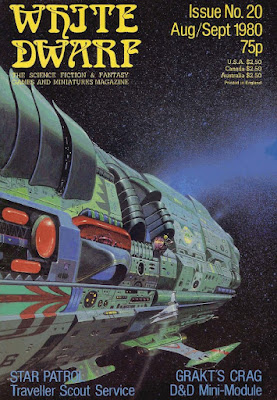
White Dwarf: Issue #20

Issue #20 of White Dwarf (August/September 1980) features another science fiction-inspired cover by Angus McKie, which pleases me. As I said previously, I appreciate seeing SF ideas and themes like this, since I've always been more of a sci-fi fan than a fantasy one. White Dwarf – and UK gaming products in general – seemed quite comfortable with genre bending to a greater degree than contemporaneous US RPG publications. I'm not sure why that should be; I may even be mistaken in this impression, but that's certainly how it appears in hindsight.

The issue begins with an interesting editorial by Ian Livingstone, in which he opines about the ever-contentious topic of alignment. Livingstone begins by musing that alignment ought to be "taken tongue-in-cheek." He then humorously asks, "Do they [i.e. players] stop to consider whether they are lawful good, neutral good, or lawful neutral before rushing into the tavern to decimate the dwarfs having lunch?" His point, it seems, is that, because roleplaying is, by definition, a fantasy, "why obey the codes of the real world?" "Why not," he wonders, "have a little fun while you're at it?," "fun" in this context being "hack and slay" without concern for the consequences. Unless Livingstone's point is simply that RPGs shouldn't be taken too seriously – a point I largely share – I'm not quite sure what to make of his editorial. 

"Dungeons & … Dragoons?" by Phil Masters is the first article of the issue. Masters offers up capsule descriptions and game statistics for a variety of troop types associated with historical cultures, such as Greek hoplites, Persian immortals, and Carolingian Franks. It's an odd little article, whose purpose is supposedly to expand the scope of D&D opponents beyond those grounded in medieval feudalism. Fan as I am in broadening the understanding of "fantasy," I'm not sure that this particular article offers much to achieve that end. On the other hand, Andy Slack's "Star Patrol" is quite successful in its goal of providing an advanced character generation system for the Scout service in Traveller. It's a very solid piece of work and does a much better job of it than does the official advanced Scout rules found in GDW's own Book 6. 

"The Alchemist" by Tony Chamberlain is a new character class for use with Dungeons & Dragons. I must say I was disappointed, when I saw that Chamberlain intended it only as a class for NPCs, specifically the expert hirelings mentioned in the Dungeon Masters Guide. As presented, the class is basically a pared down version of the magic-user, with a limited spell selection and the ability to aid proper MUs in the creation of magic items. I've longed for a playable alchemist class to my liking since I was a kid, so I was quite disappointed to find this one brings me no closer to achieving that goal.

"Open Box" reviews multiple GDW products, starting with the SF wargame, Dark Nebula (9 out of 10). Dark Nebula is something of a white whale for me. I've never seen, let alone owned it, and hope one day to do so, if I can find a good copy at a reasonable price. Also reviewed are High Guard (8 out of 10), The Spinward Marches (9 out of 10), and Citizens of the Imperium (8 out of 10). Good to see lots of Traveller material represented here. The final reviews of this issue are TSR's The Awful Green Things from Outer Space (7 out of 10) and Philmar's The Mystic Wood (9 out of 10). I think this might be the first issue of White Dwarf where all the reviews are quite positive, with 7 out of 10 being the lowest score assigned to any product.

Will Stephenson's "Grakt's Crag" is an AD&D mini-module for 3rd-level characters. The adventure features the tomb of King Grakt, which has been built into the side of a mountain and reputed to be filled with many treasures. I remain impressed with the density of text in White Dwarf's various "mini-modules." They fit more material into three pages than many other magazines could in twice as much space. "The Fiend Factory" presents six new monsters for use with D&D, including the evil frog-folk and zombie-like cauldron-born. 

Bob McWilliams gives us more Traveller material with the first installment of a new column called "Starbase." In this inaugural column, McWilliams briefly discusses how to start up a new Traveller campaign, with a focus on practical matters, such as the PCs' very first encounter. Meanwhile, "Treasure Chest" presents thirteen "Odd Items" – peculiar magic items like the whistle of pig calling and antacid. Rounding out the issue is Roger Musson's "Conversion," which looks postulates a new clerical ability, the aforesaid conversion. Musson lays out a simple system (akin to combat) by which a cleric can, through a combination of logic and casuistry, attempt to convert someone to his own faith. It's not a bad idea and it's one I've considered before myself, so naturally it was of interest. Musson's system has the benefit of being easy to use, if not necessarily "realistic," which is why I might actually consider making use of it.

With this issue, it's becoming more clear that White Dwarf, as I remember it, has nearly come into full existence by the second half of 1980. It will be fascinating to see if the recent trend in excellent content continues without interruption. 

Tuesday, January 17, 2012

The Articles of Dragon: "Special Skills, Special Thrills"

Of all the iconic classes of D&D, the cleric is the one that sticks out like a sore thumb. Whereas the fighting man, the magic-user, and even the thief are all pretty broad archetypes easily -- and non-mechanically -- re-imagined in a variety of different ways, the cleric is a very specific type of character. With his heavy armor, non-edged weapons, Biblical magic, and power over the undead, the cleric is not a generic class, recalling a crusading knight by way of Van Helsing. There's thus a distinctly Christian air to the cleric class, an air that increasingly seemed at odds with the game itself, which, as time went on, distanced itself from its earlier implicit Christianity and embraced an ahistorical form of polytheism instead.

For that reason, there were growing cries among some gamers to "fix" the cleric. In this context "fix" means change to make it less tied to a particular religion, in this case a particular religion the game itself had eschewed. The first time I recall seeing an "official" answer to these cries was in Deities & Demigods, where it's noted that the clerics of certain deities had different armor and/or weapon restrictions than "standard" clerics. A few even got special abilities reflective of their divine patron. This idea was later expanded upon by Gary Gygax himself in his "Deities & Demigods of The World of Greyhawk" series of articles, which I credit with giving widespread attention to this idea. I know that, after those articles appeared, lots of my fellow gamers wanted to follow Gary's lead and tailor their cleric characters to the deities they served, an idea that AD&D more formally adopted with 2e in 1989.

In issue #85 (May 1984) of Dragon, Roger E. Moore wrote an article entitled "Special Skills, Special Thrills" that also addressed this topic. Moore specifically cites Gary's articles as his inspiration and sets about providing unique abilities for clerics of several major pantheons. These pantheons are Egyptian, Elven, Norse, Ogrish, and Orcish -- a rather strange mix! Of course, Moore intends these to be used only as examples to inspire individual referees. Likewise, he leaves open the question of just how to balance these additional abilities with a cleric's default ones. He notes that Gygax assessed a 5-15% XP penalty to such clerics, but does not wholeheartedly endorse that method himself, suggesting that other more roleplaying-oriented solutions (ritual demands, quests, etc.) might work just as well.

Like a lot of gamers at the time, I was very enamored of the idea of granting unique abilities to clerics based on their patron deity. Nowadays, I'm not so keen on the idea, in part because I think the desire for such only underlines the "odd man out" quality of the cleric class. Moreover, nearly every example of a "specialty cleric" (or priest, as D&D II called them) still retains too much of the baseline cleric to be coherent. Why, for example, would a god of war be able to turn the undead? Why should almost any cleric wear heavy armor and be the second-best combatant of all the classes? The cleric class, even with tweaks, is so tied to a medieval Christian society and worldview that it seems bizarre to me to use it as the basis for a "generic" priest class. Far better, I think, would be to have individual classes for priests of each religion or, in keeping with swords-and-sorcery, jettison the class entirely.

Saturday, October 16, 2010

Clerics versus Undead Monsters

As is well known now, the cleric was inspired, in large part, by the character of Dr. Van Helsing, as ably portrayed by Peter Cushing, in numerous Hammer horror films in the 1950s, 60s, and 70s. Consequently, the class's signature ability is not spell casting but its ability to "turn away" undead monsters, such as zombies, ghouls, and, of course, vampires.

As I noted in my earlier post on the subject, anti-clerics lack the ability to turn undead entirely in OD&D. This is a stance that, so far as I can recall, no other version of D&D adopts, not even Holmes, which otherwise does include OD&D's anti-clerics (or "evil clerics," as the good doctor calls them). AD&D, intriguingly, does not allow evil clerics to turn or destroy the undead, but they can neutralize or even command them. Moldvay/Cook/Marsh gives all clerics, regardless of alignment, the ability to turn undead, a stance also adopted by Mentzer.

Of all these options, I find the one adopted by Moldvay/Cook/Marsh and Mentzer to be the least satisfactory to me, as it makes all clerics equally efficacious against the undead, regardless of their deity (if any) and alignment. The implication seems to be that the simple fact that a character is a cleric is sufficient to have power over the undead. The AD&D position, meanwhile, is more coherent, inasmuch as alignment is significant, but it's also more dualistic (or perhaps "multipolar"), since it gives all alignments some power over the undead. OD&D, as noted, implies a "monopolar" reality, where Law, which is often equated with goodness, is the only force to which before which undead monsters flee.

Of course, in my Dwimmermount campaign, Law does not equal Good, or at least not all Lawful beings can be reckoned good ones, except in the narrow sense that they oppose Chaos, which seeks the destruction of all. The religion of Typhon, to cite a prominent example from the campaign, is a staunch defender of human civilization, a paragon of Law, but it also turns a blind eye to oppression and cruelty and supports strength as an indicator of rectitude. As in the LBBs, there are no non-Lawful clerics, excepting demon worshipers, which follow slightly different rules.

Given that all Lawful clerics, regardless of the deity they serve, can affect the undead, it seems clear to me that it is a cleric's Lawfulness, not his deity, that grants him this power, a position that carries with it cosmological implications I've embraced rather than shied away from in my campaign setting. Though there is no "church of Law," as we see in some early D&D materials, there is a Lawful cult, one that eschews the usual gods and personifies Law itself as a kind of Supreme Deity. This cult doesn't have clerics but rather paladins, who, interestingly enough, lack the ability to turn the undead (as in Supplement I), an oddity that I think helps to paint a delightfully muddled cosmology -- just the way I like it.

Tuesday, April 13, 2010

The Animal Kings

As some of you may recall, I introduced a character into my Dwimmermount campaign called the King of the Cats. I created the King as an improvisation through play, after the characters encountered a cat (later dubbed Dusty) deep in the depths of the megadungeon and Brother Candor got the idea of using his speak with animals spell in order to pump him for information about the ancient Thulian mountain citadel.

In general, I don't like to stall my players, preferring to come up with answers -- any answers -- to their queries on the spot, even if, in retrospect, they seems less clever than they might have been if I'd have taken the time to think up "good" ones later. My feeling is that the speed of a referee's replies is more vital to the continued success of a campaign than their "rightness," which is to say, I'd rather offer a mediocre answer now and expand upon its meaning later than slow down a session by agonizing over a reply -- or, worse still, defer an answer till another session. In my opinion, nothing undermines the "reality" of a setting than a referee dumbfounded by his players' unexpected questions.

Still, there are times when stalling of a sort might be appropriate and Brother Candor's intention to use speak with animals to converse with Dusty -- a very clever plan and one that shows just how useful supposedly useless spells can be if you're, you know, imaginative -- seemed like an appropriate time. So, I made mention of the Kings of the Cats and how all the information his subjects know is really his "property" and one must make an entreaty to him for permission to learn it. This gave me some breathing room to figure just what Dusty knew and, at the same time, it gave me the chance to introduce something unexpected of my own to the campaign.

The King of the Cats is my own invention but I drew on a lot of different sources, chiefly Moorcock's notion of the Beast Lords and Lovecraft's "The Cats of Ulthar," along with innumerable mythological tales about intelligent animals. I also probably remembered Gygax's Cat Lord, Rexfelis, whose name I almost stole for the King of the Cats before I thought better of it. While I'm not above swiping names and ideas from my inspirations, I prefer to do so only when they're sufficiently obscure and, given the prominence of Rexfelis in Gary's later fiction, I didn't think he qualified as obscure.

In meeting the King of the Cats, the characters learned that there were other Animal Kings -- or rather, it was strongly implied by reference to an ongoing war with the Rat King in Adamas and a snide comment about most humans being "stupidly in the thrall of the King of the Dogs." Through further play, I've fleshed out the cosmology of the setting a bit more and the players have begun to learn some details of how magic works and its relationship to gods and other supernatural entities. There's still a lot they don't know and probably never will (and not just because I haven't worked it all out yet). But one thing I am certain of: there are many Animal Kings and, like all "gods," they have clerics devoted to them and their clerics can cast spells.

Here are some rough guidelines for handling clerics of the Animal Kings:

The Animal Kings have very few clerics. Anytime an animal is encountered, there is a 1% chance that it is actually a cleric of an appropriate Animal King. The spells available to these clerics are listed below. Animal clerics cannot read scrolls and generally cannot use other clerical magic items unless it is feasible for them to be able to do so based on their physiology. Animal clerics gain 1 additional hit point per full hit die for each clerical level they possess. Thus, a 3rd-level cat cleric (which normally has 1d2 hit points) gains +3 hit points to its total, whereas a wolf cleric (2+2 hit dice) of the same level would gain +6 hit points to its total.

Spells Usable by Animal Clerics by Level
1-Cure Light Wounds, Detect Evil, Detect Magic, Protection from Evil
2-Bless, Find Traps, Hold Person, Speak with Humans
3-Cure Disease, Locate Object, Remove Curse, Speak with Dead
4-Cure Serious Wounds, Neutralize Poison, Protection from Evil 10' Radius, Speak with Plants

If druids exist in the campaign, referees may substitute spells from that class's list for those cited above.

Level Limits of Common Animal Clerics by Species
Ape - Gorilla (3), Chimp (5), Orangutan (7)
Badger - 3
Bat - 3
Bear - Black (5), Brown (3), Cave (4), Polar (4)
Boar - 3
Cat - 8
Cattle - 4
Crocodile - 5
Dog - 5
Elephant - 7
Frog - 3
Horse - 4
Hyena - 3
Jackal - 3
Lion - 6
Rat - 4
Shark - 5
Tiger - 6
Turtle - 7
Weasel - 5
Wolf - 5
Whale - 7

Clerics of the Animal Kings rarely reveal themselves to humans, let alone use their spells for their benefit. However, if their trust is gained, they can prove invaluable allies.

Tuesday, November 24, 2009

The Paladins of Dwimmermount

Lots of gamers make the claim that the paladin class, first introduced to OD&D in Supplement I, doesn't fit well with the other classes. While I certainly see the logic of this claim, it's not one I share. I consider the paladin's pedigree in the game at least as solid as that of the thief and since, as I've discovered, a great many gamers will defend to the death the sanctity of the thief as a "core" class of the game, I think I'm on pretty solid ground here.

Now, it's true that, if one is going to treat Dungeons & Dragons as solely a product of gritty swords-and-sorcery, there's not much precedent for the class. For all my championing of the pulp fantasy roots of the game, even I don't argue that S&S is the only influence on OD&D. From the beginning, D&D's been assimilating all kinds of imaginative literature, to the betterment of the game's "DNA," in my opinion. It's a stronger game for having a more diverse genetic background, although that does sometimes mean its various parts don't always interact well with one another.

The paladin is a good case in point. The uptight, "do-gooder" image of the class is at odds with the way most D&D characters are played. That's part of why I suspect the class has a "bad reputation" with many gamers: a paladin in the party cramps their style. And of course playing a paladin properly is quite difficult, particularly if the referee is going to be a stickler when interpreting the lawful goodness of the character's actions.

My Dwimmermount campaign takes most of its cues from swords-and-sorcery literature. On first blush, paladins wouldn't seem to have a place in the setting. In actual fact, as my players are about to discover, paladins played a key role in the setting's history by spearheading many of the rebellions that overthrew the Termaxian-dominated Thulian empire. The Thulians had a state religion -- the Great Church -- made up of the temples of all the Lawful deities. That religion was subverted by the Termaxians once they rose to power, as Turms Termax had no clerics of his own. Instead, clerics of other gods were devoted to their own gods as aspects of Turms. In this way, the whole Great Church came to serve the cult of the Man-Become-God.

Paladins serve no known god. Indeed, they generally consider all gods to be, at best, merely powerful otherworldly beings and, at worst, demons masquerading as divinities. Paladins serve only Law, which they consider synonymous with Goodness. They take particularly umbrage at gods who claim to be Lawful and yet subvert Law for evil ends, like Typhon. Paladins travel the world singly or in pairs, spreading their particular interpretation of Law and rooting out cults devoted to Turms Termax, which they consider particularly dangerous, moreso even than the temple of Typhon. Interestingly, paladin do not shun those who do not share their beliefs, even Termaxians. Instead, they seek them out and often join their adventuring parties, hoping to use their unique abilities and charisma to sway the wayward to their cause.

No one knows where paladins come from, although rumors persist of a hidden fortress called simply "The Palace," from which they are sent out into the world. Likewise, paladinhood is not something one can aspire to; it is simply something one is. These facts, coupled with their penchant for traveling incognito makes paladins a mysterious group about whom many tall tales and legends have sprung up. Given their rarity and secretiveness, most people have no idea whether any of the stories are true, only that paladins are unusual fighting men, unlike any others in the world.

Thursday, May 29, 2008

Medic!

One of the commonest complaints leveled against the cleric is that the class is just a glorified healer and nobody likes to play the healer. I have to admit that I've always been puzzled by this assertion, because in my experience, while cleric is indeed a healing class, that's not all that it is. Yet, you'll still hear lots of people make the baseless assertion, for example, that the reason the cleric was included in OD&D is because of the need for magical healing. I call this assertion baseless, because Chainmail, whose fantasy supplement is the immediate precursor to OD&D, does not include clerics among the options for play. There are "heroes," "superheroes," (both examples of what would later be called fighting men or fighters) and wizards, but no clerics. So where did clerics come from?

Like many things from the prehistory of roleplaying, the answer to this question is murky, but the most consistent explanation and the one offered by Mike "Old Geezer" Mornard, who enjoys the possibly unique distinction having played in the campaigns of Dave Arneson, Gary Gygax, and M.A.R. Barker. According to Mornard, Dave Arneson created the cleric class, modeling him on Abraham van Helsing as portrayed by Peter Cushing's portrayal of the vampire hunter in the Hammer Films series. According to this version, the cleric was intended as a foil to a vampire player character in Arneson's campaign, Sir Fang by name, meaning that the class was first and foremost conceived as a fighter of the undead, a role it has retained throughout every edition, including 4e.

As presented in OD&D, a cleric can heal. However, of the 26 clerical spells offered in the little brown books, only two -- cure light wounds and cure serious wounds -- are direct healing spells. Supplement I expands the total number of clerical spells to 46, but adds no more healing spells. There were, of course, "restorative" spells of various sorts, such as remove curse (which the cleric shared with the magic-user) and cure disease, as well as neutralize poison and raise dead. Nevertheless, the bulk of the cleric's spell selection in OD&D is made up of what might best be called "utility" spells -- light (again, shared with the MU), find traps, locate object, speak with plants, create food, word of recall, control weather, and so on.

AD&D expands the spell list for clerics yet again. There are 76 cleric spells in First Edition. Of these, there are only two new direct healing spells -- cure critical wounds and heal. The majority of the new spells are additional utility spells, particularly abjurations and divinations. Second Edition follows First quite closely in most respects, but the addition of specialty priests (of which the traditional mace-wielding cleric is but one possible example) actually made it possible to play a "cleric" who couldn't heal at all. Third Edition adds many, many more spells to the cleric's repertoire, including some new direct healing spells to fill in gaps in the progression (cure moderate wounds, for example), but, again, the vast majority of a cleric's spells are utility spells. Moreover, 3e seems to have gone out of its way to ensure there were also direct damage-dealing options available to clerics, a category that was largely non-existent in previous editions. Of course, 3e also added the spontaneous casting of healing spells, which allowed a cleric to freely convert any spell into a healing spell of the same level. Thus, if any edition formally turned the cleric into the "medic," it was 3e, but, even there, the charge is weak. (As an aside, in OD&D, evil clerics -- called "anti-clerics" -- could not heal at all and cast damage-dealing spells instead)

The identification of the cleric with "healer" is a classic example of how game rules sometimes take on a life of their own through play. Because the cleric was initially the only character class who could heal at all, that ability soon became its singular distinction. OD&D describes clerics in terms that suggest it was intended to be a "hybrid" between the fighting man and the magic-user. Likewise, AD&D -- and Gygax himself -- makes a connection between clerics and the medieval orders of religious knighthood, like the Templars. Thus, they were intended to be religious militants: crusaders who went toe to toe with their enemies rather than standing in the back and healing, to borrow a MMO turn of phrase. Part of the problem is that, in AD&D, the paladin usurped that role (OD&D's paladin is a slightly different class -- it's not a spellcaster, for one), leaving the cleric holding the medkit. The other issue is that, except during the 2e era, D&D has never provided examples of non-clerical "priests," which is to say, religious leaders who tended to the needs of the faithful. That made it hard to make a distinction between adventuring clerics who bashed skulls for their gods and the parish priests who hung around Hommlet preaching and giving alms.

Unfortunately, the D&D cleric is an incoherent mess -- half what its creators intended it to be and half what players expect it to be. I can't in good conscience recommend ditching either half, because the tension between the two is part of what makes the cleric what it is. On the other hand, I'm completely sympathetic to the notion that the cleric is in need of something; I'm just not sure what that is. In any pulp fantasy game I write, I'd be inclined to ditch the cleric entirely or subsume most of his abilities into an expanded magic-user class. That seems truer to the source material. But if I were doing anything that had to be recognizable as "D&D," I don't quite know what I'd do. Moreso than any other class, the cleric has issues that aren't easily resolvable and pretty much any proposed solution is sure to tick someone off.