Issue #9 of
Polyhedron (December 1982) features a piece of
Star Frontiers-inspired cover art by Jeff Easley. That makes sense, since this issue features a pair of
Star Frontiers articles, no doubt intended to introduce the 'zine's readers to TSR's then-new science fiction RPG. Issue #9 is also notable for being 32 pages in length, twice that of
issue #8. While that sounds good in principle, the amount of
gaming material is not noticeably greater in my opinion. Much of the additional page count is given over to advertising for the RPGA and
its products. That make sense, I suppose, given the actual purpose of
Polyhedron, but I always looked on the fanzine as a "
Dragon Jr" and so was disappointed by how much of it was devoted to strictly RPGA matters.
Editor Mary Kirchoff's "ESP" column not only crows about the increased bulk of Polyhedron, but also suggests in passing that, by this point, the RPGA had about 5000 dues-paying members. She then introduces Gary Gygax's "Holiday Greetings!" column, which is accompanied by this somewhat frightful image, drawn by Jim Holloway:
Though I know it's meant in fun, I nevertheless can't help but wince a little bit. As I've mentioned many times on this blog before, TSR spent many years promoting Gary Gygax as the company's version of Stan Lee – an avuncular, slightly cranky authority figure to serve as its public face. No doubt it worked well for
TSR fanboys like myself, but I cannot help but wonder if led to problems elsewhere (not the least of which being the feeding of Gygax's ego). In any case, Gygax's column doesn't hold much of lasting interest; it's mostly a rundown on the growth and future of the RPGA.
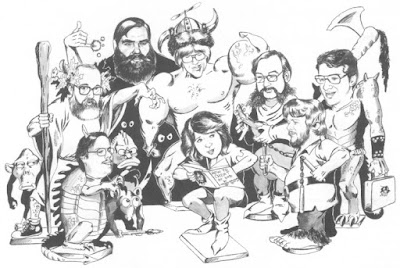
More interesting is Mary Kirchoff's second article, "Confessions of a Greenhorn Gamer." In it, she admits to a "deep, dark secret" about herself, namely that she is "not yet a 'gamer.'" She further admits that, when she was hired for her position as editor, she hadn't played any roleplaying games. Though she's rectified this during her time at TSR, she is "still not among the masses who can quote the DMG." With that confession out of the way, she shares her initial impressions of roleplaying, focusing on her time playing a fighter/cleric named Derrick in a confusing session that resulted in Derrick's death at the hands of another party member. From Kirchoff's brief description, it doesn't seem as if the established players made much of an effort to ease her into the game – not surprising: that was the style at the time – but she somehow came to enjoy the experience anyway. Truth be told, this is one of the more interesting articles in the issue and probably worth examining at greater length, if only for the Jim Holloway illustration that accompanies it:
Next up, Steve Winter "reviews"
Star Frontiers. I put reviews in scare quotes, because it's not really a critical look at TSR's new SF RPG so much as an advertisement for it. The most interesting part of the piece is that, since its release in August,
Star Frontiers had sold 49,500 copies. Winter compares this favorably to FGU's
Space Opera, released in 1980, which had sold only 20,000 copies. On the other hand, GDW's
Traveller, released in 1977, had sold over 250,000 copies. I can't speak to the veracity of these numbers, but, if correct, they're very instructive about the relative popularity of the three big science fiction RPGs of my youth.
There's a "Christmas Crossword" reprinted from the first issue of the
Grenadier Bulletin, along with reprints (also from the
Bulletin) of two pun-filled Reiga Nerd tales by Kim Eastland. This month's "Encounters" article is written by David Cook and features a meeting between a human "xenopologist" and a member of the octopus-like Ul-Mor species from
Star Frontiers. It's a bit underwhelming, to be honest, and I'm honestly not sure how useful it'd be to anyone actually playing the game. Potentially greater value is to be found in "Dispel Confusion," which offers answers to
AD&D, Top Secret, and
Gamma World questions sent in by readers.
The winners of the
Top Secret gadget contest announced in
issue #3 appear in this issue. There are nine winning gadgets, none of which struck me as being anything we've haven't all seen before in one form or another in spy novels and movies. To my mind, the most noteworthy thing about the winners is that one of them, Matt Forbeck, would later go on to become a professional game designer, working on
Dungeons & Dragons, among many other games. The winners of the
Gamma World art contest, also announced in issue #3, are mentioned too, but the artwork does not appear. I wonder why.
Mike Carr pens a very airy – no pun intended – reflection on Dawn Patrol, which is even less substantial than Steve Winter's review of Star Frontiers. As I said at the beginning of this post, Polyhedron may have expanded its page count, but very little of it was devoted to "game-y" content. That said, Frank Mentzer's "Spelling Bee" looks at the similarities and differences between the polymorph self, polymorph other, and shape change spells in AD&D. This is helpful to both players and referees, though it seems clear Mentzer's intended audience is primarily the latter, since he devotes much of his commentary on the ways to "control" use of the spell, which is to say, rein it in against abuse.
Continuing with the issue's Christmas theme, there are six RPG-themed carols presented here: The Great Druid's Coming to Town, Silver Shells (for Gamma World), O Purple Worm, Jingle Bells, White Dragons, and The Twelve Days of Christmas Gaming. There's also a Christmas-flavored installment of Ron Shirtz's "The Knight-Error" comic. "Gen Con XV: Megacon" is a report on the major events of that convention, complete with photographs. Frank Mentzer's "Notes for the Dungeon Master" is the usual grab bag of ideas and advice. However, it also states that "Gary doesn't run a straight AD&D campaign; he's too creative to feel comfortable in that rigid system." He quickly follows this up with, "You say you are, too? How many games, modules, and articles have you written lately?" It's a very odd response in my opinion, suggesting that only the most imaginative, creative, and lofty of people should be free from using the game as written. This kind of attitude is precisely why many gamers were becoming turned off by AD&D at the time.
Aside from the letters page and "Notes from HQ," dealing with RPGA ephemera, all that remains of the issue is the aforementioned catalog of products for sale. All in all, issue #9, despite its size, doesn't really show off Polyhedron to its fullest. Certainly, it's not one of the issue I most remember from my youth. Fortunately, there are – eventually – better ones on the horizon.


