Showing posts with label rasmussen. Show all posts

Tuesday, December 19, 2023

Polyhedron: Issue #15

Could the cover of issue #15 of Polyhedron (December 1983) by Keith Parkinson be any more 1980s if it tried? Like most recent issues, the illustration depicts a character from the "Encounters" feature, in this case an 8th-level Dungeons & Dragons fighter named Edrie Solo. Edrie is the player character of Randy Solo (no relation), who was the second-place winner of the RPGA membership drive announced all the way back in issue #3. His prize included an illustration of his character by his favorite artist (Parkinson), as well as a brief scenario involving her, written by James M. Ward. My teenage self thought that was a pretty cool prize – and it is.

The issue marks the department of Kim Eastland as publisher of Polyhedron, a role he took over from Frank Mentzer about a year and a half prior. Eastland is, for me anyway, one of the more mysterious members of TSR's staff. I remember his name, but, until I started re-reading Polyhedron, I don't think I could have told you what he did at the company. Looking back over his credits, he wrote or contributed to a number of modules for TSR RPGs throughout the '80s, though, as I said, until I made the effort, I don't think I could have recalled any of them. That probably says more about my aging memory than it does about him.

Issue #15 also marks the end of the RPGA catalog as part of Polyhedron. Apparently, like me, many readers felt that it took up too many pages that could have been more profitably used for gaming content. From this point on, all RPGA merchandise was sold exclusively through the Dungeon Hobby Shop in Wisconsin. I remember this shift, because I suddenly started receiving a copy of the DHS catalog in the mail a couple of times a year. I adored the catalog, because it included both gaming products I'd never heard of before and those I of which I had heard but never seen in the wild. I wish I still had my copies, because I suspect they'd be a treasure trove of information and nostalgia.

The letters page is mostly ephemera, but one letter and its response stood out:

While I don't doubt the sincerity of the response, I nevertheless find it odd, because, so far as I can recall, no other periodical, then or now, includes copyright or trademark symbols when printing the name of a product that's under legal copyright. As a practice, it's something I only ever recall seeing in TSR's '80s-era magazines and publications. I really can't fathom who advised TSR to undertake this approach, because it's absolutely obnoxious.

"Dispel Confusion," as always includes a wide variety of questions about all of TSR's roleplaying games. The only one that really caught my attention was the following, since it pertained to a favorite adventure of mine.
As I stated in my original retrospective post about Murder in Harmony, its central mystery is difficult to unravel, but it's far from impossible. I find it amusing that someone actually bothered to write into Polyhedron, hoping that author Mark Acres would confirm the identity of the murderer.

"The AD&D Game Exam" by Philip Meyers is a reprint of an article that originally appeared in issue #47 of Dragon. Polyhedron editor Mary Kirchoff mentioned earlier in this issue that she'd be reprinting articles from Dragon that would otherwise never seen reprinting in, say, The Best of Dragon anthologies, no doubt in order to find more material to fill the 'zine's pages now that the RPGA catalog had been removed. The exam presented in the article is pretty tough, bordering on the obsessive in my opinion. I consider myself pretty knowledgeable about AD&D, but many of the questions asked here are beyond my feeble intellect. 

"Do It Yourself" by Roger E. Moore tackles solo adventuring in AD&D. Like all of Moore's articles, this one is pretty good, touching on a lot of matters that are of relevance to its subject. Moore spends time discussing arena combat, dungeon delving, and wilderness adventures as options. In each case, he provides not only ideas for how to proceed but points the reader toward existing tools, like the random tables in the Dungeon Masters Guide, that would be of assistance. He also, wisely, I think, suggests that characters used in a solo campaign should not be integrated into a "regular" campaign, because of the differences in style and outcome. I suspect many solo characters acquired a much more impressive array of magic items, for example, than would be typical in a well-refereed multi-player campaign.

Moore returns with an installment of "Notes for the Dungeon Master" aimed at high-level adventures. Again, lots of solid and useful advice here. Though I rarely had the opportunity to make use of any of his suggestions, I nevertheless recall wishing I could have, because he made high-level adventures sound like fun. I also recall the article for its delightful accompanying illustration by Larry Elmore:
To this day, I make references to Sir Kay Mardt from time to time. No one else seems to know what I'm talking about.

"Mas Day in New Hope" is a bit of Christmas-themed nonsense for Gamma World by James M. Ward. The scenario involves an "X.M.A.S. Unit" – a robotic Santa Claus with a grav sled pulled by similarly robotic reindeer – that's been modified to act as a weapon of mass destruction attacking a peaceful village. As I said, it's nonsense but amusing enough, if you're in the right frame of mind. "House Rules In" by Mike Carr looks briefly at some Dawn Patrol rules variants that players might find useful. Carr notes that house rules are often the test bed for eventual rules changes, so there's nothing inherently wrong with them, so long as all the players are on board with them.

There are two Gangbusters articles in this issue, starting with "The Vesper Investigation" by Antonio O'Malley. This is a short, two-page scenario intended for one to three private investigator characters. Ostensibly an investigation into the disappearance of a young woman's uncle, the adventure turns into more than that – including, possibly, a ghost story. David Cook's "Casin' the Joint" looks at sources of literary inspiration for Gangbusters games, particularly pulp novels. Among those he suggests are the stories of Doc Savage and other globetrotting heroes, like the Shadow and the Spider. Taken together, the two articles point toward an alternate future where Gangbusters broadened its subject matter to include a wider range of interwar subject matter, not just cops and robbers.

"Cash & Carry for Cowboys" by Glenn Rahman is another reprint from Dragon, in this case issue #54. The article is a listing of historical prices for various items not listed in the equipment list for Boot Hill. I love articles of this sort, especially so back before the Internet made it possible to find this sort of information with relative ease. Finally, there's Merle Rasmussen's "College Courses and Vital Statistics," which presents a series of courses Top Secret agents can attend – and their costs and the time required to do so. These courses increase an agent's skills and abilities once completed. I've always liked the idea of characters undertaking training in-game to improve themselves, so this article had defnite appeal for me. I wish I'd had the chance to use it when I last played the game.

Polyhedron continues to transition into something. Based on various comments in this issue, it's clear that, like me, a lot of its readership wanted to see more gaming material in its pages rather than updates about conventions and other RPGA activities. At the same time, it's also clear that the 'zine's staff was not prepared for this shift in focus, hence the reprinting of Dragon articles to pad out its page count. As I recall, the staff eventually gets the balance right and Polyhedron became something quite good and distinctive. How long that process takes is something I'm keen to see, as I continue to re-read these issues from my youth.

Tuesday, November 28, 2023

Polyhedron: Issue #12

Issue #12 of Polyhedron (June 1983) features a very striking cover by Larry Elmore that depicts a pegasus-riding warrior about to engage a red dragon in aerial combat. Like all of the newszine's recent covers, this one draws inspiration from the issue's installment of "Encounters" about which I'll write shortly. 

The issue proper kicks off with an editorial by Kim Eastland – now the publisher of Polyhedron – in which he discusses several matters. The first of these is that Polyhedron has joined TSR's publishing division. I've often called the 'zine "Dragon's little brother" in jest, but, starting with this issue, it's actually somewhat true. Consequently, Mary Kirchoff, who serves as editor, will see her attention divided between Polyhedron and other TSR periodicals. On the other hand, the look and layout of Polyhedron clearly benefitted from this arrangement.

Eastland also discusses the many and various meanings of "official" with regards to TSR and the RPGA. That he has to do this at all is painful reading in retrospect, particularly when it comes to the contortions relating to Gary Gygax's columns in Polyhedron and elsewhere. I'm not sure that the fans of any RPG company has ever been as obsessed with "officialdom" as those of TSR, but they clearly were. Sad to say, I was one of them. It's all so silly now, yet, at the time, it seemed oddly important to me and so many others.

The letters page contains one interesting letter and reply, concerning the omission of the Cthulhu and Melnibonean chapters of Deities & Demigods:
As with all such replies by TSR spokesmen, I'm sure there are additional complexities to be considered. Nonetheless, it's a fairly straightforward and plausible answer to a longstanding and much debated "mystery" of D&D history.

This issue sees the appearance of "Two Cents," a new column devoted to RPGA member opinions and suggestions. It's a fine idea for a column, though, if the first installment is any indication, few of the ideas on offer are all that remarkable. Gali Sanchez, a name I most strongly associate with Pacesetter Games, is the author of this issue's "Encounters," featuring Grifton Dunsaway, a human fighter, riding Orrex, a pegasus, as they do battle with Forszahn, a red dragon. Though evocative in concept, there's not much more to the encounter, which is too bad. I very much love the idea of aerial combats in D&D; I've just never seen them handled very well under the rules of the game.

There is a "Convention Update" on RPGA events about which there's little to say. "Dispel Confusion" is three pages in length this time, covering all of TSR's RPGs. The questions cover a wide range of topics, from the ridiculous to the sublime. My favorite question – or, more accurately, response – concerns the lethality of Gamma World, as answered by designer James M. Ward. 
GWQ: The GAMMA WORLD game system is so deadly, my players complain that their characters get killed off almost before they have rolled them up! What can I do to help them last long?

GWA: If your characters are constantly dying, they're probably not being very careful. The game was designed to test the intelligence and role-playing skill of everyone who tries their hand.

Ward does go on to offer some genuinely useful advice about how to moderate the game's deadliness for beginners, but I can't help but chuckle at his initial response.

"Basically Speaking" by Jon Pickens takes a look at mass combat in Dungeons & Dragons. It's a topic of long-term interest to me, but, unfortunately Pickens doesn't provide much in the way of concrete guidance on how to integrate large battles into D&D beyond "read some Tony Bath." Good advice, certainly; I guess I'd hoped for more. "Knight Hawks: A New Dimension" by Doug Niles is an overview of the Knight Hawks boxed starship rules set for Star Frontiers. It's mostly a bit of advertising dressed up as an article, alas. 

Part III of Frank Mentzer's "Mapping From Square One" continues its focus on how to describe dungeon rooms to players engaged in mapping. It's good stuff and I appreciate the effort Mentzer put into this, even as I realize that, by comparison, my own maps have always been rather straightforward. Mentzer, meanwhile, favors rooms like this:

Yikes!

Gary Gygax takes over "Notes For the Dungeon Master" this issue, with a very nice two-page discussion of how to create a campaign setting of one's own. Gygax introduces the "bullseye method" of using concentric circles of detail – lots toward the center and less with each "ring" around it, at least to start. Merle Rasmussen's "Roles" looks at the various kinds of agents possible in a Top Secret campaign – double agent, triple agent, mole, blunt instrument, etc. It's too short in length but offers some food for thought nonetheless. The same can't be said about Kim Eastland's continuation of his series on the RPGA tournament scoring system. Perhaps I am unduly harsh and this would have been of interest to RPGA members at the time. Now, it's tedious ephemera of the worst kind.

Leaving aside the RPGA catalog that takes up the final eight pages of the issue, that's it for issue #12. 

Tuesday, November 7, 2023

Polyhedron: Issue #9

Issue #9 of Polyhedron (December 1982) features a piece of Star Frontiers-inspired cover art by Jeff Easley. That makes sense, since this issue features a pair of Star Frontiers articles, no doubt intended to introduce the 'zine's readers to TSR's then-new science fiction RPG. Issue #9 is also notable for being 32 pages in length, twice that of issue #8. While that sounds good in principle, the amount of gaming material is not noticeably greater in my opinion. Much of the additional page count is given over to advertising for the RPGA and its products. That make sense, I suppose, given the actual purpose of Polyhedron, but I always looked on the fanzine as a "Dragon Jr" and so was disappointed by how much of it was devoted to strictly RPGA matters.

Editor Mary Kirchoff's "ESP" column not only crows about the increased bulk of Polyhedron, but also suggests in passing that, by this point, the RPGA had about 5000 dues-paying members. She then introduces Gary Gygax's "Holiday Greetings!" column, which is accompanied by this somewhat frightful image, drawn by Jim Holloway:
Though I know it's meant in fun, I nevertheless can't help but wince a little bit. As I've mentioned many times on this blog before, TSR spent many years promoting Gary Gygax as the company's version of Stan Lee – an avuncular, slightly cranky authority figure to serve as its public face. No doubt it worked well for TSR fanboys like myself, but I cannot help but wonder if led to problems elsewhere (not the least of which being the feeding of Gygax's ego). In any case, Gygax's column doesn't hold much of lasting interest; it's mostly a rundown on the growth and future of the RPGA.

More interesting is Mary Kirchoff's second article, "Confessions of a Greenhorn Gamer." In it, she admits to a "deep, dark secret" about herself, namely that she is "not yet a 'gamer.'" She further admits that, when she was hired for her position as editor, she hadn't played any roleplaying games. Though she's rectified this during her time at TSR, she is "still not among the masses who can quote the DMG." With that confession out of the way, she shares her initial impressions of roleplaying, focusing on her time playing a fighter/cleric named Derrick in a confusing session that resulted in Derrick's death at the hands of another party member. From Kirchoff's brief description, it doesn't seem as if the established players made much of an effort to ease her into the game – not surprising: that was the style at the time – but she somehow came to enjoy the experience anyway. Truth be told, this is one of the more interesting articles in the issue and probably worth examining at greater length, if only for the Jim Holloway illustration that accompanies it:
Next up, Steve Winter "reviews" Star Frontiers. I put reviews in scare quotes, because it's not really a critical look at TSR's new SF RPG so much as an advertisement for it. The most interesting part of the piece is that, since its release in August, Star Frontiers had sold 49,500 copies. Winter compares this favorably to FGU's Space Opera, released in 1980, which had sold only 20,000 copies. On the other hand, GDW's Traveller, released in 1977, had sold over 250,000 copies. I can't speak to the veracity of these numbers, but, if correct, they're very instructive about the relative popularity of the three big science fiction RPGs of my youth.

There's a "Christmas Crossword" reprinted from the first issue of the Grenadier Bulletin, along with reprints (also from the Bulletin) of two pun-filled Reiga Nerd tales by Kim Eastland. This month's "Encounters" article is written by David Cook and features a meeting between a human "xenopologist" and a member of the octopus-like Ul-Mor species from Star Frontiers. It's a bit underwhelming, to be honest, and I'm honestly not sure how useful it'd be to anyone actually playing the game. Potentially greater value is to be found in "Dispel Confusion," which offers answers to AD&D, Top Secret, and Gamma World questions sent in by readers. 

The winners of the Top Secret gadget contest announced in issue #3 appear in this issue. There are nine winning gadgets, none of which struck me as being anything we've haven't all seen before in one form or another in spy novels and movies. To my mind, the most noteworthy thing about the winners is that one of them, Matt Forbeck, would later go on to become a professional game designer, working on Dungeons & Dragons, among many other games. The winners of the Gamma World art contest, also announced in issue #3, are mentioned too, but the artwork does not appear. I wonder why.

Mike Carr pens a very airy – no pun intended – reflection on Dawn Patrol, which is even less substantial than Steve Winter's review of Star Frontiers. As I said at the beginning of this post, Polyhedron may have expanded its page count, but very little of it was devoted to "game-y" content. That said, Frank Mentzer's "Spelling Bee" looks at the similarities and differences between the polymorph self, polymorph other, and shape change spells in AD&D. This is helpful to both players and referees, though it seems clear Mentzer's intended audience is primarily the latter, since he devotes much of his commentary on the ways to "control" use of the spell, which is to say, rein it in against abuse.

Continuing with the issue's Christmas theme, there are six RPG-themed carols presented here: The Great Druid's Coming to Town, Silver Shells (for Gamma World), O Purple Worm, Jingle Bells, White Dragons, and The Twelve Days of Christmas Gaming. There's also a Christmas-flavored installment of Ron Shirtz's "The Knight-Error" comic. "Gen Con XV: Megacon" is a report on the major events of that convention, complete with photographs. Frank Mentzer's "Notes for the Dungeon Master" is the usual grab bag of ideas and advice. However, it also states that "Gary doesn't run a straight AD&D campaign; he's too creative to feel comfortable in that rigid system." He quickly follows this up with, "You say you are, too? How many games, modules, and articles have you written lately?" It's a very odd response in my opinion, suggesting that only the most imaginative, creative, and lofty of people should be free from using the game as written. This kind of attitude is precisely why many gamers were becoming turned off by AD&D at the time.

Aside from the letters page and "Notes from HQ," dealing with RPGA ephemera, all that remains of the issue is the aforementioned catalog of products for sale. All in all, issue #9, despite its size, doesn't really show off Polyhedron to its fullest. Certainly, it's not one of the issue I most remember from my youth. Fortunately, there are – eventually – better ones on the horizon.

Wednesday, August 2, 2023

Retrospective: Quagmire!

Like The Forest Oracle, Quagmire! is an almost universally disliked module from the early Silver Age of Dungeons & Dragons – and justifiably so in my opinion. By almost any standard I can think of, this is not a good module and I find it difficult to muster anything more than the feeblest defense of it. Nevertheless, for all its manifest flaws, I have a strange fondness for it. Therefore, it is not the intention of this post to change anyone's opinion of Quagmire!, but rather to explain the sources of my weird affection for it.

Originally published in 1984 and written by Merle M. Rasmussen, best known as the designer of Top Secret, Quagmire! is designated module X6, indicating that it was intended to support the D&D Expert Set. This fact undoubtedly explains a small part of my affection for the module, since the Expert Set, too, occupies a special place in my heart. The module's premise is that the player characters, while near a seacoast, find a bottle inside of which is a plea written on a piece of parchment. The plea was written by someone who calls himself Molariah, King of the Swamp and Ruler of the city of Quagmire. The king explains that the city, once a center of trade and commerce, languishes under a triple threat of rising waters, plague, and a blockade by their covetous neighbors. He offers a rich reward to anyone who can aid him and his people within six months of his having written the plea, which is how long he reckons the city can hold out. Unfortunately, the plea is not dated, so there is no way of knowing whether it is already out of date by the time the PCs find it. 

The characters can, of course, check around the local ports for rumors about Quagmire (who names their city such a thing?) and will find some evidence to support what the King of the Swamp wrote. The adventure then assumes they set out westward toward the Serpent Peninsula where the city supposedly lies in order to render what aid they can. Even by the standards of D&D modules from the time period, this is a flimsy basis for an adventure, but I like it all the same. A big part of it is that the module adds to the map of the "Known World" setting introduced in the The Isle of Dread and previously expanded in Master of the Desert Nomads. I'm a sucker for maps of any kind, but especially setting maps. Likewise, as I've noted before, I was intrigued by the "Known World," so its expansion here no doubt elevates it in my estimation.

The bulk of Quagmire! is simply a hexcrawl through "the Wild Lands" of the Serpent Peninsula and the surrounding area. Rasmussen directs the referee to the rules for wilderness travel and exploration in the Expert Set, but also provides more than two dozen unique random encounters to spice up the characters' trek through the region. This is in addition to a similar number of encounters tied to a specific location and six new monsters. I appreciate what Rasmussen is trying to do here, even if his reach somewhat exceeds his grasp. For example, many the unique encounters are rather dull, consisting of herds of mundane animals or even inclement weather. My guess is that they were meant to be evocative of the locale – a hot, humid, swampy peninsula – but the execution regularly falls flat.

The same must be said about the centerpiece of the whole module, the city of Quagmire. That's a shame, because the idea behind the city (and its two sister cities) is delightfully fantastical. Quagmire is housed within a giant spiraled seashell consisting of thirteen levels and nearly 60 keyed locations. However, the location is simply too small for its purpose. Quagmire is supposed to be an important trading port in the region, filled with riches and exotic goods, a place well known across the Known World. Instead, it comes across as a very tiny place that, even before its current travails, could not have housed more than a couple of hundred people at most. Now, it's even more pathetic, with only about 40 survivors left.

Yet, for all of that, there's a peculiar majesty to the place nonetheless – or at least it seemed so to me when I first read the module almost four decades ago. In my mind's eye, Quagmire is a much more impressive and indeed magical place, befitting a giant, inhabited seashell rising up out of the sand. Ultimately, I suspect that's why I retain a fondness for module X6: it inspired me. As written, there's no question that Quagmire! is underwhelming. However, I rarely use modules wholly as written, preferring to use them as starting points for my own imagination – a map here, an encounter there, etc., to which I added my own ideas to those provided by the designer. 

Viewed from that perspective, Quagmire! is far from being in contention for the worst module ever published for Dungeons & Dragons. A better summation, I think, is that it fails to live up to its potential. All of the ingredients for a solid hexcrawl adventure are there, along with a central location that's perfect for pulp fantasy. For whatever reason – a failure to follow through, editorial meddling on the part of TSR – Rasmussen was unable to stick the landing. That leaves me wondering what might have been and whether the cool adventure I've had in my head since 1984 was ever really a possibility.

Tuesday, August 1, 2023

Polyhedron: Issue #3

Issue #3 of the technically-still-unnamed Polyhedron newsletter (Winter 1981–82) is notable for numerous reasons, starting with the absolutely gorgeous piece of Erol Otus Gamma World art that graces its cover. It's yet another glimpse of an alternate reality where TSR better supported its post-apocalyptic science fantasy game. Of course, the issue is filled with remarkable – and original – illustrations by TSR's stable of artists, so many, in fact, that I'll probably make another post highlighting some of them. 

The issue is double the size of the previous two issues (32 pages), though editor Frank Mentzer mentions that it will return to 16 pages with issue #4. The reason for that is, starting with that issue, the newsletter will appear bimonthly rather than quarterly. Mentzer also announces the establishment of a $1000 RPGA Scholarship Fund to the college-bound RPGA member "with the highest College Entrance Examination Board scores or equivalent thereof." Though I didn't subscribe to Polyhedron until a few issues later, I do remember the announcement of the winner of the scholarship each year.

Issue #3 sees the inauguration of Mentzer's "Where I'm Coming From" column, which he calls "my podium." This first installment isn't all that insightful. It's mostly a paean to the RPGA Network and thanks to readers for the warm response to the newsletter. "Dispel Confusion" continues, though it's no longer credited to a single TSR but simply to "The Game Wizards." As ever, it's an interesting look into the minds of the more rules-obsessed gamers of the early '80s. There's a question about surprise, for example, that brought to light the fact that, in by-the-book AD&D, each segment a character is surprised, he is subject to a full round's worth of attacks – up to five. I can honestly say I have never played the game this way nor have I ever seen anyone else do so, but then it's been long established on this blog that I frequently do it wrong. Oh well!

There is a massive – 7-page – interview with James Ward that is well worth discussing in its own right. Naturally, Ward has a lot to say about Gamma World, among other topics, which is what most interests me, given my lifelong fondness for the game. Dawn Patrol gets two articles devoted to it, the first of which is a report about the results of a tournament at the most recent GenCon. The article includes a turn-by-turn recap of a dogfight between five German and three American planes that ended in a German victory. The second article is another Dawn Patrol by Mike Carr, this time focusing on medals and commendations. Like Gamma World, Dawn Patrol is another game for which I have great fondness, but, unlike GW, I have not played it in decades. One of these years, I may have to fix that.

Don Turnbull's "Turnbull Talking" returns. He devotes himself to the question of just what hit points actually represent, a perennial topic of debate in the old days (and perhaps even nowadays, come to think of it). Michael W. Brunton's "Figure Painting" is just that, a three-page article about the ins and outs of painting figures for use with roleplaying games. Sadly, unlike similar articles in the pages of White Dwarf, no photographs accompany it, which makes the piece a lot less appealing to a painting-impaired reader like myself. Then we get three more pages of "Convention Wrapup," in which the events of GenCon XIV and GenCon East are reported. The focus is naturally on the results of the RPGA AD&D tournaments, as one might expect.

Merle Rasmussen announces a "Top Secret™ Gadget Contest." I'll be curious to see the results of the contest when they're revealed in a later issue. More immediately interesting is the piece of Erol Otus artwork that accompanies the article.

The uncredited "Codebook" is a brief meditation on the use of codes and cyphers in RPGs, followed by four coded messages that are presented as part of a contest for readers to decipher. Later, there's also a Gamma World art contest – there sure are a lot of contests in this issue – in which readers are called upon to illustrate the monsters presented in issue #2 and in this issue. "Mutants: A Continued Sampling of the Weak Ones" by James Ward gives us four more opponents for use with the game. I was (and am) a sucker for stuff like this, so I was happy to see more of it here.

There are more reader-created tricks and traps in "Notes for the Dungeon Master," alongside "Notes from Overseas" by Don Turnbull. Also present is an uncredited full-page article "Spelling Bee" that looks at the use and abuse of the invisibility spell. "Saga of Marnie" by Marnie Bosch is a firsthand account of someone's experiences at GenCon East in July 1981. "Incomplete Convention Schedule '82" is simply a listing of gaming cons for the coming year. I was interested to see that Origins 82 was held in my old hometown of Baltimore that year. I never actually attended Origins until 1991, even though it was often held in and around Baltimore. What can I say? Cons were not a big part of my formative experiences in the hobby (and still aren't, though I should make a stronger effort to change that).

As I said at the beginning, issue #3 of Polyhedron is a significant one, demonstrating that it's already growing and changing in response to its increased readership. Having no direct experience with the RPGA itself, I can't help but wonder how successful it was during the first part of the 1980s. Certainly TSR seems to have placed great stock in it, if Polyhedron is any indication. 

Tuesday, July 18, 2023

Polyhedron: Issue #1

Polyhedron was the newsletter of the Role Playing Game Association (RPGA), TSR's official "club" for players of its various RPG offerings. When the first issue appeared during the summer of 1981, it wasn't called Polyhedron yet but rather the much more banal "RPGA News." A contest to give it a proper name is mentioned, but it will be several more issues before the winner is announced. Darlene provided an original illustration for the cover, one of several provided in issue #1 by her and other early TSR artists, like Greg Bell, Jeff Dee, Dave LaForce, and Erol Otus. 

Polyhedron is notable for, among other things, providing Frank Mentzer with a regular soapbox from which to preach, since he was Polyhedron's inaugural editor. Mentzer was later responsible for the revision of the Dungeons & Dragons line, starting in 1983. That version of the game, consisting of the Basic, Expert, Companion, Master, and Immortals boxed sets, was reputedly the best-selling one of its first quarter-century, and remains much beloved by generations of players. However, it was through his association with the RPGA and Polyhedron that Mentzer first made a name for himself.

The newsletter's first issue opens with a "letters page," an odd choice since, as Mentzer admits, "there were no letters to the editor" yet. Instead, he presents "a few incomplete comments plus one letter from the DRAGON™ files." Most of these "incomplete comments" are mere ephemera, but one of them is longer and worth discussing. Its unnamed author (known only as "DB" from Montgomery, Alabama) offers up a house rule from his home AD&D campaign. Mentzer reply is as follows:
Concern about AD&D rules variants started to become commonplace in official TSR circles around this time, with "international tournament stability" (or similar things) being offered as an explanation of the company's skepticism toward them. This stance would harden as the years wore on, with Gary Gygax taking up the cause through his own soapbox in the pages of Dragon.

"Dispel Confusion" was Polyhedron's version of "Sage Advice," offering official answers to rules queries about TSR's RPGs. Initially, this column differed from "Sage Advice" in that there was no single author. Instead, Polyhedron tapped multiple TSR designers for answers. In this issue, the designers are Lawrence Schick, David Cook, and Harold Johnson, but I suspect future issues will see different ones included in the roster.

The issue devotes four pages to a lengthy and genuinely interesting interview with Gary Gygax. The interview is wide ranging, so it'd be impossible to do it justice with a short summary. Previously, I've covered a couple of portions of it on this blog, so I'd recommend talking a look at those posts for a glimpse into the kinds of things Gygax says. I'll probably return to the interview again in the future to highlight other sections of note. Suffice it to say that, as with all Gygax interviews, it's a mix of truths, half-truths, and dissimulations – absolutely fascinating stuff but it must be approached with some degree of suspicion.

"The Fastest Guns That Never Lived" by Brian Blume, with Allen Hammack, Gary Gygax, and Tim Kask is an article for Boot Hill. Its title riffs off a section in the game's rulebook, "Fastest Guns That Ever Lived Chart," which provides statistics for historical gunfighters from the Old West. By contrast, the article provides stats for fictional characters from Western media, like the Lone Ranger, Bret Maverick, and Ben Cartwright, as well as composite stats for actors who portrayed a number of different characters. It's a fun little article and the kind of thing that aficionados of Westerns can argue about. In case anyone cares, Clint Eastwood's characters have the highest Gun Accuracy rating (+22), closely followed by those of Lee Van Cleef (+21). 

"Notes for the Dungeon Master" is a collection of eleven short descriptions of "really good, relatively unknown trick[s] or trap[s]" for use with Dungeons & Dragons. As with all such articles, how much one enjoys it depends heavily on one's tastes and experience. For me, the descriptions are all fine but not phenomenal. "The Fight in the Skies Game" by Mike Carr is a brief overview of the World War I aerial combat game that would soon be revised as Dawn Patrol. "An Open Letter to Frank Mentzer" by Merle Rasmussen is similar, if much shorter, in that it's mostly a plug for Top Secret and its continuing support by TSR.

"Gen Con® South Report" is, as its title suggests, a report of events at TSR's convention in Jacksonville, Florida earlier in 1981. I sometimes forget that, once upon a time, there are a number of reginal Gen Cons, though none of them survived past the '80s so far as I know. The article focuses primarily on the results of tournaments at the con. However, it does include a photo of the top winner, Matthew Rupp and his fellow gamers, which I found very charming.
The last article is "Gamma World Science Fantasy – A Role Playing Game with a Difference" by James A. [sic] Ward. Like the previous articles on Dawn Patrol and Top Secret, this one is simply a plug for Gamma World and its upcoming support by TSR. It's fine, but then I have an inordinate fondness for Gamma World (and the decades-long, unfulfilled promises of a revision of Metamorphosis Alpha compatible with it). Closing out the issue is a full-page comic by Tom Wham called "Rocksnoz in the Land of Nidd." If you're a fan of Mr Wham's work, you'll likely enjoy this one too. I'd never seen it before, so it was definitely a treat for me.

There you have it: issue #1 of Polyhedron and the start of a new series of retrospectives on a gaming periodical of yore. I suspect this series will not run as long as my previous one on White Dwarf, because I have access to fewer issues and because (due to its not being monthly until very late in its run) there are simply fewer issues to review. Nevertheless, I'm looking forward to this one, if only as a dose of nostalgia for my days as a TSR fanboy

Friday, August 12, 2022

Retrospective: Lathan's Gold

Lately, I've found myself strangely interested in historical attempts by game companies to produce solo or small-group roleplaying adventures. This is a field pioneered by Tunnels & Trolls, whose Buffalo Castle is, I think, the first example of a "solitaire dungeon" in the hobby. (If I am mistaken in this surmise, I am sure my readers will let me know in the comments.) Other companies followed suit, with varying degrees of enthusiasm, in the following years. However, I don't think it was until the success of the Fighting Fantasy series – which I suspect was very successful indeed – that TSR put much effort into solo gaming and, even then, the approach was scattershot and frequently gimmicky

One of the better examples of TSR's forays into this market is 1984's Lathan's Gold, written by Merle M. Rasmussen. Rasmussen is perhaps best known for having designed Top Secret, but it's worth noting that, in the very same year as Lathan's Gold, he also penned Midnight on Dagger Alley, another solo adventure, albeit employing a rather different approach. In fact, Lathan's Gold evinces a rather different approach in a number of areas, which might explain why I think much more highly of this solitaire module than I do of others of its kind, as I'll explain.

One of my biggest complaints about previous TSR solo modules is that they're quite limited when it comes to the types of characters one can play. In most cases, they're limited to a single, pre-generated character or several characters that are all fairly similar to one another. Lathan's Gold, conversely, gives the player the choice of six characters, each one of a different class: elf, dwarf, cleric, fighter, magic-user, and thief – all that's missing is a halfling. This might seem like a small thing, but it's not, especially when one considers that several of these characters are spellcasters, something for which I don't believe any previous solo modules made allowances. Consequently, Lathan's Gold feels a bit more "open," even if, of necessity, the range of choices is still very restricted when compared to a "normal" Dungeons & Dragons module.

Related to this is the fact that each character has his own quest, which the player uses to guide his choices. For example, the elf Lathan, after whom the module is named, is on a quest to raise 1000 gp to pay the ransom of his betrothed. Meanwhile, Suparjo the magic-user is on a quest to find a rare seven-headed hydra and Krag Skraddle the thief is seeking a buried pirate's treasure. The other four character each have unique goals as well. All these goals have time limits placed upon them, ranging from about 20 to 90 days. To "win" while playing a particular character, the player needs to succeed in his character's quest within the given timeframe. That's yet another way in which Lathan's Gold differentiates itself from other solitaire modules.

Like the Fighting Fantasy books (or Choose Your Own Adventure books), Lathan's Gold is presented as a series of numbered sections. As a character proceeds through the module, the player turns from section to section, each one describing the situation as it unfolds. In doing so, the player makes use of an "expedition record sheet." The sheet tracks your character's hit points, money, and rations, as well as the number of days that have passed. This is a rare example of a published module where the passage of time plays a central role to a character's ultimate success. It's a genuinely remarkable thing.

Also remarkable is the module's alternate combat system. Rather than having the player play out every combat between his character – and his hirelings; yes, you can bring along hirelings – and any opponents he might encounter, Rasmussen has devised a simpler way to determine the results of a fight. The player compares the number, level/hit dice, and armor classes of those engaged in a fight and then rolls on a few tables to find the outcome. The tables remind me quite a bit of those used in hex-and-chit wargames. Some might find them less satisfying than "real" D&D combat, but I find they work quite well in the context of a solitaire adventure, where the player has to handle all aspects of gameplay. Obviously, opinions will vary on this front.

Lathan's Gold is not a highly detailed adventure. Rather, it's a collection of procedures for handling a character's journey in urban environments, on the seas, and on one or more mysterious islands in the seas. These procedures are quite expansive in their available options, especially when compared to most solitaire adventures, but they're sketchy at times, leaving a lot to the imagination of the player. That's the price for the openness I mentioned earlier. Unless the module for many times larger than it is, I don't see any way that it could be anything but somewhat skeletonic in its presentation. Ultimately, I'm not sure Lathan's Gold fully succeeds in its goals. Even so, it's much better than I remembered its being and far better than TSR's other experiments with solo adventures.

Wednesday, March 9, 2022

Retrospective: Midnight on Dagger Alley

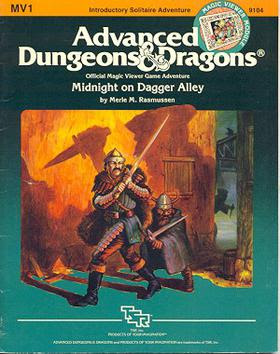
In my scheme of the broad history of Dungeons & Dragons, the year 1984 falls either at the start of the Silver Age of the game or toward the end of the transitional period of the Electrum Age. Regardless of where one places it – or indeed if one even accepts the idea of neatly defined historical "ages" – I think it's indisputable that 1984 marks the year when TSR fully committed itself to taking D&D in new directions. This was the year that Dragonlance series launched, the first adventure modules based on other media properties appeared, the Companion Rules were published – and when TSR expanded the experimentation with solo play begun in the previous year.

During 1984, TSR published no fewer than four solo adventures, the majority of which were designed for use with the Basic and Expert rules sets (no surprise, given how well they were apparently selling at the time). The only one written with AD&D in mind was Midnight on Dagger Alley by Merle M. Rasmussen, best known as the creator of Top Secret. The module is the first solitaire "magic viewer modules," so called because it makes use of a strip of transparent red film to read text and maps that have been printed in such a way as to be otherwise illegible. It's a clever solution to the problem posed by the invisible ink modules released in 1983: ensuring re-playability. Unlike its predecessors, Midnight on Dagger Alley is presented in such a way that it can be used multiple times. However, it would seem that the module was not all that well received among potential customers, as TSR never produced another adventure like it.

A player of the module chooses one of three pre-generated characters, a lawful neutral human monk, a neutral evil half-elf assassin, or a neutral elf thief. Two things immediately stand out about these characters, beyond the fact that they are all level six. The first is that they all possess thieving abilities to some degree. The second is that none of them have a good alignment (and indeed one of them is explicitly evil). This surprises me in retrospect, since the Silver Age is when TSR began to worry about "angry mothers from heck" and how they viewed the content of Dungeons & Dragons. In this context, Midnight on Dagger Alley a little like a throwback to the pulp fantasy roots of the game.  

Each character has his own unique task in the city of Goldstar, where the module is set. The text of the module is divided into four parts, each associated with a different part of the city: dungeon, street, upper level, and roof. Each part contains numbered entries whose text is (mostly) illegible due to be hidden underneath printed patterns that only disappear with the use of the magic viewer. There are also maps of the relevant parts of the city that function in the same way. Much like a Choose Your Own Adventure book, the player of Midnight on Dagger Alley movies between entries by making choices that direct him to other entries. And much like the Fighting Fantasy series – and, of course, D&D itself – there are dice to be rolled, for combat among others, that also play a roll in advancing through the entries.

I owned a copy of this as a teenager and had a surprisingly good time with it. My main complaint about it was that it was quite short – only eight pages in length – and the three scenarios associated with the pre-generated characters all took place within a very limited space of the city. That was clearly done for logistical reasons and, having tried my hand at writing a solitaire adventure or two over the years, I am sympathetic to Rasmussen's plight. Still, there are only about 120 entries in total, most of them quite short, so the range of action is indeed quite limited and that's a genuine drawback. On the other hand, I appreciate what Rasmussen and TSR were attempting to achieve with Midnight on Dagger Alley, even if their reach exceeded their grasp.

Wednesday, September 15, 2021

Retrospective: Top Secret Companion

Top Secret was one of those games I adored but didn't get to play as often as I'd have liked. There are a number of reasons for this, including the fact that I don't think my friends liked the espionage genre as much as I do. Another is that it's hard – but not impossible – to justify a "party" of spies, necessitating a smaller group of players than most other RPGs. Even so, I very much enjoyed Merle Rasmussen's articles in the pages of Dragon and kept my eyes open for new releases for the game.

Until the appearance of the Top Secret Companion in 1984, all those releases had been adventure modules. Don't get me wrong: I have fond feelings toward several of those modules, but, since I didn't get to play all that often, I didn't get as much use out of them as I might have liked. The Companion, on the other hand, was the kind of support material I could simply read without having to use it. In fact, I'm pretty sure I never used anything the Companion introduced, which is why I want to talk about it in this post.

As presented, the Companion is a collection of new and expanded rules, along with some clarifications of rules from the original game. In principle, I should have loved this book – and, in principle, I did. There's a great deal of genuinely interesting stuff here, starting with an alignment system that accounts for a character's views on politics (democratic vs authoritarian), economics (capitalist vs communist), and change (radical vs reactionary). There are also new personal traits, areas of knowledge, bureaus, divisions, missions, and more, in addition to many, many random tables for generating every conceivable detail for player character agents. There are also new and optional rules for weapons, hand-to-hand combat, and equipment, not to mention a genuinely interesting system for improving a character through enrolling a character in special training courses. Topping it all off is a lengthy mission entitled "Operation: Meltdown," dealing with, among other things the space race between the West and the USSR. 

If all of the foregoing sounds interesting, you'd be right. I loved reading the Top Secret Companion and thinking about all the ways I could use the new material in my infrequent games. Unfortunately, when the time came to run a session of Top Secret, I never actually made use of any of it. Partly, it was because it simply didn't seem worth it to add new rules to a game I played so rarely and partly it was because so many of the new rules and expansions were of the kind that are simply too fiddly or hard to remember to make good additions to regular play. The Top Secret Companion was thus the first time I encountered a "theoretically good" RPG book, one that seemed to satisfy my desire simply to read rather than to play. 

I don't know that the Companion was uniquely perverse in this regard. Indeed, I am sure that there were many people who made good use of the book and its expanded options for Top Secret. If so, I am happy to hear this. For myself, though, this book represents the start of a period in my later teens when I found myself increasingly drawn towards the ideas contained in a game book than I was in actually using them at the table with my friends. In fact, during my later years of high school, I had less and less time to play RPGs at all and yet, despite that, I continued to be an avid consumer of roleplaying game products, many of which I neither used nor, in my opinion, could have used. 

From what I have gathered talking to others, my experience was not unique. Many people continued to acquire the latest roleplaying games and supplements for them, even though they never had the chance to play them. From my current vantage point, that strikes me as perverse, but, at the time, reading a book like the Top Secret Companion was a good substitute for playing with my friends, which I did less and less, as the demands of school increased and I had less free time to engage in gaming. Looking back on it, I can't help but wonder to what extent companies like TSR understood this about their customers and so published more and more material that might continue to appeal to people who still considered themselves roleplayers even though they didn't actually play RPGs all that much anymore. It's something I continue to wonder about even today, as I look out on a market saturated with so many games and game products that there is simply no way most of them are being played by anyone.

Perhaps unfairly, I look back on the Top Secret Companion as a harbinger of a change within TSR and the hobby as a whole. The faddishness of the late '70s and early '80s was dying down somewhat and the earliest generations of gamers were starting to drift away from the hobby. Even I, in my mid-teens by this point, played the games that had meant so much to me just a few years prior a lot less. Much of my "gaming" activity was no devoted to thinking about playing rather than doing so. That's probably why a book like the Companion appealed to me so much when it was released. My feelings about it now are decidedly less positive, but maybe that says more about my own personal history than it does about the book itself.