Showing posts with label elmore. Show all posts

Tuesday, September 24, 2024

The Articles of Dragon: "Robots – Mechanical Sidekicks for Traveller Players"

Stop me if you've heard this one: Traveller is probably my favorite roleplaying game. Although I've played it far less often than I've played Dungeons & Dragons, GDW's game of science fiction adventure in the far future remains my true love (and I say this even after having taken a stab at having created my own SF RPG). 

There are many reasons why this is the case and I could go on at some length enumerating them. Rather than do that here, I'll simply say that Traveller's main virtue is that, in its classic form, it's a versatile, easy to use set of rules that gives a referee nearly everything he needs to create his own planet-hopping sci-fi setting and keep it going for years. When I called 1982's The Traveller Book "the perfect RPG book" a few years ago, I meant it.

Even so, Traveller's approach to science fiction is quirky at times. There are numerous lacunae in its rules, such as, for example, the lack of laser pistols. While that particular omission never bothered me – I had Star Frontiers for that flavor of sci-fi – there was one area where I did feel as if Traveller had dropped the ball: robots. Until the release of Book 8: Robots in 1986, Traveller had no official rules for robots. Indeed, outside of the warbots employed by the Zhodani, there was scarcely a mention of robots at all within the canon of the game.

I felt the lack of robots in Traveller very keenly. At the time, I felt robots were an important, if not essential, aspect of spacefaring science fiction. Consequently, I was very happy to see Jon Mattson's article in issue #64 of Dragon (August 1982), "Robots – Mechanical Sidekicks for Traveller Players." In just six pages, Mattson provides fairly complete rules for designing and using robots in Traveller. His rules take inspiration from similar design sub-systems in Traveller, such as the starship construction system. This works to their advantage, since players of the game should already be familiar with the general framework on which he's riffing.

Obviously, a six-page set of rules cannot cover every possibility. There are plenty of areas that probably deserve expanded treatment (like the use of robots as player characters) or additional options beyond those Mattson includes. However, that's a minor criticism. The genius of the article is not that it's comprehensive, but that it provides a structure from which a referee could work in his own campaign. Because there was nothing comparable in GDW's materials, this was a godsend, which is why the articles remains a standout for me in this issue of Dragon.

So useful did I find this article that it achieved a status reserved only for a handful of others: I photocopied it and included it in my GM's binder. Like a lot of gamers in those days, I had this large binder in which I kept my notes, hand drawn maps, character sheets, and other papers I felt important enough to carry around with me, like Xeroxed copies of articles from Dragon and other gaming magazines. I regret that I no longer have that binder, if only to see what articles and other bits of ephemera I deemed valuable enough to keep inside it.

Another reason "Robots" looms large in my memory is the full-page artwork that accompanied it – by Larry Elmore, no less! I think the illustration supports my contention that Elmore was better suited to science fiction than to fantasy. (It's also an inadvertently ironic piece in that it depicts large numbers of human workers involved in the manufacturing of robots, which fitting, given Traveller's own occasionally quaint notions of technological development.)

Friday, August 23, 2024

Lament for a Lost Age

One of my most popular posts is "The Ages of D&D," which I wrote more than fifteen(!) years ago, on January 11, 2009. In it, I attempted to sort the history of Dungeons & Dragons into a series of "ages" – Golden, Silver, Bronze, etc. I was still fairly new to the blogging game when I wrote that post and, while I largely stand behind its conclusions, I now concede that I relied more on hazy memories and intuitions than on anything approaching "research." Perhaps one day I'll offer a more considered discussion of the Ages of D&D, complete with evidence to support my assertions, but, for the purposes of the present post, I'm going to go with the categories and timeframes I established back in 2009.

In the original post, I assert that the Golden Age of D&D lasted almost a decade, from 1974 until 1983. In retrospect, I'm not entirely sure why I chose 1983 as the end point of the Golden Age. My guess is that it I saw the arrival of Dragonlance in 1984 as marking a definitive break with the way the game had previously been marketed and played. Even so, if you read my original post, you'll see that I allow for the possibility that the Golden Age actually ended somewhere 1979 and 1981, with either the completion of AD&D or the publication of Moldvay's Basic Set being important milestones, albeit for different reasons. Even then, I think I recognized that the game had already changed by the time I first encountered it in late 1979 and indeed that I might never have encountered it at all had it not been for those changes.
I've previously discussed the foundational role played by David C. Sutherland III in giving birth to the esthetics of Dungeons & Dragons. Sutherland's grounded, vaguely historical illustrations were, for several years, the face of D&D. During the three-year period between 1975 and 1978, Sutherland and Dave Trampier were together responsible for nearly all the art that appeared in TSR products, not just Dungeons & Dragons but other games, too, like Gamma World and Boot Hill. Not bad for a couple of "talented amateurs." is it?

By now, you can probably guess where I'm going with this: the end of the Golden Age is marked by a shift in the game's esthetics away from the extraordinary ordinary artwork of Sutherland and Trampier and toward something else – just what is a different question. Nevertheless, consider that, in 1979, TSR began to expand its stable of artists, hiring Erol Otus (whose TSR artwork debuted in later printings of the AD&D Dungeon Masters Guide) and David "Diesel" LaForce (ditto). The next year, in 1980, TSR added Jeff Dee, Jim Roslof, and Bill Willingham as well. The cumulative effect of their artistic talents is unmistakable.
The change in the look of Dungeons & Dragons products in the aftermath of hiring these five artists cannot be denied. Pick up almost any D&D book or module published between 1979 and 1981 and compare it to its predecessors. Earlier products have a stiff, staid, "serious" look to them that, to my eyes at least, shows some continuity with the look and feel of the historical wargames out of which the hobby grew. By contrast, the D&D books and modules from the '79 to '81 period are bright, bold, and dynamic. They are clearly the work of different artists with very different esthetic sensibilities.

These sensibilities ranged from the comic book inflected art of Dee and Willingham to the more restrained heroic action of Roslof and the underground comix stylings of Otus. Whether this shift was "better" or "worse" than what preceded it is immaterial. What matters is that it happened and it denotes the beginning of a new phase in the history of Dungeons & Dragons – the mass marketing of the game to an audience beyond college age and older wargamers whose points of reference were the pulp fantasy authors and stories that I've attempted to draw attention to over the years.
I entered the hobby right smack in the middle of this period of D&D history. After my initial exposure to Dungeons & Dragons through the Holmes Basic Set and In Search of the Unknown, many of my earliest memories of the game are filtered through the artwork of Dee, Otus, Willingham, and the other newcomers to TSR. While only a few of my Top 10 Illustrations of the Golden Age – bear in mind I wrote those posts before I started to re-evaluate my thoughts on the matter – are the work of these artists, that does nothing to diminish the impact they had not just on me but on D&D's presentation to the wider world. For a large cohort of new players, the 1979–1980 hires defined Dungeons & Dragons in much the same way that Sutherland and Trampier did before them.

But, like all such periods of roiling creativity, it did not last long. By 1982, many of these artists no longer worked at TSR and those that remained, like LaForce, shifted over to cartography, doing illustrations only sporadically. New artists, like Larry Elmore and Jeff Easley, appeared on the scene around the same time, lending their considerable talents to depicting the fantastic realism of the dawning Silver Age. Lots of readers slightly younger than me no doubt have similar feelings of affection toward this next group of artists, as they should, but, for me, many of my fondest memories of Dungeons & Dragons will be forever intertwined with that first "new" generation of artists whose arrival on the scene coincided with my own.

Tuesday, July 16, 2024

The Articles of Dragon: "Singing a New Tune"

In starting this new iteration of The Articles of Dragon, I struggled a bit with deciding when to begin. The very first issue of Dragon I remember buying for myself – from Waldenbooks, no less – was issue #62, which features a phenomenal cover painting by Larry Elmore. However, I'd been reading the magazine for a few months prior to that purchase, largely thanks my friend's older brother, who acted as one of our gaming mentors. He had a collection of Dragon issues and we'd often sneak into his basement bedroom to read them when he was out of the house. 

Issue #56 (December 1981), with its memorable Phil Foglio cover, was among the issues in that collection and is thus the first Dragon magazine I ever read. It's not a great issue, at least in comparison to many of those that followed, but it has two articles in it that I remember quite vividly, the first of which I decided would be the first entry in this new series, whose purpose, after all, is to use old Dragon articles as an occasion to share memories of my early days in the hobby.

Written by Jeff Goelz, "Singing a New Tune" offers up "a different bard, not quite so hard" for use with Advanced Dungeons & Dragons. AD&D's bard, as presented in the Players Handbook, is a bizarre and unprecedented multi-class/split class thing. A prospective bard begins play as a fighter. Then, after achieving a level between 5 and 7, he takes up thievery. He then abandons the thief class sometime between 5th and 9th level and becomes a bard proper. Why Gygax opted for this scheme is unclear, since Doug Schwegman's original bard class from Strategic Review, Vol. 2, issue 1 (September 1976) is a straightforward class without multiclassing. So different is this class than any other in the game that it's stuck in an appendix at the end of the PHB.

In his article, Goelz proposes to return bards to something closer to what was seen in the Strategic Review, albeit with numerous tweaks of his own. He begins with an amusing exchange between a DM and two half-orc NPCs, in which they discuss bards.

I was so taken with this dialog that, all these years later, I can still quote sections of it from memory. The idea of a Dungeon Master chatting with two non-player characters, who call him "boss," is quite funny to me for some reason. The dialog also serves the purpose of pointing out the problems with both previous versions of the bard class.

Goelz opted for a middle road between a wholesale rewriting of the class and a simple reworking of what had come before. He looked to the Welsh bard, both historical and mythical, for inspiration, using it as a guide for what aspects of previous bard classes to retain, to omit, or to alter. The result is, in my opinion, pretty good – simpler, more playable, and with a power level that's comparable to the other AD&D classes. Most importantly, Goelz's bard has a clear niche for itself as a loremaster with strong social skills and a smattering of druid and illusionist spells.

That list bit is important, because I think the real judge of whether the existence of a class is justified is its role within the game. Both previous versions of the bard were very broad classes with a wide range of skills and abilities that stepped on the toes of several other classes. This new one is much more unique, carving out a specific role that is not clearly served by any other class. That it's also mechanically less onerous is another point in its favor. That's why I was quite taken with it when I first read this article more than forty years ago.

At the same time, I've never been a huge fan of any version of the bard class. The bard has always felt weirdly specific – Goelz's version especially so – in much the same way that the monk did. In some campaign settings, a bard is perfectly reasonable and appropriate, while in others it would stick out like a sore thumb. My dislike is also probably a function of the people I've know who are boosters of the class: flamboyant, theatrical types with a penchant for extemporaneous poetry and song. I readily admit this is a me problem, not a bard problem as such, but it's there nonetheless. That's why I cannot recall the last time I've permitted a bard in any of my D&D campaigns. Were I to do so, however, I wouldn't hesitate to use the version in this article (or some variation thereof).

Monday, July 15, 2024

A (Very) Brief Pictorial History of Halflings

For today's look at the art of TSR era Dungeons & Dragons, I've decided to step away from monsters and instead focus on something a little different: halflings. Halflings, as everyone knows, originate in the works of J.R.R. Tolkien and have little or no antecedents in real world myth or legend. Despite Gary Gygax's well-known dislike of The Lord of the Rings, he was, however, a fan of The Hobbit, which introduced halflings – or, rather, hobbits – to the world. Both books were very popular among fantasy aficionados during the early 1970s, when D&D was born, so it's not at all surprising that Tolkien's diminutive creations should find their way into the game (along with several of his monsters). Of course, this usage was completely unauthorized and legally dubious. Saul Zaentz's Middle-earth Enterprises threatened legal actions against TSR for its usage of "hobbit" (and "ent" and "Nazgûl," I believe) in OD&D. Subsequent printings of the game, such as the one I own, changed "hobbit" to "halfling" and that term then became the common one in Dungeons & Dragons. 

There are no clearly identified illustrations of halflings in OD&D. However, there is this piece of Greg Bell artwork that I think is supposed to be a halfling:

As you can see, the illustration is crude and looks more like the common depiction of a leprechaun – note the hat – than what we now expect of a hobbit or halfling. However, there are no leprechauns in OD&D, playable or otherwise. Further, if you look carefully, you can see the figure above is using a sling in his right hand, a signature weapon of halflings in both OD&D and the Fantasy Supplement to Chainmail. 

The earliest unambiguous illustration of a halfling comes in the AD&D Monster Manual by David Sutherland. Sutherland's depiction is broadly consonant with Tolkien's descriptions of hobbits, including their hairy feet.
The next year, in 1978, Sutherland illustrated module B1, In Search of the Unknown. One such illustration shows a short figure I assume is meant to be a halfling. Because he has no beard, I don't think he's supposed to be a dwarf, but there's no way of knowing for certain.
Next up is Bill Willingham's take on a halfling from the 1980 reprint of White Plume Mountain – even though it actually depicts a polymorphed efreeti masquerading as a halfling. Once again, furry feet à la Tolkien are visible.
1980 also saw the release of Slave Pits of the Undercity, whose cover features this towheaded halfling by Jeff Dee.
The Tom Moldvay D&D Basic Set (1981) includes this depiction of several different character classes by Dave LaForce. In the bottom right-hand corner, you can see a halfling, armed with a bow. 
The Cook-Marsh Expert Set (1981) includes one of my favorite depictions of a D&D halfling (by Jeff Dee). 
Frank Mentzer's 1983 revisions of the Basic and Expert Sets include many illustrations of halflings, probably the most of any TSR edition of Dungeons & Dragons. For the purposes of space, I'm including only a single example (by Larry Elmore), though there are many other excellent options to choose from.
The same year saw the release of The Shady Dragon Inn, a supplement filled with artistic renderings of every conceivable D&D character type, including halflings. It also features portraits of characters based on the LJN D&D toy line, such as Figgen the Halfling Thief (whose toy, ironically, was never actually produced as far as I know). This is Timothy Truman's version of Figgen:
In the third episode of the first season of the Dungeons & Dragons cartoon series (also 1983), we're introduced to a character called Hector the Halfling (who's actually bad guy Venger disguised by magic). He's the only halfling to appear in the series of looks quite different than all previous depictions of the race. He lacks hairy feet, but he wears peculiar pants that cover half of his oversized feet, leaving the toes visible. He also has pointed ears, an inconsistently portrayed aspect of D&D halflings.
The Forgotten Realms Campaign Set (1987) presents us with another slightly anomalous vision of halflings. Jeff Easley's halflings are skinny, goofy-looking little people with mildly larcenous demeanors. They still have big, slightly hairy feet, but otherwise strike me as quite unique.
Jim Holloway's version of halflings from 1989's Monstrous Compendium is, in my opinion, a little creepy, with his heavy eyebrows, half-lidded eyes, and languorous pose. He also boasts a veritable mane of hair that starts at his ankles and then drapes over the tops of his feet. To my eyes, the overall effect is suggestive of a satyr rather than a hobbit and I can't say I'm keen on it.
Tony DiTerlizzi's piece from the 1993 Monstrous Manual is better, exuding a kind of scrappy heroism that works well for halflings. 
As you can see from just this small sampling of illustrations, there's never been a fully consistent conception of halflings. I wouldn't be surprised if this was driven, at least in part, by a desire to legally distinguish D&D's diminutive race from Tolkien's hobbits. At the same time, there can be no question that, at base, halflings are hobbits in all but name. The presence of hairy feet – a characteristic derived from Tolkien – in nearly all of the above pieces of artwork demonstrates that. If the intention were to avoid comparisons to the denizens of Middle-earth, you'd think removing that feature would have been at the top of the art director's list. (Interestingly, the kender of Dragonlance pointedly wear shoes – take that, Saul Zaentz!).

There's a lot more to be said on this topic, I think, but I'll leave that to another day. For now, I'm interested in your thoughts about both the art and the place of halflings in your own D&D campaigns. Do you use them? Do you, like me, replace them with another race? Or you omit them entirely? 

Tuesday, December 19, 2023

Polyhedron: Issue #15

Could the cover of issue #15 of Polyhedron (December 1983) by Keith Parkinson be any more 1980s if it tried? Like most recent issues, the illustration depicts a character from the "Encounters" feature, in this case an 8th-level Dungeons & Dragons fighter named Edrie Solo. Edrie is the player character of Randy Solo (no relation), who was the second-place winner of the RPGA membership drive announced all the way back in issue #3. His prize included an illustration of his character by his favorite artist (Parkinson), as well as a brief scenario involving her, written by James M. Ward. My teenage self thought that was a pretty cool prize – and it is.

The issue marks the department of Kim Eastland as publisher of Polyhedron, a role he took over from Frank Mentzer about a year and a half prior. Eastland is, for me anyway, one of the more mysterious members of TSR's staff. I remember his name, but, until I started re-reading Polyhedron, I don't think I could have told you what he did at the company. Looking back over his credits, he wrote or contributed to a number of modules for TSR RPGs throughout the '80s, though, as I said, until I made the effort, I don't think I could have recalled any of them. That probably says more about my aging memory than it does about him.

Issue #15 also marks the end of the RPGA catalog as part of Polyhedron. Apparently, like me, many readers felt that it took up too many pages that could have been more profitably used for gaming content. From this point on, all RPGA merchandise was sold exclusively through the Dungeon Hobby Shop in Wisconsin. I remember this shift, because I suddenly started receiving a copy of the DHS catalog in the mail a couple of times a year. I adored the catalog, because it included both gaming products I'd never heard of before and those I of which I had heard but never seen in the wild. I wish I still had my copies, because I suspect they'd be a treasure trove of information and nostalgia.

The letters page is mostly ephemera, but one letter and its response stood out:

While I don't doubt the sincerity of the response, I nevertheless find it odd, because, so far as I can recall, no other periodical, then or now, includes copyright or trademark symbols when printing the name of a product that's under legal copyright. As a practice, it's something I only ever recall seeing in TSR's '80s-era magazines and publications. I really can't fathom who advised TSR to undertake this approach, because it's absolutely obnoxious.

"Dispel Confusion," as always includes a wide variety of questions about all of TSR's roleplaying games. The only one that really caught my attention was the following, since it pertained to a favorite adventure of mine.
As I stated in my original retrospective post about Murder in Harmony, its central mystery is difficult to unravel, but it's far from impossible. I find it amusing that someone actually bothered to write into Polyhedron, hoping that author Mark Acres would confirm the identity of the murderer.

"The AD&D Game Exam" by Philip Meyers is a reprint of an article that originally appeared in issue #47 of Dragon. Polyhedron editor Mary Kirchoff mentioned earlier in this issue that she'd be reprinting articles from Dragon that would otherwise never seen reprinting in, say, The Best of Dragon anthologies, no doubt in order to find more material to fill the 'zine's pages now that the RPGA catalog had been removed. The exam presented in the article is pretty tough, bordering on the obsessive in my opinion. I consider myself pretty knowledgeable about AD&D, but many of the questions asked here are beyond my feeble intellect. 

"Do It Yourself" by Roger E. Moore tackles solo adventuring in AD&D. Like all of Moore's articles, this one is pretty good, touching on a lot of matters that are of relevance to its subject. Moore spends time discussing arena combat, dungeon delving, and wilderness adventures as options. In each case, he provides not only ideas for how to proceed but points the reader toward existing tools, like the random tables in the Dungeon Masters Guide, that would be of assistance. He also, wisely, I think, suggests that characters used in a solo campaign should not be integrated into a "regular" campaign, because of the differences in style and outcome. I suspect many solo characters acquired a much more impressive array of magic items, for example, than would be typical in a well-refereed multi-player campaign.

Moore returns with an installment of "Notes for the Dungeon Master" aimed at high-level adventures. Again, lots of solid and useful advice here. Though I rarely had the opportunity to make use of any of his suggestions, I nevertheless recall wishing I could have, because he made high-level adventures sound like fun. I also recall the article for its delightful accompanying illustration by Larry Elmore:
To this day, I make references to Sir Kay Mardt from time to time. No one else seems to know what I'm talking about.

"Mas Day in New Hope" is a bit of Christmas-themed nonsense for Gamma World by James M. Ward. The scenario involves an "X.M.A.S. Unit" – a robotic Santa Claus with a grav sled pulled by similarly robotic reindeer – that's been modified to act as a weapon of mass destruction attacking a peaceful village. As I said, it's nonsense but amusing enough, if you're in the right frame of mind. "House Rules In" by Mike Carr looks briefly at some Dawn Patrol rules variants that players might find useful. Carr notes that house rules are often the test bed for eventual rules changes, so there's nothing inherently wrong with them, so long as all the players are on board with them.

There are two Gangbusters articles in this issue, starting with "The Vesper Investigation" by Antonio O'Malley. This is a short, two-page scenario intended for one to three private investigator characters. Ostensibly an investigation into the disappearance of a young woman's uncle, the adventure turns into more than that – including, possibly, a ghost story. David Cook's "Casin' the Joint" looks at sources of literary inspiration for Gangbusters games, particularly pulp novels. Among those he suggests are the stories of Doc Savage and other globetrotting heroes, like the Shadow and the Spider. Taken together, the two articles point toward an alternate future where Gangbusters broadened its subject matter to include a wider range of interwar subject matter, not just cops and robbers.

"Cash & Carry for Cowboys" by Glenn Rahman is another reprint from Dragon, in this case issue #54. The article is a listing of historical prices for various items not listed in the equipment list for Boot Hill. I love articles of this sort, especially so back before the Internet made it possible to find this sort of information with relative ease. Finally, there's Merle Rasmussen's "College Courses and Vital Statistics," which presents a series of courses Top Secret agents can attend – and their costs and the time required to do so. These courses increase an agent's skills and abilities once completed. I've always liked the idea of characters undertaking training in-game to improve themselves, so this article had defnite appeal for me. I wish I'd had the chance to use it when I last played the game.

Polyhedron continues to transition into something. Based on various comments in this issue, it's clear that, like me, a lot of its readership wanted to see more gaming material in its pages rather than updates about conventions and other RPGA activities. At the same time, it's also clear that the 'zine's staff was not prepared for this shift in focus, hence the reprinting of Dragon articles to pad out its page count. As I recall, the staff eventually gets the balance right and Polyhedron became something quite good and distinctive. How long that process takes is something I'm keen to see, as I continue to re-read these issues from my youth.

Saturday, December 2, 2023

Philatelic News

Yesterday, several of you sent me a link to an announcement by the United States Postal Service that, in honor of the 50th anniversary of Dungeons & Dragons next year, ten new stamps featuring D&D artwork will be released. 


My apologies for the poor quality of the images, but I couldn't find any higher resolution versions online. 

While I'm glad to see that D&D is being honored in this fashion, I can't help but be a little disappointed that, with the exception of the stamp featuring Larry Elmore's iconic cover to the 1983 Basic Set, all of the illustrations featured are of very recent vintage. They're also, in my opinion, not even particularly interesting examples of contemporary D&D art. Granted, the odds that the game's current owners would deign to draw attention to the illustrations and illustrators of its formative years were slim, but, even so, these stamps are supposed to be celebrating a half-century of "the world's greatest role-playing game." Is it asking too much to see Tramp's PHB cover or maybe Erol Otus's cover to the 1981 Basic Set, too? 

Ah well.

Tuesday, November 28, 2023

Polyhedron: Issue #12

Issue #12 of Polyhedron (June 1983) features a very striking cover by Larry Elmore that depicts a pegasus-riding warrior about to engage a red dragon in aerial combat. Like all of the newszine's recent covers, this one draws inspiration from the issue's installment of "Encounters" about which I'll write shortly. 

The issue proper kicks off with an editorial by Kim Eastland – now the publisher of Polyhedron – in which he discusses several matters. The first of these is that Polyhedron has joined TSR's publishing division. I've often called the 'zine "Dragon's little brother" in jest, but, starting with this issue, it's actually somewhat true. Consequently, Mary Kirchoff, who serves as editor, will see her attention divided between Polyhedron and other TSR periodicals. On the other hand, the look and layout of Polyhedron clearly benefitted from this arrangement.

Eastland also discusses the many and various meanings of "official" with regards to TSR and the RPGA. That he has to do this at all is painful reading in retrospect, particularly when it comes to the contortions relating to Gary Gygax's columns in Polyhedron and elsewhere. I'm not sure that the fans of any RPG company has ever been as obsessed with "officialdom" as those of TSR, but they clearly were. Sad to say, I was one of them. It's all so silly now, yet, at the time, it seemed oddly important to me and so many others.

The letters page contains one interesting letter and reply, concerning the omission of the Cthulhu and Melnibonean chapters of Deities & Demigods:
As with all such replies by TSR spokesmen, I'm sure there are additional complexities to be considered. Nonetheless, it's a fairly straightforward and plausible answer to a longstanding and much debated "mystery" of D&D history.

This issue sees the appearance of "Two Cents," a new column devoted to RPGA member opinions and suggestions. It's a fine idea for a column, though, if the first installment is any indication, few of the ideas on offer are all that remarkable. Gali Sanchez, a name I most strongly associate with Pacesetter Games, is the author of this issue's "Encounters," featuring Grifton Dunsaway, a human fighter, riding Orrex, a pegasus, as they do battle with Forszahn, a red dragon. Though evocative in concept, there's not much more to the encounter, which is too bad. I very much love the idea of aerial combats in D&D; I've just never seen them handled very well under the rules of the game.

There is a "Convention Update" on RPGA events about which there's little to say. "Dispel Confusion" is three pages in length this time, covering all of TSR's RPGs. The questions cover a wide range of topics, from the ridiculous to the sublime. My favorite question – or, more accurately, response – concerns the lethality of Gamma World, as answered by designer James M. Ward. 
GWQ: The GAMMA WORLD game system is so deadly, my players complain that their characters get killed off almost before they have rolled them up! What can I do to help them last long?

GWA: If your characters are constantly dying, they're probably not being very careful. The game was designed to test the intelligence and role-playing skill of everyone who tries their hand.

Ward does go on to offer some genuinely useful advice about how to moderate the game's deadliness for beginners, but I can't help but chuckle at his initial response.

"Basically Speaking" by Jon Pickens takes a look at mass combat in Dungeons & Dragons. It's a topic of long-term interest to me, but, unfortunately Pickens doesn't provide much in the way of concrete guidance on how to integrate large battles into D&D beyond "read some Tony Bath." Good advice, certainly; I guess I'd hoped for more. "Knight Hawks: A New Dimension" by Doug Niles is an overview of the Knight Hawks boxed starship rules set for Star Frontiers. It's mostly a bit of advertising dressed up as an article, alas. 

Part III of Frank Mentzer's "Mapping From Square One" continues its focus on how to describe dungeon rooms to players engaged in mapping. It's good stuff and I appreciate the effort Mentzer put into this, even as I realize that, by comparison, my own maps have always been rather straightforward. Mentzer, meanwhile, favors rooms like this:

Yikes!

Gary Gygax takes over "Notes For the Dungeon Master" this issue, with a very nice two-page discussion of how to create a campaign setting of one's own. Gygax introduces the "bullseye method" of using concentric circles of detail – lots toward the center and less with each "ring" around it, at least to start. Merle Rasmussen's "Roles" looks at the various kinds of agents possible in a Top Secret campaign – double agent, triple agent, mole, blunt instrument, etc. It's too short in length but offers some food for thought nonetheless. The same can't be said about Kim Eastland's continuation of his series on the RPGA tournament scoring system. Perhaps I am unduly harsh and this would have been of interest to RPGA members at the time. Now, it's tedious ephemera of the worst kind.

Leaving aside the RPGA catalog that takes up the final eight pages of the issue, that's it for issue #12. 

Tuesday, August 8, 2023

Polyhedron: Issue #4

Issue #4 of Polyhedron (March 1982) is the first issue to officially bear that title, though it's nowhere to be seen on its cover, which features original artwork by Larry Elmore. The first use of the new title appears is inside, where it's also given the definite article – The Polyhedron. Frank Mentzer explains that the title was suggested by RPGA member Bill Huber of Petaluma, California, beating out many other suggestions (e.g. Role Players Guide to Adventure, Multiverse, Roles & Rules, etc.), none of which struck me as very good. 

Highlighted on the Letters page is a missive from Gary Gygax, in which he talks about his first meeting with James M. Ward. Mentzer follows this with the following comment: "See, folks, he really reads this stuff!" While I'm sure it was meant innocently enough, the comment strikes me as an example of the Cult of Gygax that TSR promoted sometimes promoted and to which fanboys like myself were often prone. With the benefit of hindsight, it also reminds me uncomfortably of the parasocial relationships with celebrities that contemporary social media tries to foster.

Mentzer's "Where I'm Coming From" is brief and focuses on new and upcoming features in Polyhedron, such as Jon Pickens's column for Basic D&D and Roger Raupp's "Nor" comic strip, both of which premier in this issue. There's a similarly brief piece announcing the winner of Grenadier's 1980–81 "Wizard's Gold" giveaway. The winner was a 14 year-old boy from Florida, which oddly pleased me. I remember the ads for "Wizard's Gold" in the pages of Dragon at the time but I can't say I ever gave much thought to who might have won. More than four decades later, now I do.

"RPGA Interview with 'Jake' Jaquet" is, as its title suggests, an interview – and a lengthy one at that – Gary "Jake" Jaquet, one of the forgotten employees of TSR Hobbies during the late '70s and early '80s. His name is well known to me because of his involvement in the creation of the first edition of Gamma World. He was also an important figure in the early days of Dragon, where he served in a variety of capacities, including Publisher. As with previous interviews in Polyhedron, this one is full of wonderful anecdotes and trivia about TSR and its products. I could – and probably should – devote an entire post to sharing some of these tidbits. For now, though, I'll share one of them, which feels strangely relevant in our present age.

"White Rabbits" is where Frank Mentzer corrects errors and oversights from previous issues. This time, he takes the time to credit people whose names were inadvertently omitted. One of these names is Jeff Dee, whose illustration of the bone (not ice) devil was the subject of some speculation in an earlier post on this blog. Don Turnbull's "Turnbull Talking" serves as a reminiscence of his early experiences with D&D and the expansion of its roster of available character classes. Turnbull notes that some players and referees dislike the addition of new classes to the game, but he does not share this view. 

"Spell Bee" returns, with a look at the AD&D versions of the spells magic missile, fireball, and lightning bolt – complete with diagrams! Believe it or not, this is actually a very interesting and useful article. Though the article isn't credited, internal evidence ("My wizard Felonius") suggests that Frank Mentzer wrote it. He does a good job, in my opinion, of laying out how these three common offensive spells actually work according to the rules of AD&D, something that's often forgotten by many players. Certainly, some might find it a bit tedious in its specificity, but we must remember that Mentzer cut his teeth in the world of official AD&D tournaments, so his knowledge of the game's rules is highly exact. I don't think the article can be criticized for being similarly precise.

"Dispel Confusion" answers some not very interesting AD&D questions, while "Basically Speaking" by Jon Pickens is a disappointingly dull overview of what to do with your shiny new copy of the D&D Basic Set, right down to how to use that crayon that came in the box. "News from HQ" is just a collection of ephemeral notes about then-current concerns of the RPGA. Roger Raupp's "Nor" is a full-page comic whose first installment shows a spaceship crash land on a planet that appears to be a fantasy setting of some sort. This is a common enough trope, but I'm curious to see where Raupp takes it. On the other hand, I started reading Polyhedron with issue #8 and don't recall seeing "Nor." That suggests the comic, like Tom Wham's "Rocksnaz" from issues #1 and #2 won't last long ...

I continue to find Polyhedron interesting reading, though mostly from a historical perspective. More so than, say, Dragon, the RPGA newsletter includes lots of "inside baseball" information about TSR and its employees that I find very compelling. That's probably while I'll make a serious attempt to examine its interview articles much more closely in the coming weeks. There are lots of nuggets to mine in them and I suspect that readers of this blog will find them as fascinating as I do.

Monday, February 21, 2022

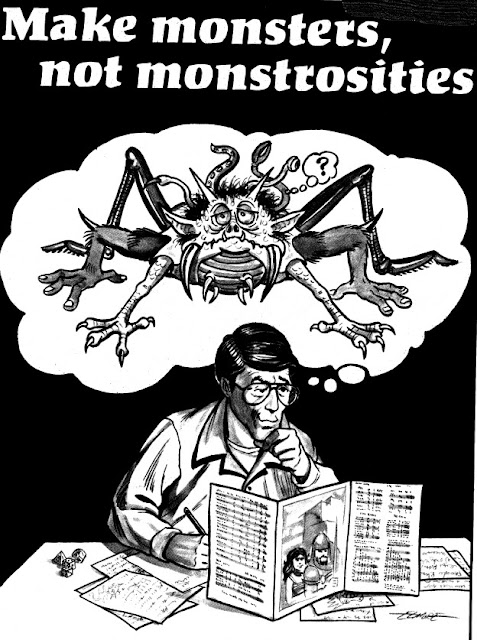
Make Monsters, Not Monstrosities

Larry Elmore joined TSR as a staff artist in late 1981, after which his artwork became a staple of the company's many products, from Dungeons & Dragons to Gamma World and Star Frontiers, among many, many others. My own earliest memories of Elmore's distinctive style are from the pages of Dragon, such as this piece, which appeared in issue #59 (March 1982).

I'm fond of this piece for its humor, a trait I generally associate with the work of the late Jim Holloway. I also have a weird fascination with illustrations that depict ordinary people playing or thinking about roleplaying games, so this one scratches that itch. Take note, too, of Elmore's rendition of Dave Trampier's iconic artwork from the Dungeon Master's Screen, which I think adds to the charm of the whole thing.

Monday, July 5, 2021

Elmore's Debut

I was flipping through issue #55 of Dragon (November 1981), an issue I never owned – or saw – back in the day and only relatively recently acquired. There's a surprisingly large amount of interesting material in its 80 pages, to which I may return later. For the moment, I want to draw everyone's attention to a three-page comic that appeared in the issue, drawn by none other than Larry Elmore. Here's the first page.
Does this look at all familiar to anyone? Bear in mind this is 20 issues and nearly two years before the formal appearance of the first SnarfQuest comic, but it sure looks like Snarf, doesn't it – a prototype of the heroic zeetvah, to be sure, but the resemblance is clear. 

How is it that I've never seen anyone reference this comic before? The comic's story is intended to announce the arrival of Larry Elmore at TSR as a staff artist, making this (I presume) his first published work for the company (someone can correct me if I am mistaken in this). At any rate, my eyes nearly popped out of my head when I saw this and I thought it worth sharing with readers who might otherwise have not yet seen it.

Tuesday, May 11, 2021

Legendaria

The very first issue of Dragon I vividly remember buying was issue #62 (June 1982), in large part because of its spectacular cover painting by Larry Elmore. I read that issue cover to cover so many times that I must have committed a good portion of its contents to memory. I also clearly recall its many advertisements, one of which still fascinates me.

From what I have been able to gather, Legendaria was a short-lived gaming magazine published by an outfit called WITS Publishing in Philadelphia, Pennsylvania, edited and written by Chandler Driggs. I can confirm that there were at least five issues of the magazine. The illustration above, which is quite striking, was done by Helen Goldman, about whom I can find no information. 

For a long time, I thought that Legendaria was a fantasy comic book, owing to my misunderstanding the subtitle, "the illustrated log of the Varna Adventurers' Guild." As you'll see from the following scan of its inaugural editorial, it was nothing of the kind.

Based on this, Legendaria would seem to have been a rather well done amateur publication presenting material derived from the editor's home campaign of Varna. If you poke around online, you can find images of the covers of the five published issues but not much else. Did any readers own copies of this magazine? I'd love to know more about it, if only to satisfy the curiosity that ad from issue #62 engendered almost forty years ago.

Monday, January 4, 2021

Join the Galactic Legions

I don't pretend to understand a great deal about advertising. In fact, I am regularly baffled by the approaches taken in many ad campaigns. A good case in point is this full-page advertisement that appeared on the pages of Dragon in late 1982 and throughout 1983.

TSR's Star Frontiers distinguishes itself for its excellent black and white art, thanks in no small part to the illustrations of Larry Elmore (whose technical brilliance, I've long argued, is a better fit for sci-fi than for fantasy). Yet, the ad reduces the prominence of Elmore's cover art and pairs a bland, generic illustration with cartoonish graphic design. In addition, the text of the advertisement says next to nothing about Star Frontiers itself or the game's setting (there are no "Galactic Legions," for example). 

I presume the writer of the ad was attempting to riff off military recruitment posters of the era, which is a tried and true – if unimaginative – advertising technique. But, if you're going to go that route, why wouldn't you put Elmore's art front and center and use text that actually reflects the content of the game? As I said, I don't pretend to understand the ways of advertising. It's possible, I suppose, that there were very good reasons for producing the ad in this way, but, if so, I can't imagine what they would be.

Monday, December 28, 2020

Computer-Assisted Gaming

I've mentioned before that the very first issue of Dragon I remember buying (as opposed to owning or reading) was issue #62 (June 1982), in part because of its glorious Larry Elmore cover. I carried that issue around everywhere with me and read it cover to cover so many times that it literally fell apart. The other day I was reading the PDF version of the issue included in the Dragon Magazine Archive I got back in 1999 – one of the best purchases I've ever made – and, while doing so, I came across an advertisement I hadn't thought about in decades. It's for a program called Game Master, produced by a company called Alkazar Associates of Arlington, Virginia, USA. 

At the time this ad appeared, personal computers were pretty uncommon, at least among my friend group. A classmate of mine was an early adopter of PCs, having a TRS-80 on which we used to play a Star Trek (or perhaps Star Trek-inspired) game that I thought was the most amazing thing ever. Another friend, whose older brother was an early (albeit reluctant) gaming mentor and whose father was a wargamer, owned an Atari 800 (I believe; it's possible it was a 400). But I didn't have a computer of my own till I was in graduate school a decade later. Consequently, ads like these intrigued me mightily. The very idea that there were computer programs that might assist one in playing a roleplaying game was equal parts baffling and exhilarating and I tried to imagine how they might work.

Though I never did see Game Master, which, after a little digging online, I learned came in "basic" and "advanced" versions, I did eventually see a very good computer program produced for the Amiga in the early '90s. Called "Chargen," it was an exceptionally easy to use and functional character generation program for use with Second Edition AD&D. The program, as I recall, allowed the user to determine which rulebooks and supplements to use, in addition to providing the means to add one's own material. That was a huge bonus and one that made the program quite attractive to me at the time, since I had been elected referee of a Forgotten Realms campaign that had been running for several years prior to my arrival and had been heavily house-ruled during the course of its existence. 

In the years since, I've made only intermittent use of computers in running or playing roleplaying games. I have a few programs that automate aspects of Traveller, for example, one of which – a character generator – I sometimes idly "play" to pass the time, but these days I mostly prefer to do things "by hand" and roll my own dice. Mind you, I don't play any games that would really require the use of computer assistance, which may well bias my feelings on the matter. At the same time, I pretty strongly feel that roleplaying games are an "analog" form of entertainment and that the introduction of computers and other forms of digital or electronic technology warps game play in various ways, some obvious, some subtle. I say this even as someone who has played in or refereed multiple long-running campaigns online, so I'm not speaking out of ignorance on the matter. It's a subject I find myself thinking about throughout 2020, since face-to-face gaming hasn't really been an option and likely won't be for some time to come. 

Monday, September 28, 2020

Pinball Wizard


Via this very useful site, I was able to prove that my age-addled recollections of their having been a Dungeons & Dragons pinball game weren't mistaken. According to the site, this Bally-made cabinet was released in 1987, which is later than I'd have guessed. That's well after the Golden Age of arcades in the mid-1980s or the period of D&D's faddish popularity, though pinball has always struck me as being its own thing, distinct from other arcade games, so the aforementioned factors might not be relevant. 

In any case, here it is, in all its glory, complete with a reproduction of Larry Elmore's iconic cover illustration to Frank Mentzer's 1983 revision of the D&D Basic Set. I'm no expert in these matters, but it looks rather nice to my eyes. Did anyone else ever see one back in the day?

Saturday, July 21, 2012

French D&D Images

As promised, here are some scans of a few pieces of artwork from the 1982 French edition of Dungeons & Dragons Basic Set edited by Tom Moldvay. What you'll notice is that a great many of the images below are re-imaginings of pieces that appeared in the original 1981 English language version, like this one:
The original version of this from the 1981 edition is almost identical, right down to the numbers shown on most of the dice, so why bother commissioning a new piece?

Goofy though it is, I actually really like this illustration by Jim Holloway. There is a comparable illustration in the 1981 edition, but it depicts two people (one male, one female) imagining themselves as D&D characters, not one, and neither looks anything like this fellow, who seems a truer representative of the cohort of gamers entering the hobby via the Basic Rules.
This looks to be another Jim Holloway piece, depicting what I suspect are meant to be a thief, an elf, and a dwarf. It's wholly original and has no antecedent in the 1981 edition.
This is Larry Elmore's version of the famed alignment illustration from the 1981 book. I can't be certain, but I think it had previously appeared elsewhere, perhaps in an issue of Polyhedron, but my memory is faulty after three decades.
Here's another reworking, this time of Erol Otus's wizards arguing over who gets which magic items from their latest haul. While the entirety of this piece by Larry Elmore (so far as I can recall) never appeared anywhere, the female magic-user on the left makes several appearances in the 1983 Frank Mentzer-edited Basic Set.

There are many more illustrations in the French Basic Rules I can share if there's sufficient interest in seeing them. I picked the ones above because they struck me as interesting and because the majority of them are either direct re-imaginings of things found in the 1981 English version or depict similar things. I find myself wondering why all the interior artwork is new and unique to this edition but the Erol Otus cover painting was retained. Regardless, I find it helps give the 1982 French version a flavor all its own that distinguishes it from the original work from which it was derived.

Thursday, August 25, 2011

The Ads of Dragon: D&D Poster

If you ever need a concrete reminder that the days of Dungeons & Dragons as a mainstream pop cultural phenomenon are long past, you need only look at this advertisement from issue #90 (October 1984) of Dragon:
Back in 1984, you could buy a D&D poster, featuring art by Larry Elmore, from Sears stores or from the Sears Christmas catalog. When was the last time that you saw a D&D poster at all, let alone available through a major department store chain? It's little things like this that remind us how big a fad D&D was once upon a time.