Tuesday, February 17, 2026
The Articles of Dragon: "These are the Voyages of the Ginny's Delight ..."
Monday, October 13, 2025
Pulp Fantasy Library: Yours Truly, Jack the Ripper
The story’s plot is simple but clever. Set in contemporary Chicago, it follows Sir Guy Hollis, a visiting Englishman who approaches a skeptical American psychiatrist, John Carmody, with the extraordinary claim that Jack the Ripper still lives. Hollis explains that the Ripper was no mere man but an occultist who discovered a means of prolonging his life through ritual murder. The killings, he insists, have continued for decades, always masked by local crimes. Carmody humors Hollis, until a twist ending reveals the truth in classic pulp fashion, namely, that the Ripper is indeed alive and much closer than anyone suspected.
Despite its shock ending, Bloch’s tale is more than a clever “gotcha” story. It’s a condensation of the author’s lifelong preoccupations with the psychology of evil and the thin membrane separating reason from madness. Bloch's Ripper is not a shadowy figure from the past but a symbol of the persistence of violence and the darkness within modernity itself. The idea of evil as immortal, adaptable, and perversely rational is one Bloch would return to repeatedly, most famously in his novel Psycho, adapted into the even more famous Alfred Hitchcock film of the same name. Bloch's fascination with hidden monstrosity under a civilized veneer runs through “Yours Truly, Jack the Ripper,” which expertly combines the analytic tone of mid-century crime fiction with the lurid, occult sensibility of Weird Tales.
The story also marks a bridge between two eras of pulp horror. Bloch’s early mentor, H. P. Lovecraft, had encouraged him to look beyond imitation and find his own unique take on horror. “Yours Truly, Jack the Ripper” shows that lesson fully absorbed. While Lovecraft looked outward to cosmic terrors, Bloch looked inward to psychological ones. His Ripper is a mortal man sustained by unholy ritual rather than an inhuman being, yet he represents a similar idea – that horror is not confined to a time or a place but an enduring truth about existence.
Other pulp writers of the same era, such as Seabury Quinn and August Derleth, had already blended supernatural elements with the detective story, but Bloch’s version somehow feels more modern than their efforts. Its clipped dialogue, urban setting, and psychiatric framing anticipate the tone of postwar noir as much as the supernatural mystery. The story’s success, both in Weird Tales and in the numerous anthologies that reprinted it, helped establish Bloch as a master of the short form and demonstrated that pulp horror could engage with contemporary anxieties rather than remain trapped in the past.
Bloch himself would later revisit the central idea of this story in a different medium. For the television series, Star Trek, he wrote the 1967 episode “Wolf in the Fold,” which imagines Jack the Ripper as an incorporeal entity feeding on fear across time and space. The science-fictional reframing underscores how adaptable the premise is and how central it was to Bloch’s conception of evil as rational and enduring. That Star Trek episode, like the 1943 story, reflects his belief that horror is never merely historical. Instead, it’s part of Man, wherever and whenever he lives.
Tuesday, June 17, 2025
REPOST: The Articles of Dragon: Ares
From issue #84 to issue #111 (July 1986), Ares was one of my favorite sections of Dragon, since I've always been more of a SF fan than a fantasy one. The section featured articles on games like Traveller and Star Trek and Space Opera, as well as Gamma World, Star Frontiers, and a host of superhero games, especially Marvel Super Heroes. Because sci-fi has always played second (or third) banana to fantasy, you'd have expected that the pool of articles would have been pretty shallow in Ares but that wasn't the case. In my opinion, the quality of the articles in this section was consistently high, higher even than that of the rest of Dragon (which is saying something). However, its appeal was definitely more limited, which is why I suspect it was eventually killed. Why devote some many pages of each issue to genres that are also-rans compared to fantasy, especially D&D's brand of fantasy?
To this day, though, when I look back on the years when I subscribed to Dragon, the Ares articles are among those that stick out most prominently in my mind. Its coverage of Gamma World, for example, was truly excellent and I used a number of its Traveller rules variants over the years. And of course Jeff Grubb's regular "The Marvel-Phile" column was invaluable if you were running a Marvel Super Heroes campaign (or even if you weren't and were just a fan of the comics). I've always thought it a pity that a non-fantasy-centric gaming mag never really gained any degree of prominence. GDW's Challenge, where my first published writings appeared, was a decent stab at such a thing, but it eventually folded, too, much to my disappointment. Like Ares, Challenge filled a hole in the hobby that needed filling. In my opinion, it still does.
Wednesday, May 7, 2025
Retrospective: Star Wars: The Roleplaying Game
Thursday, June 20, 2024
Retrospective: The Triangle
The Triangle takes its name from an area of space that lies between the territories claimed by the United Federation of Planets and Klingon and Romulan Empires. Consisting of a little more than 120 class M worlds, most of which are independent of any of the aforementioned great powers, the Triangle is a contested area, filled with danger, mystery, and lots of opportunities to turn a credit. That makes it an ideal place to set a campaign, especially if you're interested in interstellar intrigue in the Star Trek universe – or at least FASA's interpretation of that universe.
That's an important thing to bear in mind. The Triangle was first released in 1985. At that point in time, there were only three movies and The Next Generation was still two years in the future. And while there were a good number of novels and comic books, the concept of a Star Trek "canon" as the word is used today was very loose, almost to the point of non-existence. Consequently, each licensee was largely free to develop the setting in whatever way it chose and without regard for – and sometimes in contradiction of – how any other licensee did so. I know it's hard to imagine
FASA took full advantage of this creative freedom to flesh out their own unique take on the Star Trek universe, one that, in retrospect, has a decidedly Cold War edge to it, with the Federation standing in for NATO and the Klingons and Romulans for different aspects of the Warsaw Pact. It wasn't quite as overtly militaristic as, say, Starfleet Battles, as it tempered its power politics with elements sincere idealism, but it also wasn't quite as wide-eyed as The Next Generation regularly was. It was a vision of the 23rd century that reflected the tensions and concerns of the mid-1980s and so probably would feel a bit dated to some today. At the time, though, I loved it.
The Triangle makes the most sense when viewed in this context. This is an area of space filled with mostly independent worlds whom each of the three nearby major powers wishes to sway to their side, whether for noble or cynical reasons, reminiscent of the way that the United States and the Soviet Union used Third World nations as pawns in their Great Game. But because no one wishes to ignite an interstellar war, they must act with caution – and often covertly – lest they light the spark that throws everything into chaos. As I said, it's a great place to set a campaign.
In addition to the Federation, the Klingons, and the Romulans, The Triangle introduces us to several other regional powers. The Affiliation of Outer Free Worlds is a Federation-friendly – but still independent – coalition of planets. The Orion Frontier Mercantile Association is a front for moneyed Orion interests to exploit the worlds of the Triangle. The Imperial Klingon States is a breakaway Klingon government headed by an admiral who failed in his attempt to seize the throne. The Mantiev Colonial Association is another coalition of worlds but one whose fractious politics have brought to the brink of civil war, with each faction backed by one of the major powers.
In addition to fleshing out these regional powers, The Triangle details every individual world, along with significant NPCs, new alien races, and corporations. There's also information of trade routes and black markets, both of which are essential if it's used in conjunction with Trader Captains & Merchant Princes. Of course, the Triangle works just as well as the setting for campaigns focusing on Federation or Klingon ships and characters. The book provides lots of hooks for referees looking to run almost any sort of adventure you can imagine in the Star Trek universe – exploration, rescue missions, espionage, diplomacy, and more. It's jam packed with ideas. Even if you find only a few of them of immediate interest, The Triangle has more than enough to keep a campaign moving for months or years.
I had a lot of fun with The Triangle after its release, using it as the basis primarily for merchant adventures. Unfortunately, I didn't use it for very long, though mostly for reasons having nothing to do with the supplement itself. In fact, I enjoyed it so much that I had hoped I'd get the chance to referee a long-running campaign in the region. The book certainly provides enough ideas on which to build such a campaign, which is my usual metric for determining the value of a gaming supplement, hence why I think so highly of The Triangle.
Wednesday, June 12, 2024
Retrospective: Trader Captains and Merchant Princes
FASA's Star Trek the Role Playing Game was one of my favorite RPGs in my youth, eclipsing even Traveller in my affections, if you can believe it. One reason for this is that Star Trek was my first fandom. I was initiated into the mysteries of Gene Roddenberry's vision of the future by my paternal aunt, who was a teenager when I was born. She was thus old enough to have been a fan of The Original Series during its initial broadcast and to be close enough to my own age that we shared a lot of interests (she also took me to see Star Wars in 1977 and introduced me to Kolchak: The Night Stalker).
Before she married, my aunt still lived with my grandparents, which I visited nearly every Saturday. That was also the day when a local independent TV station showed reruns of Star Trek, which we'd watch together. This weekly ritual, started when I was quite young, made me a devoted fan of the series, long before it became heavily merchandised (though there were still a few tie-in products kicking around). My earliest conceptions of science fiction were thus strongly influenced by Star Trek.
Another reason is that FASA's RPG adaptation is a very good one that, in my opinion, did a great job of capturing the vibe of what Star Trek was like in 1982, when what is now a bloated, sclerotic franchise devoid of good ideas (James, tell us how you really feel) was still as wide open and rife with possibilities as the Final Frontier itself. Recall that, at that time, we had only The Original Series itself, its short-lived animated continuation, two movies, and a fairly small number of comics and novelizations. That was in the process of changing, of course, but, upon its publication, Star Trek the Role Playing Game still felt like it belonged to the looser, more freewheeling era of fandom my aunt had introduced to me.
So, when FASA released the Trader Captains and Merchant Princes supplement in 1982, I immediately snapped it up. I've mentioned my love for it previously, but, until now, I've not had the chance to talk about it in any detail. Where Star Trek the Role Playing Game was (obviously) devoted to Starfleet characters and their exploration of the galaxy, this 52-page book focused on civilian characters, specifically "traders, privateers, merchants, con-men, and rouges [sic]," as its back cover boasted. If you're the sort of person who ever watched "The Trouble with Tribbles" and wondered what other shenanigans Cyrano Jones might have gotten up to or imagined what life was like for Harcourt Fenton Mudd as he perpetrated his illicit schemes at the far corners of space. this is the supplement for you.
For myself, all of that was compelling, no doubt, but what really grabbed my interest was simply learning more about life on the fringes of the galaxy's Great Powers. Up to this point, everything we'd seen of Star Trek was about Starfleet and the Federation, leaving me to wonder what else there might be to do out there among the stars. Characters like Jones and Mudd hinted at the existence of people living on the edge, doing what they needed to turn a credit while trying to stay ahead of any authorities that might look too closely at what how they earned their livings. Roddenberry had, after all, originally pitched Star Trek as Wagon Train in space, so it only made sense that there'd be futuristic gamblers, rustlers, and snake oil salesmen out there somewhere. This supplement let you play them.
In addition to new character generation options, like the Merchant Academy, Trader Captains and Merchant Princes also offered both new personal equipment and new starships. The latter were especially interesting to me, because they were all small craft, with a crew complement of no more than a dozen, which made them both the perfect size for a "party" of civilian characters and a nice counterpoint to the huge vessels of Starfleet. The book also included rules for trading, running and maintaining small ships, taxes, tariffs, piracy, and playing the stock market. Topping it off were guidelines for refereeing merchant adventures and campaigns, as well as a sample setting, the Twilight Nebula, an unclaimed area of space at the fringes of the Klingon Empire.
I'm a big fan of supplements that expand the scope of a RPG, opening up new avenues for fun and exciting play. Trader Captains and Merchant Princes really did that for Star Trek the Role Playing Game, at least for me. I ran a merchant campaign for my friends in parallel with the missions of the USS Excalibur aboard which their Starfleet characters served. I even recall that one of the Starfleet characters spent time undercover as a merchant, operating under an assumed name to learn more about the Romulans' activities in a region of unclaimed space. We had a lot of fun and this supplement gave us the rules and inspiration to make it happen.
Tuesday, April 30, 2024
Polyhedron: Issue #24
Tuesday, April 9, 2024
Polyhedron: Issue #21
Issue #21 of Polyhedron (January 1985) features a cover illustration by Timothy Truman, who produced a lot of artwork for TSR throughout the 1980s before going on to greater success as a comic book artist. The piece depicts the protagonist of this issue's "Encounters" article, facing off against a creature of para-elemental ice, but, as I'll explain shortly, I have some questions.
The issue starts with another "Notes from HQ" article by Penny Petticord. Her position is RPGA Network Coordinator, which I assume is the title of the head of the RPGA. However, starting with issue #22, Petticord will also be the editor of Polyhedron, taking over from Mary Kirchoff, who'd been on the staff of the newszine since issue #5. She would then devote herself full-time to fiction, writing numerous Dragonlance novels and later becoming part of TSR's book publishing division.
Next up is the aforementioned "Encounters" article by James M. Ward. The scenario sees a young paladin named Ren Grakkan on a quest to retrieve "the most potent of all artifacts," the white cloak of enchanting (or is it charming? The text is inconsistent) for his unnamed lady love. The cloak is found in a cave guarded by para-elemental ice monsters. As I noted, I have a couple of questions. First, Ren is described as a paladin, but he looks more like a classic sword-and-sorcery barbarian based on Truman's illustration. The text at least supports this, since he's described as wearing no armor but only bracers of defense (AC 4) and having Dexterity 18 (hence a –4 defensive adjustment). Even so, he looks nothing like what I'd expect of a "paladin," but perhaps I simply lack imagination. (I suppose it's possible the artwork depicts the cloak's original owner, a barbarian lord, who lost it in battle against the ice creatures, but then why isn't the cloak shown?) Second, this so-called "potent artifact" Ren is seeking makes its wearer's charm and illusion spells harder to resist, especially if the wearer is female. Could it be that Ren's "lady love" is actually a sorceresss who's charmed him? There's no evidence of this in the text, but the thought occurs to me. (Also, why does Ward keep re-using the name "Ren" for his characters?)
Sonny Scott's "Observations from a Veteran Gamer" is short piece of fluffy advice from a long-time player of AD&D who's also a stalwart of the RPGA. I don't mean to be so dismissive, but there's nothing here you've never heard a thousand times before. More interesting is Gary Gygax's "Why Gargoyles Don't Have Wings But Should." The article begins with classic Gygaxian boasting: he speaks of his association with Flint Dille ("Did you know his grandfather invented Buck Rogers?") and their upcoming joint projects. Then, he moves on to his dissatisfaction with depictions of both the gargoyle and the mar(l)goyle from Monster Manual II. The illustrations for both, Gygax says, lack wings and this should be corrected in "some future edition" of AD&D. For reference, here are the two illustrations in question:
![]() |
| "Don't try to tell me those dark shadows are wings!" Thus spake Gygax. |
Wednesday, November 15, 2023
A Mystery Solved?
According to this article, a listing on eBay for a replica of the Enterprise caught the eyes of some fans, who suspected that it might well have been the model missing for nearly half a century. They contacted the seller with their suspicions, recommending he get in touch with Roddenberry's family about it. Soon thereafter, Roddenberry's son, Rod, issued the following statement:
“Along with much of the Star Trek community, I was excited and pleased to learn that the original 3-foot filming model of the Starship Enterprise appears to have been discovered after being missing for decades (pending full authentication). I can confirm that I am now, through an intermediary, in contact with the individual who possesses the model.
This prototype played a key role in the visualizing design of the famous television starship during Star Trek’s early development in 1964. Once the show went into production, the model was actually filmed in numerous visual effects shots seen throughout the life of the original Star Trek series, along with a larger, 12-foot model that is currently displayed at the Smithsonian National Air and Space Museum. I am convinced that this prototype model holds immense significance for Star Trek and its 58-year history. From its creation in the mid-60s until about 1977, the model was in the possession of my father, Star Trek creator Gene Roddenberry. Unfortunately, it went missing after being loaned out during the production of Star Trek: The Motion Picture.
Beyond its physical value, the greater significance is this prototype Enterprise model really represents the underpinning ideas my father imbued into the series. That we are clever, resilient and can learn from our mistakes. We can and will move beyond archaic belief systems. And once we truly embrace the infinite diversity all around us, both in form and idea, we will then take those next step into a prosperous and unlimited future.
Guided by this principle, one of my primary goals over the past decade has been to locate, recover, and digitally archive significant Star Trek materials and artifacts through the Roddenberry Archive project. The intention would be to scan it in the finest detail for the Roddenberry Archives and after rigorous scrutiny make it available to the public. Furthermore, I firmly believe that a piece of such importance should not be confined to any private collection. This iconic artifact should be enshrined along side the 12-foot shooting model at the Smithsonian’s National Air and Space Museum, where it can serve to help tell the story of television history, the history of space exploration and ultimately, a beacon of hope for the future.”
I'm quite curious to see how this story plays out. Growing up in Maryland, I regularly visited the National Air and Space Museum in Washington, D.C. A highlight of any such trip was seeing the 11-foot studio model of the Enterprise used for exterior shots in the 1960s TV series. Consequently, this story really piqued my interest. I imagine many of my readers will feel the same way.
Wednesday, August 23, 2023
Retrospective: Traders and Gunboats
I've mentioned before that Star Trek was my first fandom. If you were a kid with an interest in science fiction in the early 1970s, there simply weren't many other options. Despite this, Star Trek wasn't heavily merchandised at the time, certainly not to the extent that Star Wars would be in a few years. Consequently, fans like myself had to make do with a fairly limited selection of Star Trek products to sate our lust for more information about Gene Roddenberry's vision of the 23rd century.
A couple of items from that limited selection stand out in my memory, both of them created by the German technical artist Franz Joseph Schnaubelt, known by his nom de plume, Franz Joseph. In 1975, Ballantine Books released Joseph's Starfleet Technical Manual and Star Trek Blueprints. Each included lots of beautifully rendered maps and schematics of Star Trek space vessels and technology (and, fascinatingly, served as the basis for Starfleet Battles, but that's another story). Needless to say, I owned and adore both of them, spending countless hours poring over the secrets they revealed about the layout of the USS Enterprise and other Starfleet ships of the line. These books initiated my lifelong love for deckplans of all sorts, but particularly of science fiction vehicles – a love I'd later transfer into the realm of science fiction roleplaying games.
GDW's Traveller, which I first picked up sometime in 1982, was more than accommodating of my love of starship deckplans. Nearly every adventure released for the game, along with many of its supplements, included one or more deckplans of this sort. There were even separate but related games, Snapshot and Azhanti High Lightning, that included deckplans large enough to use with cardboard counters or 15mm miniatures. From the standpoint of someone like myself who loved starship deckplans, Traveller delivered the goods.
Which brings us to the true topic of this post: Supplement 7: Traders and Gunboats. Released in 1980 and written by Traveller's creator, Marc Miller, with assistance from Frank Chadwick, John Harshman, and Loren Wiseman, Traders and Gunboats is a 48-page supplement that provides information on, as its title suggests, merchant starships and patrol craft. The information is not limited solely to game statistics – though there's plenty of such detail – but also includes an equal amount of information on the place of such vessels within GDW's Third Imperium setting. The inclusion of both game mechanical and setting information makes Traders and Gunboats equally useful to players and referees, as well as to those using Traveller's official setting or one of their own creation.
Ultimately, what makes Supplement 7 so appealing to me is its practicality. All of the space vessels described in its pages are small in size. The largest is no more than 1000 displacement tons, but the vast majority are in 100–400 ton range, which makes them perfect for use by – or against – player characters. That's one of the things that's always appealed to me about Traveller: it keeps its focus on the PCs and their adventures. It's true that Traveller can be vast in scope and certainly the official Third Imperium setting encompasses tens of thousands of worlds spread across dozens of sectors of space. Yet, the play of the game remains human-scaled, which is exactly what Traders and Gunboats supports with its information on smaller space vessels.
Of course, as you'd expect, given my preamble, it's the deckplans that still excite me. Here's a sample page featuring a few small (20–50 ton) craft.
Thursday, July 27, 2023
Splitting the Party
This mindset carried over into other RPGs, too. One that sticks very firmly in my mind – and that's relevant to the larger topic I want to discuss in this post – is Star Trek the Role Playing Game. As I've no doubt said too many times before, Star Trek was my original fandom, the gateway through which I entered more solidly into the wider world of nerdery. When FASA published their RPG adaptation of the TV series in 1982, I snapped it up immediately and ran the game almost non-stop over the course of several years in the mid-80s. Though the rules of the game made some effort to model the conventions of the show – the starship combat system is perhaps the most successful instance of this – they weren't as strongly wedded to emulation of that kind as were the superhero roleplaying games I mentioned above.
Even so, my friends and I, as if by suggestion, tried to replicate the beats of the 1966 Star Trek series as best we could in play. One of the ways I attempted this – I say "I," because I was almost always the referee – could be seen in my handling of landing parties. In our sessions, as in the television program, characters would sometimes split up, with some of them remaining aboard ship, while others transported down to the planet it was orbiting. The two groups would stay in communication with one another, conveying useful information back in forth, but there were often times when they were out of contact for short or extended periods of time. Occasionally, the lack of communication between ship and landing party was a major plot point, with each group of characters having to deal with a problem in isolation, with only part of the overall picture available to them.
This set-up makes for good drama and I thought it'd make for good roleplaying too, especially since my friends and I were all fairly committed to bringing our sessions in line with the TV show. In those days, we regularly played in the basement of the home of two brothers. In sessions where one group of characters beamed down to a planet and another stayed in orbit, I'd physically separate them, sending one group upstairs to the living room or kitchen, while leaving the other in the basement. I'd shuttle back and forth between each group, handling their current situation in isolation. When they communicated with each other, I'd allow a player from one group to go to the other and they'd exchange information, as if they were using a communicator. This approach, while it slowed down play and involved a lot of running back and forth on my part, was often quite effective. I can still recall several sessions where the ignorance of one group of characters about the activities of the other led to memorable moments of roleplaying (and humor). Nowadays, I could probably handle this much more easily and effectively with technology unavailable to us in the 1980s.
Ironically, in my House of Worms campaign, the characters recently found themselves in a situation where I could have made use of a technological solution – and I didn't do so. While exploring a mysterious location, the characters came across a large, pillar-like object with multiple open apertures leading inside. After some experimentation to determine that it was probably safe, several of them entered and all found themselves in a different place. As some of them eventually discovered, the pillar was a device of the Ancients called a superposition enclosure and it was being used to hold an Undying Wizard called Getúkmetèk prisoner. Each of the characters who entered found himself in a separate reality in which he experienced a possible past/present/future where he had achieved some goal he greatly desired. Meanwhile, there were several characters outside the superposition enclosure, none of whom had any idea what was going inside it.
Bear in mind that House of Worms has been, since its inception in 2015, an entirely online game. We use Discord for voice chat and the campaign's server could easily accommodate separate voice channels into which I could separate all the characters so that their players would have no idea what was happening elsewhere. I didn't do this, however, and I'm not entirely sure why. Part of it, I suspect, is that I was simply lazy. Unlike my teenage self, the thought of popping back and forth between voice channels seemed like too much work, even though the end result might have been dramatically effective. Part of it, too, is that I worry about players losing focus while I tended to a player segregated in his own channel. As I have been running it, all the players have the chance to hear what's happening to their comrades, even if their characters do not. That keeps everyone engaged and, more than once, hearing the reactions of the players to things their characters do not know was positively delightful.
Does anyone reading this have any experiences with this sort of thing? Have you ever split up players in this fashion and, if so, how did it turn out? I'm quite curious to know how others have done it.
Tuesday, June 6, 2023
White Dwarf: Issue #77
Tuesday, May 16, 2023
White Dwarf: Issue #74
The good stuff lies in Tschai's rich scents and colours, and in elaboration of style. No Vance villain would say 'I'll get you for that.' Instead: 'Low-grade assassins will drown you in cattle excrement! Twenty pariahs will drub your corpse! A cur will drag your head along the street by your tongue!'
Langford's byline reappears under "The Power of the Frog," a science fiction short story about a human junior military officer held prisoner by an alien race. Like all of Langford's previous short stories, this one is both brief and amusing. It's clear the man has talent, which is why I sometimes feel bad at the lack of interest his book review column elicits. Truthfully, I wish he had contributed more fiction to White Dwarf.
"Terror at Trollmarsh" is an AD&D adventure for 4th–5th-level characters by Peter and Janet Vialls. I really enjoyed this one, which takes the form of a murder mystery with fantasy/horror elements. A monster is stalking the halls of Baron Uther Torgrim, killing his servants, and it's up to the players to figure out just what is really going on. While the overall concept is a standard, even clichéd one, the authors handle it well, giving the referee an interesting, well mapped out environment, an array of compelling NPCs, and a culprit with clear, understandable motives. "Terror at Trollmarsh" is nothing revolutionary, but, like all good scenarios, it gives players lots of "moving parts" with which to interact as they grapple with its central mystery.
"A Company of Wolves" by Peter Blanchard looks at lycanthropy in AD&D from both a game and folkloric perspective. The article doesn't offer much in the way of new rules mechanics, which I appreciate, focusing instead on "social" aspects of this magical curse, which is to say, how it might function in a fantasy setting, including its advantages and drawbacks. "The Hide of the Ancestor" by Chris Watson is a short RuneQuest scenario about the recovery of a relic holy to the twenty-six tribes of the Ithillian-Fane, a race of lion-centaurs. I find it oddly refreshing to read a RQ adventure set in Glorantha whose author feels comfortable enough with the setting to his own creations, like the Ithillian-Fane to it. Too often settings like Glorantha – and Tékumel and Hârn and ... – are treated as inviolable to the point that no one is even willing to play in them, lest they "do it wrong." That's nonsense in my opinion, which is why I delight in scenarios like "The Hide of the Ancestor."
"Gentlemen and Players" by Richard Edwards and Chris Elliott is nice little article about creating British characters for use with Call of Cthulhu. As its title suggests, the article focuses on the creation of "gentlemen" (or aristocratic amateurs) and "players" (professional sportsmen). "Hitting the Right Note" by Ian Berridge presents information on musical instruments, their use, and the how to learn to play them for use with AD&D. Articles like this are godsends to those whose campaigns would benefit from such fine details – and absolutely useless to those whose campaigns wouldn't.
"Alternative Origins" by Ian Thomson is a collection of random tables for use with Games Workshop's Golden Heroes. The tables are intended to replace those presented in the game for character generation in order to produce more "convincing" heroes whose powers are an incompatible jumble. This makes good sense to me, but then I haven't looked at a copy of Golden Heroes in decades, so it's hard for me to judge how useful this article would be. Elsewhere, Joe Dever offers part three of his look at "Dioramas," accompanied by some lovely – though non-diorama – photographs of painted miniatures.
The issue also includes more "Thrud the Barbarian," a full-page "Gobbledigook," and "The Travellers," which continues its Shadows-inspired plotline. I particularly enjoyed the latter, especially this bit:
Wednesday, March 22, 2023
Happy Birthday, William Shatner
As I have mentioned before, Star Trek was my original fandom. I was introduced to it in the mid-1970s through the influence of my paternal aunt and godmother, who was a teenager when Star Trek was first broadcast. Indeed, I attribute many of my earliest interests, whether it be science fiction or cryptozoology, to the time she spent with me as a child. Every Saturday, I used to visit my grandparents, where my aunt still lived before she married, and we'd watch reruns of Star Trek on a local independent TV station. These are among my most cherished childhood memories and William Shatner is a big part of why.
Being a bookish and generally nerdy kid, you'd have thought that Leonard Nimoy's Spock would have been my role model. While I loved Spock, Captain Kirk was who I wanted to be, probably because he was so different from myself – courageous, self-assured, decisive, and, above all, protective of his friends and crew. Kirk was everything I hoped I might someday be and Shatner breathed life into him in a way no one could have.
Nowadays, I know it's more or less required that we sneer at Shatner as a big, fat ham of an actor, but, even with the benefit of an adult's perspective, I still think his portrayal of Jim Kirk is phenomenal. Shatner imbued Kirk with the fundamental decency and indeed humanity that are vital to the character's appeal. Far from being the swaggering, overbearing, tin-plated dictator with delusions of godhood of many people's imaginations, Shatner gave Kirk a degree of thoughtfulness and sensitivity that is often underappreciated. I didn't fully recognize this as a child; I only knew that I liked Kirk and wanted to be more like him, which I think would be high praise for any actor.
Happy Birthday, Mr Shatner! My younger self owes you a lot.
Friday, February 17, 2023
My Top 10 Non-D&D RPGs (Part II)
Part I of this list can be found here.
5. Star Trek the Role Playing Game
Star Trek is my original fandom. I started watching the Original Series in reruns on a local TV channel growing up and instantly fell in love with it. As a kid, I read everything about or related to the show that I could and one of my proudest possessions was a gold Starfleet uniform shirt that I probably wore far too often. Consequently, the appearance of FASA's 1982 was a major event for me. I bought a copy as soon as I could and immediately started refereeing a long-running campaign with my friends. In most respects, FASA's rules were nothing special – a fairly basic percentile-driven system – but they included two things that set them apart in my opinion. The first was the lifepath character generation system, which helped players get a handle on who their characters were before the campaign began. The second was a character-based starship combat system that nicely evoked the feel of ship-to-ship combat from the TV series. These, combined with the obvious love the game showed toward its source material, makes Star Trek the Role Playing Game one of my favorite RPGs even today.
4. Gamma World
I'm a sucker for post-apocalyptic settings, so it was natural that Gamma World would appeal to me. Nowadays, it's pretty common among gamers to make fun of GW and its rather, shall we say, idiosyncratic take on the End Times. On the one hand, I can understand that. From the vantage point of the present, Gamma World, with its mutant chicken-men and rabbits that can turn metal to rubber with a touch, certainly might appear silly. On the other hand, I think what's often misunderstood about the game is that it actually owes a lot more to the "dying earth" fantasy sub-genre than straight science fictional speculation. Gamma World postulates that the End Times come several hundred years hence, when all sorts of technological marvels exist and have made Earth quite unlike our own age. After the Fall, Earth becomes genuinely weird, thanks to artificial intelligences, mutagenic substances, and reality warping weapons. That's precisely why I continue to love it and why I hope to have the chance to referee another campaign of it one day.
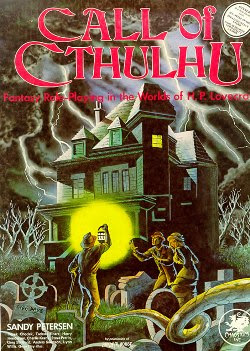
3. Call of CthulhuLike Pendragon, Call of Cthulhu is another "perfect" game in the way that it marries its game mechanics and its source material. Of course, despite its original subtitle – "Fantasy Role-Playing in the Worlds of H.P. Lovecraft" – Call of Cthulhu's source material is much broader than simply the works of HPL. As I have argued before, CoC owes a great deal to Lovecraft's admirer, August Derleth, whose literary vision is far less bleak than that of his hero. An RPG based solely on Lovecraft's nihilistic cosmicism would certainly be horrific, but would it be fun to play? I personally don't think so, which is why Sandy Petersen was wise to have leavened the existential gloom of Lovecraft with healthy doses of Derlethian optimism. In any event, I've played a lot of Call of Cthulhu over the years and hope to do so again in the future. It is, hands down, my favorite horror roleplaying game and yet another reminder that Chaosium is one of the great publishers of our hobby
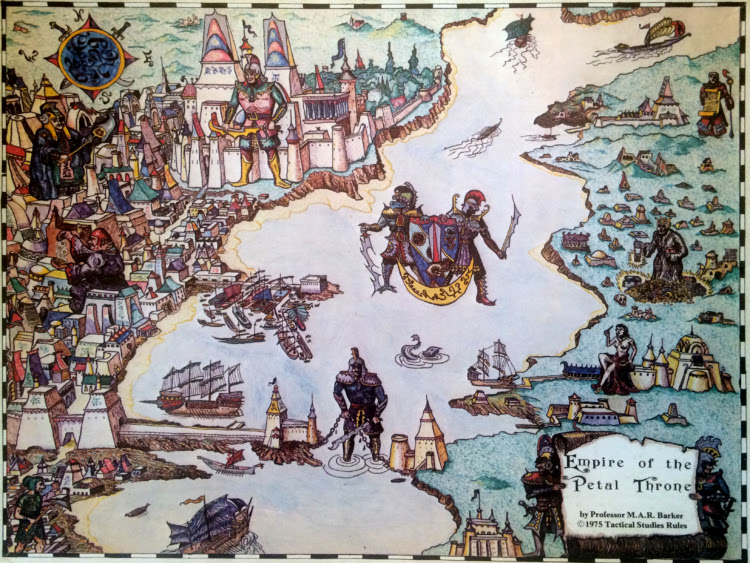
2. Empire of the Petal Throne