Showing posts with label horror. Show all posts

Monday, February 23, 2026

Chamber of Chills

I mentioned in my earlier post today that there was a Marvel comics adaptation of "The Thing on the Roof" in issue #3 of Chamber of Chills (March 1973), scripted by Roy Thomas (of Conan the Barbarian and The Savage Sword of Conan fame, among many others) and drawn by Frank Brunner. Here's the cover – and, no, nothing like this happens in either the story or the adaptation.

The adaptation is broadly faithful to Howard's story, though it eliminates the first part of it, where Tussmann comes to the narrator (here given the name of Mr Erwin rather than being unnamed) and asks his help in procuring a copy of the 1839 edition of Nameless Cults, instead launching straight into the narrator's visit to Tussmann's Sussex manor. It's also a bit more melodramatic, adding little flourishes here and there that I assume were intended to heighten the tension and horror of the tale.

Likewise, the comic ends with an actual revelation of the creature that is responsible for Tussmann's demise, something Howard intentionally leaves vague:
I can certainly see why Thomas and Brunner decided to depict the unseen Thing on the Roof, but, as is so often the case, I'm not sure it could ever have done justice to anyone's imagination of what the creature looked like. In any case, I'm nonetheless pleased to draw your attention to another comic book adaptation of a pulp writer. I think the role comics, especially Marvel comics, played in introducing a new generation to the works writers from decades before. Come to think of it, that'd a worthy topic for a post all its own ...

Pulp Fantasy Library: The Thing on the Roof

When I restarted the Pulp Fantasy Library series back in September, I did so primarily because I knew I could devote myself to writing about every H.P. Lovecraft story associated with the Dreamlands, even tangentially. Because there are a lot of stories that fit this description, I didn't have to think much about which story I'd write next, which eased a lot of the burden I'd previously felt about the series. Now that I've concluded that project, I find myself once again pondering what next to write about and I felt some of my former apprehension return. After all, with 350 entries to date, I've written about most (though not all) of the obvious stories.

Because I'd devoted the first month of the year to Clark Ashton Smith rather than to his colleague and fellow January baby, Robert E. Howard, I thought a good way to solve my immediate problem was to find one of his stories I'd never covered before. REH was a prolific writer and, while his tales of Conan and Solomon Kane are probably his best and most well-known, there's still a wealth of options to choose from, especially if I wanted something a little off the beaten path. That's when I remembered "The Thing on the Roof."

Originally published in the February 1932 issue of Weird Tales, "The Thing on the Roof" is a horror story in the vein of Lovecraft's tales of the Cthulhu Mythos. I first came across it in the early '90s in an anthology of Howard's horror fiction edited by David Drake and then, later, encountered an adaptation of it from an early '70s Marvel comic book (Chamber of Chills issue #3). Compared to, say, "Pigeons from Hell," which is likely the most celebrated of Howard's horror yarns, "The Thing on the Roof" is a much more modest affair, but it's still interesting nonetheless, if only for its slightly different take on "Lovecraftian" subject matter.

The story itself is quite short and fairly straightforward. Its unnamed narrator is a scholar and book collector. He is unexpectedly approached by his academic rival, Tussmann, who offers to publicly retract his previous aspersions on his work in exchange for help obtaining the rare 1839 “black book” edition of Friedrich von Junzt’s Nameless Cults. Tussmann has become obsessed with a passage describing a remote “Temple of the Toad” in Honduras, where a mummy wearing a toad-shaped red jewel supposedly guards a hidden treasure and believes only the 1839 edition contains a full description of the temple. After months of effort, the narrator secures a copy and Tussmann confirms that the original text contains crucial details omitted from later editions. Claiming firsthand knowledge of the temple from a previous expedition, Tussmann then departs for Central America determined to recover the treasure of the temple, convinced that the jewel is, in fact, a key to a store of gold concealed beneath the altar.

Months later, Tussmann summons the narrator to his Sussex estate, where he reveals that he found no gold, only the mummy and the strange jewel, which indeed opened a hidden passage beneath the temple. His account of what lay below is evasive and unsettling and he appears increasingly unstable, hinting that he may have awakened something when he used the jewel to open a subterranean crypt. The narrator, rereading von Junzt, realizes the horrifying implication: the “treasure” was not gold but the temple’s monstrous god. That night, amid strange noises and signs of an unseen presence, Tussmann locks himself in his room with the jewel. The narrator later breaks in to find him dead, his skull crushed by what appears to be the imprint of a gigantic hoof and the jewel missing, suggesting that whatever was released from the temple has followed its key back to England.

As a story, "The Thing on the Roof" is a modest affair. Most of the story consists of conversations between the narrator and Tussmann, as the two discuss historical details about von Juntz, the Temple of the Toad, and related matters. For a Robert E. Howard tale, it's devoid of almost any action, which is probably its most remarkable quality. As a story, it's fine – nothing special but perfectly serviceable for the kind of story it is. For whatever reason, Howard himself really like the tale, writing in a 1930 letter to his friend Tevis Clyde Smith that "this story is by far the best thing I have ever written and one which I am really inclined to believe approaches real literature, distantly, at least." Even overlooking an author's inevitable blindness about his own material, REH's self-assessment is overly charitable.

"The Thing on the Roof" is worth a read, because it's quick and has a few interesting elements, even if it's far from Howard at his best. Sometimes, even Homer nods. 

Wednesday, October 29, 2025

REPOST: Retrospective: Ravenloft

I give Dragonlance a lot of grief – deservedly so, I think – for the role it played in forever changing both Dungeons & Dragons and the way it's been sold, but Dragonlance was merely expanding on ideas first put forward in earlier modules penned by Tracy Hickman, particularly 1983's Ravenloft. Unlike the Dragonlance modules, which, even at the time, I liked more in theory than in practice, I used to love Ravenloft. It's easy to understand why. Module I6 is a very "moody" piece of work, unlike most previous AD&D modules, which achieved their moods much more haphazardly or at least less self-consciously. Ravenloft's evocation of Gothic horror was also unlike most other modules at the time and, given my relative unfamiliarity with that genre of fiction – I'd not yet read Dracula in 1983 – I found it all very compelling.

There are other factors too in why my youthful self loved Ravenloft. Strahd von Zarovich, while sporting one of the most ridiculous faux Eastern European names in gaming, seems tailor-made for referees looking for a pet NPC. He's immensely powerful, well nigh indestructible, and fun to roleplay – an angst-ridden anti-hero before White Wolf made such things a staple of the hobby. That he's the central figure in a story that provides a backdrop to the PCs' actions only made him more attractive. Moreso than most modules published before or at that time, Ravenloft is about its villain. The actions of the PCs are, in many ways, beside the point, because their sole purpose is to help to facilitate a melodrama of lust, betrayal, despair, and love beyond the grave in which NPCs are the primary actors.

And then there were the maps. Dave Sutherland's three-dimensional maps of Castle Ravenloft were amazingly innovative for the time, providing a superb sense of how all the pieces of this vast dungeon – for dungeon is it was – fit together. I know I drooled over these maps for many hours as a younger man and, even now, looking at them, I find it hard not to be won over by them. The problem, of course, is that, in play, they're quite unwieldy and sometimes even a little confusing. I'd go so far as to say that they're emblematic of Ravenloft itself: attractive, innovative, and a clear break from the past.

Now, I think it's all too easy to emphasize how much Ravenloft differed from its predecessors. At the same time, as I just noted, this is still, at base, a dungeon crawl and an occasionally non-sensical one at that. For all its Gothic horror trappings, we sometimes find monsters not at all in keeping with that style of writing. Likewise, there's plenty of low humor, especially puns, to be found in the module. The names on many of the tombs in the castle crypt – "The Lady Isolde Yunk (Isolde the Incredible). Purveyor of Antiques and Imports," for example – are outrageously bad and make Gary Gygax's own efforts seem subtle by comparison. These puns wrench one back from the Gothic atmosphere other parts of the module are trying desperately to evoke. 

The module also uses a method of placing important NPCs and magic items based on "fortune telling" with a deck of playing cards. It's actually a very clever idea and, from my memory of playing the module long ago, it's effective and lends something to the atmosphere. Plus, my icy old school heart melts when random generation is involved in such a significant way. Effective though it was, the card reading system made me wonder at the time if it was introduced partly to give the module re-playability. That is, because certain important NPCs and items were placed in Castle Ravenloft randomly, the system could, in theory, ensure that each playing of Ravenloft would be different. Brilliant! The problem is that no one is going to Ravenloft more than once, because, as it is written, you can't. Dungeon crawl it may be in many ways, but there's no overlooking the fact that Ravenloft tells a story and a heavy-handed one at that. Not only does it have a prescribed conclusion, complete with Harlequin romance level dewy-eyed sentimentality, but, ultimately, what the PCs do just doesn't matter, since everything in the module is designed to support a predetermined conclusion.

Ravenloft is, like the "Desert of Desolation" series (also by Hickman – I see a pattern here), a transitional module. There's still a great deal of old school design in its pages. There are lots of tricks and traps, for example, and Castle Ravenloft itself is a monstrous labyrinth of rooms, corridors, and crypts, making for a very non-linear portion of the game. It's also a very unforgiving module, with death around every corner, particularly if the players are foolhardy enough to try and take on Strahd without adequate preparation. Of course, unlike the later Dragonlance modules, Ravenloft can afford to be a death trap, because – and I hate to keep harping on this – the PCs' actions don't really matter. Strahd and his story are the main attraction here and it makes little difference whether a player loses a dozen characters along the way so long as he eventually has some character who's able to be present to witness the melodramatic conclusion the Hickmans have in store for them. That's a pretty big crime in my book and, while new and innovative at the time, it laid the foundation for much mischief later.

I still have a fondness for Ravenloft despite it all, but that fondness is born mostly out of nostalgia and that's fine. I don't think Tracy Hickman is the Devil any more than I think L. Sprague De Camp was. Nevertheless, I don't think it's possible to deny that, in both cases, these men planted seeds that would eventually bear bitter fruit. We're still wrestling with the consequences of design decisions Tracy Hickman made in 1983. The adventure path style of play, for example, is a direct descendant of modules like "The Desert of Desolation" series, Ravenloft, and Dragonlance, which represent an about-face from the more open-ended, sandbox play of the old school. The fetishizing of "super NPCs," whose actions overshadowed those of the PCs, got a nice boost too with the creation of Strahd von Zarovich. Neither of these things necessarily had to become the abominations they would one day be, but the immense popularity of Ravenloft made it hard for them to avoid this destiny. I think, with some work, Ravenloft could be remade into a perfectly acceptable and throughly old school module. That's more than can be said of the Dragonlance modules, so, in the final analysis, I'd have to say that module I6 isn't wholly without virtues, even if they are buried beneath even greater vices.

Monday, October 13, 2025

Pulp Fantasy Library: Yours Truly, Jack the Ripper

First published in the July 1943 issue of Weird Tales, Robert Bloch’s “Yours Truly, Jack the Ripper” remains one of the author’s most famous short stories. In less than a dozen pages, Bloch manages to do what few others had attempted: to transplant one of history’s most notorious murderers into the modern world and suggest that his evil was not an isolated eruption of Victorian depravity but rather something timeless and ongoing.

The story’s plot is simple but clever. Set in contemporary Chicago, it follows Sir Guy Hollis, a visiting Englishman who approaches a skeptical American psychiatrist, John Carmody, with the extraordinary claim that Jack the Ripper still lives. Hollis explains that the Ripper was no mere man but an occultist who discovered a means of prolonging his life through ritual murder. The killings, he insists, have continued for decades, always masked by local crimes. Carmody humors Hollis, until a twist ending reveals the truth in classic pulp fashion, namely, that the Ripper is indeed alive and much closer than anyone suspected.

Despite its shock ending, Bloch’s tale is more than a clever “gotcha” story. It’s a condensation of the author’s lifelong preoccupations with the psychology of evil and the thin membrane separating reason from madness. Bloch's Ripper is not a shadowy figure from the past but a symbol of the persistence of violence and the darkness within modernity itself. The idea of evil as immortal, adaptable, and perversely rational is one Bloch would return to repeatedly, most famously in his novel Psycho, adapted into the even more famous Alfred Hitchcock film of the same name. Bloch's fascination with hidden monstrosity under a civilized veneer runs through “Yours Truly, Jack the Ripper,” which expertly combines the analytic tone of mid-century crime fiction with the lurid, occult sensibility of Weird Tales.

The story also marks a bridge between two eras of pulp horror. Bloch’s early mentor, H. P. Lovecraft, had encouraged him to look beyond imitation and find his own unique take on horror. “Yours Truly, Jack the Ripper” shows that lesson fully absorbed. While Lovecraft looked outward to cosmic terrors, Bloch looked inward to psychological ones. His Ripper is a mortal man sustained by unholy ritual rather than an inhuman being, yet he represents a similar idea – that horror is not confined to a time or a place but an enduring truth about existence.

Other pulp writers of the same era, such as Seabury Quinn and August Derleth, had already blended supernatural elements with the detective story, but Bloch’s version somehow feels more modern than their efforts. Its clipped dialogue, urban setting, and psychiatric framing anticipate the tone of postwar noir as much as the supernatural mystery. The story’s success, both in Weird Tales and in the numerous anthologies that reprinted it, helped establish Bloch as a master of the short form and demonstrated that pulp horror could engage with contemporary anxieties rather than remain trapped in the past.

Bloch himself would later revisit the central idea of this story in a different medium. For the television series, Star Trek, he wrote the 1967 episode “Wolf in the Fold,” which imagines Jack the Ripper as an incorporeal entity feeding on fear across time and space. The science-fictional reframing underscores how adaptable the premise is and how central it was to Bloch’s conception of evil as rational and enduring. That Star Trek episode, like the 1943 story, reflects his belief that horror is never merely historical. Instead, it’s part of Man, wherever and whenever he lives.

I first encountered this story in a 1977 Del Rey anthology of Bloch's short stories whose cover is inspired by "That Hell-Bound Train," another of the stories found within it. Re-reading it for this post, I think “Yours Truly, Jack the Ripper” still holds up as a sharp, efficient masterpiece of pulp horror. Its structure is almost textbook in its presentation, its atmosphere thick with tension, and its theme of evil as an ongoing contagion remains hauntingly relevant. Visible within the story are both the legacy of Weird Tales and the seed of the more psychological horror that would dominate the second half of the twentieth century. It’s a story that, like its title character, refuses to die.

Wednesday, October 8, 2025

Retrospective: The Whispering Vault

For a long time, my Retrospective posts have focused on games and products from the so-called Golden and Silver Ages of Dungeons & Dragons, which is to say, the first fifteen or so years of the hobby. It was an arbitrary boundary, sure, but it also matched my own introduction to RPGs and, judging by reader comments, it often matched theirs too.

Alas, time moves on and here we are in 2025. Even the mid-1990s are now three decades in the past, which makes it worth looking back at some of the games from that era that have been overlooked. These titles might not feel “old school” in the classic sense and that’s okay. Grognardia has never been solely about old school gaming; it’s also about my memories of my own early days – and that sometimes means revisiting games that came later, but which still left a mark.

One of those games is The Whispering Vault, a small-press horror RPG that feels like a strange, almost forgotten cousin to the more well-known Vampire: The Masquerade. Written by Mike Nystul (of Nystul's magic aura fame) and published in 1994, The Whispering Vault focuses on Stalkers, immortal beings who carry out their cosmic hunt in a weird, unsettling universe. The game's approach to horror is quite distinctive, especially when compared to other horror games before or during its initial release, being at once heroic, moral, and surreal. 

Where Vampire (and the rest of White Wolf's "World of Darkness" games) explored personal horror and moral ambiguity, The Whispering Vault offered something equally unusual: a horror game in which the characters are empowered, not paralyzed, by the supernatural. Its Stalkers are once-mortal agents of the Primal Powers who move between the Realm of Flesh and the Realm of Essence to hunt the Unbidden, alien intruders whose presence corrupts reality. Each Stalker inhabits a personal Domain in the Realm of Essence and manifests in the mortal world through a Vessel, a form that conceals his inhuman nature while retaining traces of his former self. 

Mechanically, the game is fairly simple, using dice pools, attribute checks, and the judicious use of Disciplines and Servitors allow for a kind of "cinematic," narrative-driven play without bogging down in minutiae. While the system is easy to grasp, the game’s appeal lay more in its structure and tone. The Hunts on which the Stalkers went provided a clear goal, while the Stalkers’ moral and metaphysical responsibilities gave their work weight. Horror came not from helplessness, but from obligation, from the consequences of failing to protect the Realm of Flesh, and from confronting entities whose motives are alien and inscrutable.

The result is a game that feels both very much of its time and ahead of it. Its publisher, Pariah Press, was small and didn't have great reach. Likewise, the game's dense, sometimes opaque terminology kept it from reaching a broad audience. However, those who did find a copy found it strangely intriguing, helped no doubt by its excellent and evocative art. The Whispering Vault was nothing like older horror RPGs, like Call of Cthulhu, nor did it bare more than a superficial resemblance to White Wolf's stable. Instead, it offered a distinct, almost heroic take on horror. 

As I mentioned previously, the Stalkers’ role is to mend the damage caused by the Unbidden, restore balance, and act as moral agents in a world most people cannot perceive. The game supports this through mechanics such as the Five Keys, objects that anchor a Stalker’s identity and powers, and through the structure of their Hunts. Hunts are self-contained scenarios, intended for use as pick-up games, which is another way that The Whispering Vault sets itself apart from other horror games. Though campaign play is, of course, possible and supported, it's not the only way to approach the game, nor was it what it was originally designed for.

For years, I only ever heard about The Whispering Vault without seeing it in stores. When I finally obtained a copy, nearly a decade after its release, it was easy to miss the sense of novelty that had made the game so appealing in the ’90s. Many of its ideas had already filtered into other games by then, diluting its impact on me. Even so, it’s worth remembering what made the game unique. It occupies a fascinating space between horror, myth, and metaphysical speculation. Its focus on heroism, moral responsibility, and imaginative interpretations of supernatural threats makes it a game that I think sets it apart even now. I've still never had the chance to play it, but one day I'd like to.

Monday, October 6, 2025

Pulp Fantasy Library: The Graveyard Rats

The so-called Golden Age of the pulps is today remembered primarily for the works of H.P. Lovecraft, Robert E. Howard, and Clark Ashton Smith. That’s understandable. Together, the three formed a kind of triumvirate within Weird Tales and beyond, shaping much of what readers still think of when they imagine “pulp fantasy” or “weird fiction.” Their influence looms large not only over their own era but over nearly a century of horror and fantasy writing since.

Still, this focus has a downside. Many other pulp authors, while less visionary or distinctive, nonetheless produced work that remains both entertaining and effective. Their stories remind us that the pulps were not just breeding grounds for a few singular talents but entire ecosystems of imagination that, while crowded and uneven, was undeniably fertile. Among these lesser-remembered figures stands Henry Kuttner, a writer whose early solo work deserves far more attention than it now generally receives.

Today, Kuttner is probably remembered – if he’s remembered at all – in connection with his more famous wife and collaborator, C.L. Moore. Together, the two wrote numerous tales of science fiction and fantasy under various pseudonyms. Yet, before that partnership, Kuttner had already made a name for himself in Weird Tales, contributing stories in a grimmer, more immediate vein than the cosmic mythologizing of Lovecraft. His early horror fiction was leaner, less ornate, and more preoccupied with human frailty than with the vast indifference of the universe.

A prime example is “The Graveyard Rats,” which appeared in the March 1936 issue of Weird Tales. Barely a few pages long, the story has nevertheless become one of Kuttner’s most reprinted works, appearing in anthologies for nearly ninety years. Its endurance is no accident. “The Graveyard Rats” distills horror to its most basic elements of darkness, confinement, corruption, and fear without pretense or embellishment.

The story takes place in Salem, Massachusetts, where Old Masson, the caretaker of a cemetery, has discovered that fresh corpses are being disturbed by unnaturally large rats. These creatures, clever and relentless, drag the dead into their tunnels beneath the graveyard. Masson is less horrified than enraged, not out of respect for the dead but because the rats are stealing valuables he considers his by right. He’s long supplemented his meager income by rifling through the pockets of the newly buried and he resents the competition. Determined to reclaim his spoils, he descends into the tunnels after the vermin – and into a nightmare.

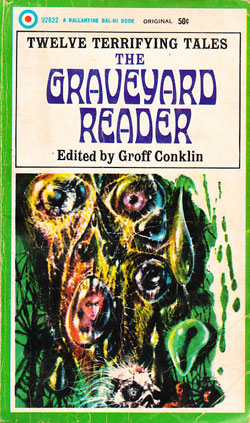
What follows is a relentless sequence of claustrophobic terror. Kuttner’s prose is stripped down but effective, evoking the choking darkness and shifting earth with dreadful precision. As Masson crawls deeper underground, his greed and fear fuse into panic until, finally, he becomes trapped in a tomb, unable to move forward or back, as the rats swarm closer. The ending is swift and merciless, a perfect punchline of pulp horror. I first encountered the tale in an old anthology called The Graveyard Reader, which I remember for its bizarre cover art and, even more, for the shock this short story delivered.

“The Graveyard Rats” is almost a model of what Weird Tales specialized in: concise, lurid, and designed to deliver a visceral jolt. It lacks Lovecraft’s cosmic scope and Smith’s luxuriant prose, but that simplicity is its strength. The story’s imagery touches on primal fears of the dark, the grave, the sensation of the earth closing in around you. It’s a morality play as well, reminding readers that greed and desecration invite their own form of damnation. Its lesson is as blunt as its prose, suggesting that there are worse fates than poverty and some appetites lead only to hell, if only metaphorically.

That bluntness is also what has kept "The Graveyard Rats" alive. Unlike many pulp horror stories, it doesn’t drown in adjectives or rely on elaborate mythologies. It is immediate, physical, and timeless. The same anxieties that drove readers in 1936 still have power today. Kuttner would go on to write more sophisticated stories, especially after joining forces with Moore, but “The Graveyard Rats” endures as a near-perfect exemplar of the pulp ethos. It’s a reminder that the pulps, for all their excesses, sometimes captured something essential about horror, namely, we are afraid of the dark and always will be.

Wednesday, October 1, 2025

October Thoughts

As I noted in my earlier post about The Grey Knight, now that it’s October, I feel the need to use this months as an opportunity to explore that in roleplaying games a little more than I usually do (which is actually a lot, come to think of it).

Now, I should be clear: I don’t have it in me to devote every post this month to horror in the way I did with The Shadow over August, when I spent the entire month examining Lovecraft and his legacy. That was an intense endeavor and, while that exercise was both fruitful and well-received, it also took a lot of work on my part. I'm simply not up to that so soon afterwards, especially with Gamehole Con coming up in two weeks (more on that later). 

So, this month, my approach will be lighter and more flexible. Horror will appear more frequently in my writing here, but it will coexist with discussions of all the usual topics I care about. That's in addition to my other ongoing work on both Patreon and Substack (which I recommend you check out if you like what I do here). 

One concrete way this will manifest is that the next four installments of Pulp Fantasy Library, starting next Monday, October 7, will turn to classic horror stories. These are tales I think worthy of attention, whether because they are historically significant, influential on later writers, or simply brilliantly unsettling. Some of them are well-known, others less so, but all have something to teach about fear, suspense, and the strange pleasures of the macabre – topics I think worthy of discussion during this month.

After these four horror-focused posts, I’ll return to looking at Lovecraft’s Dream Cycle stories in November, continuing a thread I hope some of you have been following since I restarted the feature after a long quiescence. In the meantime, consider this a kind of gentle “horror season." It won't be a deluge of posts on the topic, but there will be enough to remind us why the weird and the scary have long been a vital part of our games and our imaginations.

Thursday, August 14, 2025

Awe-ful

There is a particular kind of emotion that, in my experience, is easily forgotten in our world of algorithms and explanations but that once held a central place in human experience. I’m speaking of awe, not merely in its diluted modern sense, but in its original meaning: a mixture of wonder and fear in the face of something vast, strange, and beyond human comprehension. It’s a feeling that borders on the religious and it is the lifeblood of the weird and the uncanny.

H.P. Lovecraft understood this, perhaps better than most writers of the last hundred years. Through his work, he attempted to refine the weird tale it into a kind of secular mysticism, in which the cosmos itself becomes the site of both revelation and terror. In Supernatural Horror in Literature, he famously wrote that 

“The oldest and strongest emotion of mankind is fear, and the oldest and strongest kind of fear is fear of the unknown.” 

However, Lovecraft’s best stories do more than simply terrify. They evoke awe in its fullest sense, what he elsewhere calls a “certain atmosphere of breathless and unexplainable dread of outer, unknown forces.” When he describes beings whose very geometry defies human perception or ancient truths that shatter the minds of those who grasp them, he is evoking something far deeper than mere fright. He is pointing toward the sublime.

Sigmund Freud distinguished between the "uncanny" and the "familiar," noting how the former is not simply the unknown, but the strangely known, the familiar made alien. Lovecraft seized on this psychological dissonance and expanded it to include the entire cosmos. His monsters are not just unknowable; they are that which we once knew in some long-buried dream of pre-human memory. The sense of uncanny recognition is part of the horror. It is this effect, more than mere violence or gore, that marks the best weird fiction.

Of course, horror is only part of the equation. What often goes unspoken is how beautiful the weird can be. The shimmering city of the Elder Things beneath the ice of Antarctica; the dream-haunted vistas of Kadath; the mind-transcending journey of Randolph Carter through the stars. These are not scenes of mere terror. They are awe-inspiring in the truest sense – sublime and strange, but also profoundly glorious. Lovecraft understood that what we call horror and what we call wonder are not always distinct categories. The numinous is a threshold. The emotion it provokes may be colored by fear, reverence, or ecstasy or some combination of the three.

Naturally, this brings me to roleplaying games.

When I think back to my earliest experiences with RPGs, what strikes me most is how often they trafficked in awe. I'm not talking about desperate combats or puzzles to be solved, but fleeting and fragile moments when the game evoked something stranger and deeper. A mysterious door that could not be opened. A statue with eyes that seemed to follow you. A creature whose motives and nature eluded simple categorization. In those moments, even the purple prose of boxed text or the improvisations of a teenaged Dungeon Master could occasionally brush up against the ineffable. 

This is, I think, one of the great potentials of the roleplaying medium: its ability to resurrect feelings that modern life has largely anesthetized, like wonder before the uncanny. These feelings are not mere tropes to be mined, but modes of perception, ways of seeing the world as something deeper and more alive with meaning and strangeness.

Lovecraft feared the loss of these feelings in modernity. It's ironic that he is most famous for his fiction, because Supernatural Horror in Literature, an essay of literary criticism, is undeniably one of his greatest works. There, he laments the triumph of the merely rational in fiction and calls for a return to cosmic awe, a feeling that transcends individual psychology and touches something vast and impersonal. He believed that the weird tale could restore "the stimulation of wonder and fancy." It's no surprise, then, that his own work (and the many games it inspired) have done exactly that for generations of readers and players.

Perhaps that is the true function of the weird tale (or the weird game): to break through the crust of the mundane and let in something ancient, fearful, and magnificent. Weird tales remind us that the universe is, to paraphrase J.B.S. Haldane, not only stranger than we imagine, but stranger than we can imagine and that, in the face of that strangeness, we are still capable of awe.

Tuesday, August 12, 2025

"Lovecraft was not a good writer."

It’s a commonplace criticism of H.P. Lovecraft that his writing is overwrought and I can certainly understand why one might say so. His style is undeniably dense with adjectives, studded with archaisms, and includes unusual words like "eldritch" and "cyclopean" to cite just two obvious examples. These are old indictments. In a 1945 essay appearing in The New Yorker, the American literary critic, Edmund Wilson stated plainly 

"Lovecraft was not a good writer. The fact that his verbose and undistinguished style has been compared to Poe's is only one of many sad signs that almost nobody any more pays real attention to writing."

Many modern readers, including some who otherwise enjoy horror fiction, more or less agree with Wilson's judgment. On some level, there's more than a little truth to it, but I also think Wilson missed something essential about what Lovecraft was trying to do.

Certainly, Lovecraft’s prose is not plain. He does not describe a crumbling house or the whisper of wind through dead trees with, say, Hemingway’s economy. Instead, he piles on adjectives like charms against something too large and too old to be named. This is not accidental. Lovecraft was not a bad stylist. He was a purposeful one, even if he was not always a successful one. Any faults of his prose are, I believe, the byproduct of its ambition.

One of Lovecraft’s core preoccupations was with the limits of human understanding. His protagonists, whether scholars, scientists, or dreamers are nearly always brought to a precipice – of history, of knowledge, of space or time – beyond which lies something that cannot be fully grasped by the human mind. The horror in Lovecraft's stories is not simply monstrous; it is ontological. His stories revolve around experiences that are, by definition, indescribable. Despite this, they must be described, for the very simple reason that fiction requires language.

Faced with this paradox, Lovecraft responded in a way that makes perfect sense: he embraced inadequacy. His style is not polished to clarity but instead embraces excess. His adjectives are cumulative, not precise. His use of antiquated words is not an attempt at faux-scholarly authority, but a deliberate effort to suggest a register of experience outside the ordinary. The result is not always readable in the conventional sense, but it is evocative and that is the point.

In this way, Lovecraft’s prose functions almost like glossolalia or automatic writing. It does not persuade or explain. It reaches instead for effect. Its baroque qualities are not the product of ignorance or even bad taste, but of desperation. They're an attempt to use every available tool to conjure a feeling of cosmic awe or creeping dread. The occasional absurdity of his style, like the much-mocked “indescribable” things described at length, should not obscure the sincerity and power of his attempt.

One might say that Lovecraft was not writing about the weird so much as trying to write weirdly, if you can see the distinction. His stories are often most effective when read not for their literal content but for their cumulative mood, the way one might listen to a dissonant piece of music not to understand something, but to feel something. That he sometimes failed in this attempt is obvious. That he failed interestingly – and at times succeeded brilliantly – is equally so.

This does not mean that all criticisms of his prose are misplaced. Even Lovecraft himself was aware of his stylistic excesses and, in his letters, often laments them. However, to dismiss his writing as “bad” in some generic sense is to misunderstand both what he was trying to do and how radical it really was. His style was not an obstacle to his cosmicism. Rather, it was cosmicism writ large, trembling with adjectives and echoing with the voices of unnamable things.

Friday, June 13, 2025

Things That Go Bump in the Decade

This being the only Friday the 13th of 2025, I couldn't pass up the opportunity to muse a little about the spooky stuff I grew up with during my childhood in the 1970s, things that no doubt informed my continued fascination with the uncanny even today.

Back then, the world still seemed full of mysteries – or at least it was easy to imagine that it was. Stories of haunted houses, UFOs, Bigfoot, the Loch Ness Monster, and all manner of cryptids and bizarre phenomena were staples of popular culture. They filled the pages of supermarket tabloids, popped up in solemnly narrated TV specials, and circulated in schoolyard whispers. Even if few people truly believed in them, almost everyone enjoyed talking about them. The possibility alone was enough.

Looking back, it’s striking how pervasive the weird was in everyday life. I vividly recall garish paperbacks detailing “true” encounters with the unknown, cartoons and comics riffing on paranormal themes, and, of course, the ever-present influence of movies and television shows like In Search Of..., Project U.F.O., Kolchak: The Night Stalker, and The Amityville Horror, among many, many more. These stories occupied a curious space in the cultural imagination – not quite believed, not quite disbelieved either, and all the more compelling for it. They invited speculation, encouraged imagination, and cultivated a sense of wonder tinged with dread.

Even as a kid, I never bought into most of it. I didn’t spend my nights scanning the skies for flying saucers or lurking in the woods hoping to glimpse Sasquatch. But I wanted to believe, at least a little. The world felt more interesting, more alive, with those possibilities lurking just beyond the edges of certainty. What if there was something out there? That question alone was enough to fire my imagination.

And fire it did. By the time I discovered Dungeons & Dragons and, through it, other roleplaying games, I was already primed for them. After all, I’d spent years immersed in tales of mysterious creatures, unexplained lights, and restless spirits. RPGs gave me a new framework to explore those ideas, one where I wasn’t just reading or hearing the stories but helping to create them. I could conjure new monsters, new haunted places, new eerie events, and imagine how I or others might respond if the strange and uncanny ever crossed into our reality.

Today, that world of half-believed wonder seems distant, if not entirely gone. The Internet, with its unblinking capacity to record, debunk, and explain, has driven much of the weird to the cultural margins. Cell phone cameras are everywhere and the lack of blurry, ambiguous evidence speaks louder than all the old rumors ever did. Of course, being middle-aged hasn’t helped my credulity either. I’m more skeptical now, more prone to roll my eyes than widen them, but I still feel a twinge of wistfulness. There was a magic in those stories – the giddy unease, the delighted fear, the sense that the world might be stranger than it appeared and that something astonishing might be hiding in plain sight.

I don’t miss the bad haircuts or the shag carpeting, but I do miss that feeling, that delicious tension between belief and disbelief, the sense of possibility that once seemed to shimmer in the air. Maybe that’s why, even after more than forty years, I’m still rolling dice and spinning yarns of my own. I’m chasing that feeling, the thrill of stepping into the unknown, of turning the corner and finding that the world is bigger, weirder, and more mysterious than we’d dared to imagine.

On a superstitious day like today, I try to remember what it felt like to believe – not entirely, but just enough to wonder.

Monday, April 7, 2025

Mongoose Acquires Dark Conspiracy

Serendipity is a real thing. When I decided last week to write a Retrospective post about GDW's 1991 horror RPG, Dark Conspiracy, I had no advanced knowledge of today's announcement that Mongoose Publishing has acquired all the rights to it. This isn't exactly surprising. Once it was announced last summer that the company now owned the rights to Traveller (along with Twilight: 2000), I thought it inevitable that they'd also grab the rights to other former GDW properties. Still, it's nevertheless an odd little coincidence that I started thinking again about DarkCon after all these years.

According to the limited information available, Mongoose's re-release of the game won't be until next year. There's no official word on its rules, but I'd be amazed if it didn't use some version of the Mongoose Traveller rules, which are rapidly becoming the house system of the company. I'm fine with that, honestly. For all my complaints about the most recent iteration of the Mongoose rules, it's still a solid system and much better than Dark Conspiracy's original rules, which I never much liked. 

When I hear more, I'll be sure to share that information here. 

Thursday, April 3, 2025

Yellow Journalism

Here's another strangely prescient sidebar from that Dark Conspiracy preview insert that appeared in issue #47 of Challenge (December 1990). This is obviously dated from a socio-technological standpoint. In 1991, when the game was released, the consumer Internet barely existed, but the writing was already on the wall by that point, even if most people hadn't realized it yet. 

Wednesday, April 2, 2025

"I've Got a Really Swell Life."

Here's one of the more evocative sidebars from the Dark Conspiracy preview appearing in issue #47 of Challenge magazine (December 1990).

Retrospective: Dark Conspiracy

My history with roleplaying games is littered with games I desperately wanted to like but that, for one reason or another – sometimes many reasons – I simply couldn't. A prime example of what I'm talking about is Dark Conspiracy, a near-future horror RPG released by Game Designers' Workshop in 1991. Even now, more than three decades later, my feelings about Dark Conspiracy (or DarkCon, as it was often abbreviated back in the day) are complicated, so complicated, in fact, that I'm not entirely sure how well I'll be able to articulate them in this post. Please forgive me if what follows is more rambling than usual.

Let's start with some context. At the turn of the 1990s, the RPG world was in a state of transition. Arguably, that's been the default state of the hobby since its inception, but I think it's fair to say that, by the last decade of the 20th century, the times, they were a-changin'. Signs of the decline in the dominance of both Dungeons & Dragons and TSR were, by this time, becoming obvious and this created an opening for new games, new companies, and new approaches to roleplaying. 

Of course, TSR wasn't the only venerable RPG company to show signs of decline as the '90s dawned. Game Designers' Workshop was another one. Founded in 1973 as a wargames publisher, GDW nevertheless entered the roleplaying market quite early, when it released Traveller in 1977, only three years after the appearance of OD&D. However, by 1991, the fortunes of Traveller – and GDW along with it – were in doubt. Traveller was stuck in the doldrums of the Rebellion Era established by MegaTraveller and it was clear that something had to be done to reinvigorate the moribund game line. Likewise, history had caught up with Twilight: 2000. The fall of the Berlin Wall in 1989 put into serious question the game's speculative history of World War III, resulting in a second edition in 1990 that not only altered its timeline to bring it closer to reality but also changed its entire rules system.

Larger cultural shifts were also at play. The winding down of the Cold War, the rapid advance of computer technology, and the impending arrival of the new millennium fueled widespread anxieties. Some of these found expression in the cyberpunk genre, with its visions of corporate tyranny and technological alienation. Others surfaced in conspiracy theories about the New World Order, UFOs, and even apocalyptic religious prophecies. Like many turn-of-the-century moments, it was a chaotic, uncertain time, equal parts thrilling and unsettling. I was just entering adulthood then, and I remember the early '90s with strange affection. On bad days, I find myself longing for those times.

Enter Dark Conspiracy. Written by Lester W. Smith, Dark Conspiracy attempted to fuse cyberpunk’s dystopian corporate control with supernatural horror and alien invasion. At first glance, it seemed to be the perfect game for the era: a paranoid, near-future setting in which America had collapsed into vast urban metroplexes and lawless wastelands, while eldritch entities known as the Dark Ones manipulated humanity from behind the scenes. Thematically, it was an ambitious blend of Cyberpunk and Call of Cthulhua world where high technology coexisted with conspiracies, cults, and Lovecraftian nightmares.

In its published form, however, Dark Conspiracy was a game of contradictions. Its setting concept was rich and evocative, but its execution was often unwieldy. GDW, perhaps trying to draw on its existing fanbase, built the game’s mechanics on the same ruleset as the second edition of Twilight: 2000. While that system (which came to be known as the "House System") worked well enough for military survival scenarios, it was clunky and a poor match for horror gaming in my opinion. Character creation was detailed but slow, leaning heavily on a career-based progression system that felt more suited to military campaigns than to the investigative horror that Dark Conspiracy promised. Likewise, combat was intricate – perhaps overly so – while supernatural and investigative mechanics felt like an afterthought by comparison.

Despite these flaws, Dark Conspiracy had undeniable strengths. Its setting, which painted a grimly fascinating picture of a broken America where the supernatural lurked at the fringes of perception, held a lot of possibilities, even if they were never fully realized. The game encouraged a mix of adventure styles, from corporate espionage to alien-hunting and post-apocalyptic survival. In some ways, it was ahead of its time, prefiguring the pop culture explosion of conspiracy fiction that would define the late '90s and early 2000s. Remember that the genre-defining television series, The X-Files, wouldn't air until 1993, two years after the publication of this game. People often use the phrase "ahead of its time" too casually, but, in this respect at least, Dark Conspiracy earns it.

The game never quite found its footing. GDW supported it with a range of supplements, including adventures and setting expansions that deepened its world, but they were uneven both in terms of quality and their portrayal of the game world. Some, for example, suggested that its early 21st century setting was not too dissimilar to the real 1990s but with slightly more advanced technology, while others implied much greater social and technological changes. Early promotional materials for the game in the pages of Challenge painted a very dark, even bleak, picture of the setting, where vast swaths of the world had been largely abandoned and given over to the Dark Ones and their human co-conspirators and minions. Unfortunately, the published game was inconsistent on this point, which hampered my enjoyment of it. 

This is a great shame. As I mentioned at the beginning of this post, I really wanted to like Dark Conspiracy. In principle, it's a perfect mash-up of lots of ideas and genres that are right up my alley – science fiction, horror, dystopianism, conspiracy theories, and more. The potential of the game is immense and, especially at the time of its original publication, it managed to tap into an emerging zeitgeist. If only it had been better – better rules, better presentation, better adventures – it's possible that it could have made a bigger splash and helped lift GDW out of its doldrums. Alas, that was not meant to be and I'm left only with my conflicted feelings. 

Monday, February 3, 2025

Terror Was Never This Much Fun

From issue #86 (June 1984) of Dragon comes one of the first advertisements for Pacesetter's horror RPG, Chill, that I ever saw. The accompanying artwork, by the late, great Jim Holloway, is quite effective, though it's a bit unclear where the mutton-chopped fellow is standing. Is he standing in an open grave? If so, where's that sinister hand coming from? If he's not, where are the gentleman's legs? So many questions!

Thursday, October 31, 2024

REPOST: Fantasy is Frightening

(This month, I'd intended to write a longer post about the domestication of horror and frightening things in our popular media, including RPGs, but, as so often happens, time slipped away and here we are on Halloween and I never wrote that post. I still intend to write it; I just can't be sure when. In the meantime, enjoy this old post that touches on the topic. –JDM)
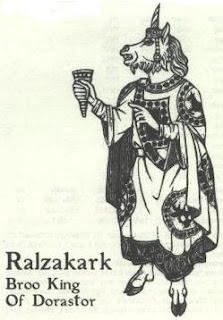
In RuneQuest, there is a race of beings known as Broos or goatkin. In my second edition rulebook, they're described as
Human-bodied and goat-headed, [they] ... are tied irrevocably with the Rune of chaos. They are given to atrocities and foul practices, and carry numerous loathsome diseases.
Broos have the ability to procreate with any species, intelligent or otherwise, with the resulting offspring taking characteristics from both its Broo and non-Broo parent. Most Broos in the Dragon Pass area (the area of Glorantha originally most detailed in RQ's early materials) have the heads of goats and other herd animals, hence their nickname, but Broos come in a variety of types, depending on their parentage.

Anyway, during the RuneQuest Renaissance of the '90s, a product was put out for RQ3 called Dorastor: Land of Doom, which detailed a Chaos-tainted land to the south of the Lunar Empire. As I've stated several times before, I never played much RuneQuest at any time, but I was often interested in it. Just before Avalon Hill was purchased by Hasbro in 1998, the company was selling off its stock of RuneQuest materials in very cheap -- and hefty -- bundles. I bought them out of curiosity and it was then that I first read Dorastor. The supplement included a NPC known as Ralzakark, leader of Dorastor and king of the Broos.

For reasons I can't fully articulate, I found Ralzakark quite frightening. Perhaps it was because he had the head of a unicorn, a creature normally associated with purity and goodness. Perhaps it was because he was an urbane, sophisticated creature unlike his subjects. Whatever it was, Ralzakark frightened me. I don't mean scared in that ooga-booga-monster-in-closet sort of way; I mean in some psychological/emotional way. Ralzakark was a disturbing NPC -- and fascinating too. For all I know, I may be the only person who finds the Unicorn Emperor of the Broos unnerving, but I suspect not. I know of many people who find the Broos more than a little creepy and Ralzakark's inversion of many of the known facts about these creatures probably does unsettle people besides myself.

This got me to thinking about how the best fantasies, the ones that really stick with me, are frightening on some level. Shelob, in The Lord of the Rings, frightens me and so does Gollum, come to think of it. They both touch on things within my psyche that I'd rather not think about and force me to confront them. Most of us, I imagine, need to do this from time to time, which is why I think it's healthy for children's stories to include frightening elements. It's the same reason I think RPGs shouldn't shy away from being frightful. That's not all they should be, of course. Still, I think they're a lesser entertainment than they can be if they neglect to include things to unnerve us from time to time.

Thursday, May 2, 2024

Scary Enough

I'm a big fan of the horror genre, whether books, movies, or roleplaying games. As a kid growing up in the 1970s, horror and the occult were in the air, so it was difficult not be exposed to it. Consequently, when I saw the first advertisements for Call of Cthulhu in 1981, I knew I had to get a copy. CoC quickly became one of my favorite games, joining Dungeons & Dragons and Traveller to form the Holy Trinity of RPGs from my youth. In the years since, I haven't played Call of Cthulhu as much as I've used to, but I still regard it very highly and hope one day to have the chance to play it again.

One of the interesting things about horror RPGs is that almost no one who plays them is ever really frightened. Someone might play his character as if he were frightened, but I don't think I've ever seen anything in a game genuinely scare a player, at least not deliberately. That never really bothered me, because, let's face it, it's not that easy to induce fear while sitting around a table in a well-lit room with a bunch of your friends. Plus, would it even be fun to play a game where you're routinely frightened in the way you might be watching a movie or reading a book? 

Even so, there's always been part of me that, as a referee, has wondered about the question of why we play horror RPGs and what we hope to get out of them. That's why I was so taken with a section in the Warden's Operations Manual for the new edition of the sci-fi horror game Mothership that addresses this very issue:

Actually scaring your players, like they might get scared watching a horror film or playing a video game is an incredibly rare thing. It is not a measure of a successful game night. Most of the time, your players simply want to have fun in a horror setting. This means they want to play characters who feel afraid, while they the players sit back eating chips and rolling dice. Sometimes you have players who love to be scared and really get into it. If that's the case, enjoy it! But don't feel bad if it doesn't happen every week. Instead focus on keeping the tension escalating.

I think this is quite close to the truth of it, at least as I've experienced the play of horror RPGs over the years. The horror present in your typical Call of Cthulhu scenario, for example, is largely intellectual rather than emotional. Very few players will ever feel frightened or disgusted by events in the game, even if they understand that their characters, being ordinary people, would probably feel those things within the context of the game world. This makes for a better roleplaying experience in at least two respects. First, it doesn't set the bar so high for the referee that he'll never achieve "success." Second, it helps maintain a little distance between the players and the often horrific things with which their characters must deal.

That said, even highly intellectualized fear, horror, and revulsion are all useful tools for the referee in presenting an engaging setting and/or scenario. After all, fantasy can be frightening and confronting frightening things in a fictional context can be very appealing to a lot of people, especially those among us who are normally not very brave. In that respect, it's not much different than the more general experience of fictional danger found in many common RPG activities, like combat or exploration. It's fun for our characters to do or to endure things that we'd never be able to or indeed want to, isn't it?