Showing posts with label wells. Show all posts

Friday, July 11, 2025

From the Brontës to Braunstein

The history of roleplaying games is, by now, well known, at least in broad outline. In the early 1970s, a handful of imaginative wargamers, drawing on a variety of inspirations, both literary and ludic – I hate jargon like that but I can think of no better word – devised a new kind of game. What began as an offshoot of miniatures wargaming blossomed into something wholly novel: Dungeons & Dragons, the first roleplaying game and the start of an entirely new hobby. What’s less often asked is whether something like D&D could have arisen earlier. Could roleplaying games have been invented, not merely in embryonic form, but recognizably so, decades before their actual debut?

It’s a question I was recently asked by a reader via email, though, as I told him in my reply, it's also one I've mulled over many times myself. On the one hand, it seems completely plausible. Human beings have always told stories, assumed roles, and imagined themselves as other people. On the other hand, roleplaying games, as we understand them today, require more than just imagination. They require rules, structure, and a framework for shared storytelling that’s open-ended but repeatable, not to mention playable by groups of people. That’s a tall order and one, I suspect, that might not have been fulfillable much earlier than it actually was.

Even so, I think it's a question worth exploring, as I told my correspondent. That's why I decided to devote this post to the topic, including some brief speculation about just what a roleplaying game produced prior to 1974, had it been created, could have looked like.

Before doing that, though, I wanted to offer a rough definition of what I mean by a "roleplaying game." To my mind, a roleplaying game is not just a game with characters or a narrative, but one in which players assume the roles of imaginary personas within a shared, evolving, fictional world. There must also be open-ended interaction with that world, adjudicated by a set of rules or by a human referee (probably both). In other words, the game must provide a mechanism for ongoing collaborative storytelling that can generate new situations, rather than merely following a pre-written script.

We can quibble about my definition and, truth be told, I'm not entirely happy with it, but I think it's good enough for my present purposes. Given the parameters, then, under what conditions could such a thing even arise?

To start, there must be a culture of play – not just childhood play, but adult leisure time devoted to structured, often abstract, pastimes. This criterion, I think, narrows the field considerably. While games of all kinds are ancient, hobby gaming of the kind that leads to things like miniatures battles, science fiction conventions, or fanzine communities is a fairly recent phenomenon. Prior to the mid-20th century, hobbies tended to be solitary (e.g. collecting stamps, building model trains) or social but formal (e.g. cards, chess, sports). The idea of imaginative, improvisational group play as a serious adult pursuit was likely a bridge too far for most societies until not all that long ago.

Then there is the economic component. RPGs are, by their nature, complex. They typically involve rulebooks, paper, dice, pencils, maybe miniatures, and a steady stream of new materials to read and incorporate. All of this presupposes access to affordable printing, widespread literacy, and sufficient disposable income to indulge in what is, quite frankly, a non-essential pastime.

Add to this the influence of fantasy literature, particularly the kind that fosters immersion in imaginary worlds. While such literature absolutely existed prior to the 20th century – my Pulp Fantasy Library series includes multiple examples of what I'm talking about – the genre had not yet reached the critical mass needed to inspire a broader movement of readers-turned-creators. That wouldn't come until the rise of the pulps and, later, the mass popularity of J.R.R. Tolkien.

All of which is to say: I don’t believe roleplaying games were inevitable. Nor do I believe they could have arisen all that much earlier than they did. Nevertheless, there are a few intriguing possibilities worth considering.

Of all the earlier eras that might have given rise to something resembling a roleplaying game, the Victorian period is perhaps the most plausible. The Victorians were inveterate hobbyists, fond of catalogs, elaborate parlor games, and gentlemanly pastimes pursued with a zeal that often bordered on the obsessive. More significantly, they were among the first to develop formal wargames, none more famous than H.G. Wells’s Little Wars, published in 1913 (technically, post-Victorian, but I'm OK with that).

While Little Wars lacks the improvisational openness and character-centered focus of a true roleplaying game, it nevertheless offers tantalizing glimpses of the path not taken. For example, it encourages the invention of fictional armies and, by implication, fictional countries to support them. Wells himself recounts some of his battles in narrative terms, portraying himself and his opponents as imaginary generals leading imaginary forces, complete with strategic dilemmas and dramatic turns of fate. In this, one can detect the germ of roleplaying. With a slight cultural shift and a bit more emphasis on character over campaign, one can almost imagine Little Wars evolving into something more like a roleplaying game.

One might also consider the games of the Brontë children, consisting of invented worlds, described through stories, poems, and letters. Inspired by a set of toy soldiers given to Branwell Brontë in December 1827, the siblings each created an imaginary kingdom, complete with its own geography, history, and cast of recurring characters. These were private amusements rather than games in any formal sense. There were, for instance, no rules or adjudication, but they demonstrate that the impulse for immersive, serialized storytelling existed, even among children raised in relative isolation. The Brontës' creations are reminiscent in some ways to a referee’s campaign setting, continuously expanded and revised over time and in response to changing events within it.

What’s striking about these two examples is how each contains one half of what roleplaying games would eventually become. Wells provided rules and structured play, but his battles lacked characters in the personal, individual sense and unfolded largely without narrative continuity beyond what the players themselves imposed. The Brontës, by contrast, created intricate, evolving worlds filled with characters and stories, but they did so without any formal rules or mechanisms for shared adjudication. In both cases, the essential components were present but disconnected: storytelling without structure and structure without storytelling. What was lacking was a bridge between these imaginative impulses and the domain of systematized, collaborative play, a framework that could make private fantasy into a repeatable, transmissible experience shared by many. The alchemy of open-ended narrative bound to procedure – the heart of roleplaying games in my opinion – had not yet been discovered.

It was not until the interwar period that some of these conditions began to change. The rise of pulp magazines introduced vast new audiences to tales of fantasy, science fiction, and weird horror. These stories, though often formulaic, laid the groundwork for shared genres and tropes. Even more important were the fandoms that grew up around them, through letters columns, conventions, and amateur press associations. Consider, for example, that H.P. Lovecraft met some of his closest friends, many of whom went on to become influential writers of fantasy and science fiction themselves, through APAs to which he belonged.

These fan communities did more than read. They created. They wrote fiction, debated continuity, argued over setting and character details, and occasionally even imagined themselves in the worlds they loved. This tendency only deepened after World War II, as mass printing and distribution became cheaper and more accessible and science fiction and fantasy matured as genres. Early versions of LARPing, the Society for Creative Anachronism, and the first fantasy board games all emerged from this stew of fannish creativity. It is no accident that Gygax and Arneson also came from this world. Without it, Dungeons & Dragons could never have been created or, if it had been created, would never have found a large audience.

Had someone in the 1930s or 1940s attempted to create a roleplaying game, I suspect it would have looked very different from what we know today. Possibly, it might have taken the form of an elaborate correspondence game, with players sending letters in-character to a central referee, who adjudicated events and mailed back results. Alternately, it might have resembled a parlor game with scripted outcomes. In any case, I suspect it would have remained confined to a small circle of friends, passed between them alone and never published. All of these are intriguing counterfactuals, of course, but they also highlight how contingent the birth of the RPG truly was. It required more than creative individuals. It required the right cultural, economic, technological, and especially social context.

Could roleplaying games have been invented earlier than they were?

In theory, yes. In practice, I highly doubt it. Too many of the prerequisites simply weren’t present until the 1960s and early ’70s: the widespread embrace of fantasy fiction, the do-it-yourself ethos of fandom, the democratization of leisure, and a new cultural openness to improvisation and play. It’s tempting to view RPGs as inevitable, as something that had to happen, but history rarely works that way. In another timeline, Gary Gygax might have remained an insurance underwriter and Dave Arneson a gifted but obscure tinkerer with wargames rules. The creation of Dungeons & Dragons was, in many ways, a happy historical accident.

Even so, it's fun to imagine a world in which Edwardian gentlemen gather in a smoky drawing room, taking on the roles of Martian adventurers or subterranean explorers, while a bespectacled referee consults a sheaf of densely typed rules from behind a screen and invokes the power of the d12. Alas, it never happened nor was it likely to have done so.

Monday, September 9, 2024

Flighty Elves and Bearded Dwarven Ladies

The astute among my readers might have noticed that the Boot Hill advertisement I shared earlier today appeared in the August 1979 issue of Dragon, the same month that the AD&D Dungeon Masters Guide was released. To mark this occasion, issue #28 includes an article in which TSR employees who had even a small hand in the completion of the DMG offer their opinions on the finished product. There's a lot of interesting stuff in the article, some of which might make good fodder for a future post. For the moment, though, I want to draw your attention to the comments offered by Jean Wells:

The section to which Wells refers is actually entitled "Player Character Racial Tendencies" and begins at the bottom of page 15 and continues on to page 16. Here's the section about elves that she so disliked:

It's pretty innocuous stuff in my opinion. Gygax explicitly calls his descriptions "guidelines" Moreover, he points out that many other factors, such as alignment, will have an impact on a character's personality. For myself, this description of elves is perfectly fine, if somewhat different than the one that was probably already common in 1979. The same holds for his description of dwarves:
The question of whether female dwarves have beards in Dungeons & Dragons is much an ancient one, as evidenced by the last sentence of Wells's comments. In truth, I have no strong feelings about it myself, but I do find it fascinating the strong emotions, pro and con, that this rather esoteric dispute elicits in some corners of the hobby. 

Tuesday, July 25, 2023

Polyhedron: Issue #2

Issue #2 of the soon-to-be named RPGA Newsletter (Autumn 1981) features a cover illustration by Stephen D. Sullivan, depicting an unfortunate encounter with a bathing nymph. Sullivan tends to be forgotten as a TSR artist, probably because his contemporaries, like Erol Otus, Jeff Dee, and Bill Willingham, all loom larger in our collective memories of the late '70s and early 1980s. Consequently, I always enjoy seeing his artwork and being reminded that, yes, TSR did in fact employ other illustrators at that time.

"Dispel Confusion" continues, though this time all the questions pertain to AD&D and are answered by Gary Gygax. Whenever I read columns like this, I'm always struck by just how different my own early experiences of roleplaying games must have been compared to those of others. Undoubtedly my friends and I were doing it wrong, but we rarely focused on the minutiae of rules interpretation and, on those occasions when we did, we never even considered the possibility of asking TSR for an "official" clarification. I've always played RPGs in a rather fast and loose fashion, trusting in common sense and on-the-fly judgment to fill in any gaps. Call me weird.

Speaking of Gygax, the second part of the interview begun in the previous issue appears here. As with the previous installment, this one is quite interesting, particularly for those of us interested in the history of the hobby. For example, Gygax talks a little bit about his work on AD&D module T2, which, of course, he never finished himself, handing it over instead to Frank Mentzer. He also mentions "the plane modules I want to do. I want to do the elemental planes, para-elemental planes, demi-planes and semi-planes, and demi-semi-planes, et cetera ..." Of all the D&D products that never were, my own thoughts drift most often toward Gygax's planar modules and supplements. I would have loved to see what he'd have done with the concept, since, from other statements he made over the years, it's clear he saw the planes as the playground of high-level characters in AD&D and that sounds terrific.

Mike Carr's "Dawn Patrol™ Preview" focuses on the creation of pilots for use with the upcoming game of World War I aerial combat. It's basically a two-page excerpt from the soon-to-be-published game, hoping to generate interest in it. Much more interesting is "How to Create Monsters for D&D® Basic and Expert Games" by Jean Wells. Wells explains that, because D&D, unlike AD&D, has comparatively few monsters, referees are likely to want to create new ones, but there's a lot to consider when doing so. She then devotes a nearly two-page article discussing various aspects of D&D monster design as she creates a new monster step-by-step. I like articles that balance the theoretical with the practical and this one does that nicely. It's also a reminder that Jean Wells was a much better designer and writer than she's often given credit for.

"Turnbull Talking" is a reprint of a short article by Don Turnbull, head of TSR UK at the time, in which he talks – rambles is perhaps more accurate – about the growth and development of the larger hobby. It's really a space filler rather than a substantial article. On the other hand, "Mutants: A Representative Sample of the Weak Ones" by James M. Ward is quite meaty. Ward presents a variety of new opponents for use with Gamma World. Despite the title, not all of these opponents are mutants, nor are they in any sense "weak." All, however, are imaginative and make me wish that, during his time at TSR, Ward had produced more support material for Gamma World. It is a mystery to me why he did not.

Also included in the issue is a RPGA Gift Catalog, featuring many of the items listed here. To this day, I wish I'd bought the "fighters wheel" gadget. "Notes for the Dungeon Master" includes more tricks and traps for use by the referee in his dungeons, as submitted by Polyhedron readers. It's amazing to me how many of these tricks are intended to foil or frustrate mapping – a reminder, I think, of just how important good cartography was in the early days of D&D. "Top Secret Transmissions" by Allen Hammack talks a bit about the popularity of "commando raid" missions for Top Secret, in part because of how much players enjoy loading their characters up with lots of weaponry. What Hammack says is true in my own experience and may go some way toward explaining why espionage RPGs have never been as popular as the books and movies that inspired them.

This issue's installment of "Rocksnoz" by Tom Wham is not a comic but rather a bit of background about the setting of the comic itself. Wham explains that, "in this very universe, before the last big bang, there was a world very similar to ours." This world, called Nidd, was inhabited by intelligent beings called "huemans." Despite its similarity to Earth, on Nidd "no chemicals combine to make gunpowder, and nuclear weapons are impossible. To make up for this deficiency, the denizens of Nidd have turned to magic." It's an odd little article but a strangely fascinating one, if only to see into the mind of Wham and his conception of fantasy. Finally, there's "The RPGA Scoring System," which lays out recent changes to the way that the RPGA evaluates players and DMs in its tournaments. Since I'm unfamiliar with the original system, I can't say this article held much interest for me, but it's probably of interest to those looking into the history of organized play.

Issue #2 of Polyhedron predates the years when I subscribed to it, so much of what's in it is new to me. What's most notable about it is its roughness. Were it not published by TSR and filled with articles by its staff, it'd be hard to tell it apart from a high-end fanzine of the same era. I think that's what's most appealing about it and why I look forward to exploring it over the coming months.

Thursday, June 8, 2023

Manual of Fear and Death

The first AD&D book I ever owned was the Monster Manual. I bought it with money my grandmother had given me for Christmas 1979, ordering it through the Sears catalog. Once my copy arrived, sometime in early January 1980, I spent untold hours poring over its contents. Though I, of course, loved all the descriptive material contained in the book's 112 pages, it was the illustrations that truly seized my imagination – so much so that, to this day, it's difficult to conceive of many Dungeons & Dragons monsters in any way other than how Dave Sutherland, Dave Trampier, Tom Wham, and Jean Wells drew them. 

One aspect of the Monster Manual's artwork that grabbed my youthful attention was how often it depicted fear and death. Consider, for example, the piece accompanying the book's title page:

Here, we get three knights in historical armor facing off against a bulette. Beneath the landshark's front right claw, you can see the corpse of a horse (perhaps belonging to one of the two unmounted knights in the foreground). It's a small detail, seemingly unimportant, but it's the first example of a recurring motif in the Monster Manual's illustrations: facing off against monsters is perilous.

Again and again, you see this throughout the book: monsters frightening, harming, or killing those who dare to challenge them – often in unexpected places, like this one.
Those are giant ants and look how they use their large numbers to overwhelm their opponents, as do stirges in another memorable illustration.
Of course, not all low-level monsters rely solely on numbers to get the better of their enemies. Take a look at this pixie.
Being surprised by a lurking monster is another common element of Monster Manual illustrations, like the classic mimic preparing to punch the unfortunate thief attempting to open a "chest."
But there are many others in this style as well.

I could offer many more examples from the book and I'm sure readers will remember some of their own favorites. I adored these kinds of illustrations as a younger person, in large part because they emphasized the danger posed by monsters, even things as seemingly innocuous as giraffes.
Everything in the Monster Manual was a potential threat to life and limb and I can't tell how exciting that was to me as a budding Dungeon Master. While I was never a killer DM, I nevertheless did revel in seeing the looks of horror on players' faces as they realized what their characters were up against. Descending into a dungeon or wandering off into the wilderness is supposed to be frightening to some degree. A big part of the appeal of games like D&D, especially for young people, is being able to face those frights vicariously. That's part of why horror movies continue to be so popular, I imagine, particularly as the real world becomes ever safer and more sanitized. Something in our nature atavistically craves, maybe even needs fear and danger. Monsters in fantasy roleplaying games should give us a chance to experience both. 

Wednesday, August 24, 2022

The Sage Disagrees

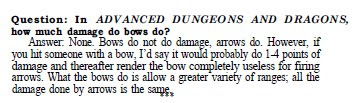
The "Sage Advice" column in issue #33 of Dragon (January 1980) contains the following question and answer:

The question itself is a genuinely interesting one, as I don't believe either the Players Handbook or Dungeon Masters Guide explicitly answers it (as always, please correct me in the comments if I am mistaken). More interesting, though, is the answer by the Sage (Jean Wells), where she states both the official rule and her own disagreement with it, along with her preferred interpretation. During her tenure as the Sage, Wells often expressed her own opinions, often drawing on her experiences playing Dungeons & Dragons. However, I can't recall any other time where she admitted to disagreeing with the official rules and then offering her alternative.

Simply from a historical perspective, this is remarkable. With the publication of the DMG in August 1979, AD&D is complete and that completion ushers in the era of wholly official answers to any question one might have about the rules. This is the Everything-I-say-is-God's-Holy-Word era, which makes it all the more striking that Wells would state her disagreement in such an unambiguous way. I suspect this might be because Wells began playing D&D quite early, in the wild and woolly age of "why have us do any more of your imagining for you?" Her job required her to state the official answer and so she did, but she was still very much a woman of the afterward [sic] to the 1974 rules. 

Friday, August 19, 2022

Dear Abby

From "Sage Advice" column of Dragon #32 (December 1979) by Jean Wells:

Friday, August 12, 2022

Sage Smackdown

The "Sage Advice" column of Dragon was often of interest to me in my youth, largely because I wanted to know the "right" way to interpret the rules of D&D and (especially) AD&D. While Jean Wells acted as the magazine's Sage, there was a certain semantic bluntness to many of her replies. Take, for example, this one from issue #39 (July 1980): 

Wells minces no words about the fact that, in Advanced Dungeons & Dragons, there is no such thing as either a lawful neutral or a dwarf paladin. How could she say otherwise? The entire purpose of the "Sage Advice" column was to present the "official" answer to readers' questions and that's the official answer. If you wish to play AD&D by the book, as Gygax intended, you don't allow either lawful neutral or dwarf paladins in your campaign. End of story.

Of course, that raises another question: do you wish to play AD&D by the book? In my experience, not many people did, mostly out of an unwillingness to be bound by each and every rule presented in the rulebooks, some of which were, I don't think it can be denied, difficult to understand. I know it's popular in some circles to suggest that AD&D simply cannot be played "by the book," should one be desirous to do so. I don't think that's true at all, though, as I said, I rarely encountered instances of it. Even now, I suspect it's quite uncommon among all but the most dedicated referees and players.

I don't see this as good or bad one way or the other. I think there are benefits and drawbacks of strict "by the book" play, just as there are benefits and drawbacks of more flexible (for lack of a better word) approaches to the game. Mind you, I am temperamentally much better suited to the "non-game" of Original D&D than the highly structured baroqueness of AD&D, so perhaps I am not fit to judge the matter. I can only say that, while my younger self, cared deeply about playing the game the "right" way, nowadays, I care more about playing it my way.

Tuesday, May 11, 2021

Different Worlds: Issue #14

Issue #14 of Different Worlds (September 1981) opens with "Judges Guild and D&D" by Patrick Amory. This is an unusual article, in that it offers an overview of all the Judges Guild D&D/AD&D products, with an eye toward drawing attention to the best ones. This is necessary, in the opinion of the author, because "the Guild has always sacrificed quality for quantity." He hopes to save the reader the need "to wade through masses of rubbish, poor art, and typoes [sic]" before finding a genuinely useful product. That's harsh but fair. The full article is five pages long and singles out those Amory considers especially worth, such as City-State of the Invincible Overlord, City-State of the World Emperor, Tegel Manor, Caverns of Thracia, and First Fantasy Campaign, among a few others. 

"Character Personality Profile" by Mark Lukens presents a system for rating the personality, attitudes, and interests of a character, whether player or non-player. The system is usable with multiple RPGs, since Lukens provides multiple rating scales (2d6, 3d6, d20, d100). The system reminds me a bit of the opposed personality traits system presented in Pendragon, albeit in a less developed form. It's not bad for what it is and I imagine many referees would find some utility in it.

Richard L. Snider offers a preview to the second edition of Adventures in Fantasy. The article is mostly interesting as a historical curiosity, since, unless I am mistaken, this second edition was never published. "Painting Miniature Figures" by Robin Wood is a lengthy but fascinating article, complete with photographs, about the process of painting figurines for use with roleplaying games. Lewis Pulsipher's "Taverns and Inns" provides a system for randomly rolling up drinking establishments – everything from their size to proprietors to patrons. "Familiars" by David F. Nalle provides a handful of short tables for generating familiars, including unique ones. 

"Plausible Geography for Role-Playing Games" by George Hersh is a surprisingly short article, consisting mostly of a recommendation to acquire copies of United States Geological Survey topographical maps to use as the basis for adventure maps. "Come, Clash with the Titans" by Larry DiTillio provides AD&D and RuneQuest stats for the monsters and opponents from the 1981 movie, Clash of the Titans, along with magic items and scenarios employing them. The issue also includes reviews of the Traveller double adventure Argon Gambit/Death Station and Grimtooth's Traps. 

Gigi D'Arn's gossip column includes quite a few tidbits this issue, starting with rumors that "SPI is losing money rapidly," which is why it is trimming its staff. Gigi also mentions Avalon Hill and Heritage had supposedly made bids on the company. There's also this story:

This is a reference to the module, Palace of the Silver Princess, about which Jean Wells talked a bit in my interview with her some years ago. I find this fascinating, since, at the time, I had absolutely no idea there was any controversy regarding the module. It was only sometime this century that I became aware of and I still sometimes can't believe it actually happened.

Issue #14 is an improvement, in my opinion, over issue #13. There's a great deal more immediately useful gaming material and not a single "theory" article, which is a welcome change. It's worth mentioning that editor Tadashi Ehara began the issue asking readers to send him letters indicating what games they play and which articles they have found most enjoyable. This suggests that Ehara was well aware of the need to better balance in the magazine's content. It will be interesting to see how things unfold in the next few issues.

Thursday, August 20, 2020

Sage Words

The late Jean Wells inaugurated the first "Sage Advice" column in issue #31 (November 1979) of The Dragon. About the purpose of the column, she stated,
I hope to answer many questions that people may have on their minds about D&D or AD&D. Part of my job at TSR is answering questions about the game, and sometimes refereeing a dispute between players and their DMs.
While this might seem like a exercise in tedium, particularly in light of statements by Gary Gygax and others that implied Advanced Dungeons & Dragons would possess clear and unambiguous rules (lest it become a "non-game" like its predecessor), it was not, thanks in large part to Wells's humor. Take, for example, her answer to the second question ever asked in the column.

Here's another amusing entry in that very first column. Taken together, I think they set the tone for her tenure as the Sage.
Wells once explained why she wrote her columns with a certain playfulness:
 I adopted this approach because this is who I am. I tend to look at humor in life. I believe in laughter especially when things are taken out of context and way over done. I chose the strangest most far fetched questions for two reasons. One, they were funny, and two they were also a sad statement on the depths that some people played this "game."

I felt the youngsters under the age of sixteen were spending far too much time being far too serious about a game when they needed to focus some of that attention back on their families and schools. I'd hoped the kids would see the humor in the situation and not take the game so seriously that every breath they took, every word they said was about D&D. 

Monday, September 3, 2012

Pulp Fantasy Library: Edison's Conquest of Mars

When I was a child, one of my favorite stories was The War of the Worlds by H.G. Wells, which I knew from original 1898 novel (and whose opening lines I can still quote from memory to this day) and the 1953 movie I must have one Saturday afternoon while visiting my grandmother. To say that the book had a huge impact on my youthful imagination would be an understatement; for many years after first encountering it I had dreams -- or, perhaps more accurately, nightmares -- of alien invasions of Earth. This is probably what has fueled my lifelong interest in UFOs, extra-terrestrials, and ancient astronauts. And while I'm considerably more skeptical of such things today than I was then (which is to say I don't believe in them at all), I nevertheless retain a great fondness for Wells's masterpiece.

Consequently, when I recently learned of the existence of an unauthorized sequel to The War of the Worlds, also published in 1898, I was greatly intrigued. Called Edison's Conquest of Mars, the novel was written by Garrett P. Serviss, an American astronomer, and was initially serialized in the New York Evening Journal. It was later collected together and published as a whole in 1947 by Carcosa House. Since then it's been republished, often in abridged form, by several other publishers, but you can also read it online, since it's now in the public domain.

Like much late 19th century literature, Edison's Conquest of Mars is very long and given to extensive digressions that detract from one's enjoyment. Serviss's prose is baroque and oddly composed, but it's worth enduring because his ideas are interesting and, in retrospect, prescient, at least insofar as science fiction goes. Written in the first person, from the perspective of an unnamed narrator, Edison's Conquest of Mars begins by both revealing its connection to Wells's original and by immediately expanding on it, as any good sequel ought:
It is impossible that the stupendous events which followed the disastrous invasion of the earth by the Martians should go without record, and circumstances having placed the facts at my disposal, I deem it a duty, both to posterity and to those who were witnesses of and participants in the avenging counterstroke that the earth dealt back at its ruthless enemy in the heavens, to write down the story in a connected form.
The Martians had nearly all perished, not through our puny efforts, but in consequence of disease, and the few survivors fled in one of their projectile cars, inflicting their cruelest blow in the act of departure.
From this, Serviss goes on to explain that the fleeing Martians had left behind "a mysterious explosive, of unimaginable puissance" in Bergen County, New Jersey -- a device so powerful that it destroyed what remained of New York and the surrounding towns. The destruction not only slays tens of thousands of people, but causes seismic shocks in Britain and on the continent of Europe. In the aftermath of the Martian invasion and the destruction of New York,
Differences of race and religion were swallowed up in the universal sympathy which was felt for those who had suffered so terribly from an evil that was as unexpected as it was unimaginable in its enormity.
Fearing that the Martians might choose to return to Earth to deliver a death-blow against a weakened mankind, the greatest human minds begin a desperate race to understand the Martians' technology and harness it so that they might be repulsed should this inevitable second attack come. Though Lord Kelvin, Herr Roentgen, and others throw themselves into this great task, it is -- as one might expect, given the story's title -- Thomas Edison who succeeds and gives humanity the means to defend itself against the alien invaders from the Red Planet.

Edison's first invention after understanding the Martians' machinery is to build a "flying ship," which uses the "principle of electrical attraction and repulsion" to overcome gravity. A test flight to the Moon proves Edison's genius, a fact made all the more apparent by his invention of a "disintegrator" weapon. Now, the nations of Earth -- led by the United States, "whose leadership was never for a moment questioned abroad" -- meet in Washington to decide what to do with these great discoveries and how best to protect humanity from the Martian threat.

Though initially considering a defensive posture in dealing with the Martians, the assembled leaders of the world come to agree that a better option is an offensive one -- taking the wars to Mars rather than waiting for it to return to Earth. With each nation pledging men and materiel for this cosmic effort, Edison then sets about building a fleet of flying ships, armed with disintegrators, to send into the void of space. In addition, Edison invents spacesuits, an "aerial telegraph," and other marvels to assist in the coming war. The human fleet stops first at the Moon, which they discover was once inhabited but was now a dead world. They also discover gems, crystals, and other materials that might aid them in the construction of yet more devices to use against the Martians.

The story continues on at some length, describing both the wonders Earth men encounter and their preparations for war. As I said, Serviss is a windy writer, given to extensive digressions and his prose leaves much to be desired in terms of beauty. Yet, he throws out so many amazing ideas, from asteroid mining to Martian meddling in Earth's past, that it's hard not to be impressed by the man's imagination, especially when you consider he wrote this story in 1898, well before most of these things had become staples of science fiction literature. Edison's Conquest of Mars is, frankly, an amazing novel from a historical perspective, even if it's far from great literature. 

Monday, January 30, 2012

RIP Jean Wells (1955-2012)

TSR alumnus Steve Sullivan is reporting that Jean Wells, who was the original "Sage" of Dragon's "Sage Advice" column, as well as the author of Palace of the Silver Princess, has died at the age of 56. This is very sad news, as we've lost another individual associated with the early days of the hobby far too soon.

Monday, February 8, 2010

Interview: Jean Wells (Part II)

7. You're probably best known for module B3, Palace of the Silver Princess, your version of which was only made available to the general public a few years ago. What do you remember about working on this project?

I remember being asked to make a teaching module. I remember trying to use Gygax monsters for the most part as we were suppose too, but also creating a few just for the module that were really different. Ed Sollers and I worked on this. I'd ask him what he'd think of something, we’d discuss it and if we felt it needed changing I would change it. Ed was my editor. I also wanted to add a little scenery, a wagon owned by an old man and his daughter who could be used to gain information from, mountains, hills, things like that where outside monsters could lurk, all leading up to the palace. I was trying to show the players that there was more to a “dungeon” than just the building. I didn't complete the palace trying to show them this map could be a mini base map for their game. The players could discover the part of the dungeon which had been caved in wasn't any longer and the DM could expand it. I was assuming that they were trying to learn to set up their own world and I was trying to help. This is all I about remember of that, however the Decapus I will never forget.

I created the Decapuses to draw paladins into the room quickly without thinking and to be the first in. I wanted them to rescue the maiden who’s clothes were torn and seemed to be surrounded by nine ugly men taunting her. Ed thought it was a good idea and so did our boss Harold Johnson. It went through the channels with no problems at all until it had been printed. Then all hell broke loose in upper management. The next thing Ed and I knew we were in trouble. Will Niebling was sitting in Dave Sutherland’s office mad as hell. Ed and I had no idea why. Will accused us of putting S&M into a child’s module. Neither Ed nor I even knew what that was. Will found it hard to believe, but it was true. Until this, upper management had no interest in a hands-on read before they modules to press.

I do want to talk about the Ubues, otherwise known as my hermaphrodites. Erol Otus didn’t read my description close enough when I described the one seen as being a female. If it had been two sexes I would have mentioned that. I designed them based on Siamese Twins, but as Siamese Triplets. By the time I saw the picture it was complete and Jim Roslof wouldn’t allow me to have it redone. I was not happy when I saw the picture.

Ubues were created because of a friend of mine. His fiancee was my college roommate and on Friday nights the “gang” would gather in my room during visitation and we would play D&D. When they came in for Linda to get their dinner and a change of clothes Steve would pretend to be an Ubue, a name he came up with. He would pretend he had two swords, lung at us and argue with his other two heads. I remember the one in the middle was named George and poor George didn’t have a weapon of his own, no arm. The heads would fight among each other about what they were going to do and who they were going to kill first. It became a regular thing and we looked forward to each week for his short visit as Linda tried to hurry him out of the room. Now that I read this, it is a shame I didn’t have the fighting Ubue in the module. I just wanted to set the record straight, I didn’t make the Ubues a hermaphrodite; Erol did.

8. Was Will Niebling the primary person at TSR who had a problem with the module as you'd written it or did he speak for others? Do you recall Gary Gygax's opinion of the matter?

I believe Will spoke for himself and the Blume brothers though I have no real proof of it. This all happened when he and the Blume Brothers were tight. I never received any feed back from Gary about B3. If he’d not been all right with it, I would have heard from him. He was far from shy about anything.

9. Did the experience of working on B3 sour your interest in writing adventure modules for D&D or did you just assume the way things turned out were par for the course at TSR?

At first I was soured, but I tried again and everything I suggested to someone, anyone, was shot down as not a good idea. My favorite idea was a Top Secret module called L.A.S.S which stood for a land, air, sea and space vehicle owned by a private company. I worked out my ideas playing with Corey Koebernick and he enjoyed it, but no one else really wanted to listen to me about it I think if Mike Carr had known about it he'd have championed me. Unfortunately he was no longer in Design and Development. I also worked on a space travel board game with play testers, one was Ernie Gygax, and they all had fun, but Lawrence [Schick --JDM] said no. I even had it at cost too. Harold ended up using me more as a secretary my last days at TSR. Was it par for the course? I have no idea about anyone else, but for me, I'd say yes.

10. Did you continue to work in game industry after leaving TSR?

No, I was courting Corey Koebernick which lead to marriage and 6 months later a pregnancy. I did continue to play in Frank Mentzer's game for a while where upon he declared me his best NPC because I hated it when they would count exactly how many 10 foot squares we'd march. Not a good idea to leave a bored Jean all alone. I looked at Frank, he grinned, and I said what do I see? Then I touched it. Myself and Corey were the only ones to live through that encounter. The monster left me alive to pass a warning to leave him alone. Corey got away. I was a mischief maker when bored.

Then Corey was let go while we were on vacation. So we moved to Beloit and had two sons 14 months apart. I still played a little until a severe illness hit me, since then I have been concentrating on combating it. If you don't mind, since there are several illnesses now I would like to not speak on them any further.

I spent several days with Gary at his home and had a blast. He was so bright, clever, and easy to speak with. He had a house full of cats who loved to chase his crumpled up cigarette packs which was fun to watch and sometime join in. I taught his wife how to make Southern Fried Chicken and she made a lot of it in the beginning. Mary didn't do too bad either. I tried to give Mary an example of a dungeon, and used the howling wind blowing down the hall from my first exposure to be hers. Her imagination was so good she wouldn't go down it. She could just see it in her mind and was scared. (laughs remembering) When Gary was in the building his door was usually opened which meant you could just go in. Then they moved to Sheridan Springs Road and I didn't get to see him as much. Gary was always nice to me, and I think he enjoyed my naiveties more than anyone else.

Since I was the one with the Southern Accent, Allen Hammock was from the south too, but didn't really sound like it too much, I got teased a lot. I remember the guys, in the days before Lawrence, would get me to talk about something just to listen to me. They'd stand there grinning like goof balls until I caught on once again as to what they were doing.

11. Do you still play role playing games?

No, I am not really interested in sitting in a room listening to a bunch of players argue about anything from what the monster is to how they want to attack it, to how many little ten foot squares they've marched.

Sunday, February 7, 2010

Interview: Jean Wells (Part I)

Jean Wells was employed by TSR between 1979 and 1981, during which time she worked as an author, editor, and illustrator. She also inaugurated Dragon's "Sage Advice" column, one of the magazine's most enduring features. As the first woman hired as a designer by TSR, Jean Wells played a unique role in the history of both the company and the hobby. She was gracious enough to answers some questions I put to her, the first part of which appear below.

1. How did you become involved in the hobby of role playing?

One weekend our dorm complex, made up of three male dorms and one female one, went on a camping canoe trip into the Ozarks. That Saturday night the guys who played D&D were pressured into running an off the cuff game for the curious. I remember the DM said when the huge doors were opened a cold wind howled blowing through the tunnel. I was the only one nosy enough to go up and see what was in there. Needless to say the guys around me were teased because a girl was brave enough to go and they weren't. When we got back to campus on Sunday the DM calling the dungeon let me look at his stuff. Soon I ordered my own and joined the D&D Gang of Statesmen Complex. I discovered I enjoyed running more than playing. It gave me an opportunity to use my creativity in an area I already liked, Medieval History and Fantasy. We used the White Boxed Set.

2. How did you come to be hired by TSR? What were your responsibilities during your time there?

I ordered a subscription to The Dragon magazine and they had an ad in it for someone to work in their Design Department. I applied. Gary and I corresponded from around Thanksgiving until mid-January when he flew me up. I spent three days at his house. We liked each other, but he knew I didn't know how to really write rules. He told me he'd teach me how to do them his way. He was hiring my imagination and would teach me the rest. I also suspect, but am not positive, that being a girl had a lot to do with it as well.

When I finally moved up to Lake Geneva it was about the same time the company exploded onto the market. I am afraid Gary never found the time to assist me as he and I had wanted. It left me lost at times.

Fortunately I met Skip Williams. He was someone I understood and felt at ease with, still just not at ease enough to tell him my problem. No one at that time had that much of my trust.

3. Was it difficult being the only woman on the design staff back then? I've interviewed other female pioneers of the hobby and their experiences vary wildly. I'm curious as to what the atmosphere was like at TSR at the time.

I don’t think my sex had anything to do with it being difficult for me. I lacked a proper mentor and that is what I believe made it difficult. I believe that lacking a mentor cast me into the role of token female. As for the atmosphere at TSR at the time it was crazy. Nothing was organized. We tended to do everything off the cuff seeing what worked and what didn’t.

We did have “girl alerts” that I helped with. Sometimes one of us would be staring out the window thinking or not, depending I guess on what was going on, and a pretty girl in a bikini would start to pass us. I would call out down the hall about her like anyone else who watched for the girls. But after Mike Carr, Steve Armour and Jeff Leason left the department, I didn't as much. It wasn't fun anymore.

4. Could you give some examples of what you meant when you call the atmosphere at TSR "crazy?"

There was a lot of fooling around on the third floor, craziness at times when the pressure of the deadlines began to eat at us. No one just sat at his desk and worked all the time. You couldn't or else you'd explode. I'd usually go to the Dungeon Hobby Shop or to Gen Con where Skipper was to blow off stream, drink a Tab and chat.

Creative energy just needed to be released, thus crazy things happened. The worst example of blowing off steam that I remember was the day the guys in Development were working on Top Secret or one of its modules. They'd bought toy machine guns and pretended to shoot the people on the street. Someone saw them. I saw them do it too. Later that day the FBI paid us a visit. No one was arrested, thank God. I never asked what was said. I was hoping I would just hear about it, but lips were tight. Like I said, that was the worst thing I remember. Mostly the craziness involved joking or playing jokes like shooting ping pall balls at each other.

5. You are the original Sage, answering questions about D&D submitted to The Dragon. During your time in this position, "Sage Advice" demonstrated a great sense of humor and wit, frequently poking fun at players and referees who took the game too seriously. Why did you adopt this approach?

I adopted this approach because this is who I am. I tend to look at humor in life. I believe in laughter especially when things are taken out of context and way over done. I chose the strangest most far fetched questions for two reasons. One, they were funny, and two they were also a sad statement on the depths that some people played this "game."

I felt the youngsters under the age of sixteen were spending far too much time being far too serious about a game when they needed to focus some of that attention back on their families and schools. I'd hoped the kids would see the humor in the situation and not take the game so seriously that every breath they took, every word they said was about D&D.

What ended up happening is I had quite a few women followers of my column who'd make their presence known to me ... somehow. I had male readers of course, but it is the women I remember best. I distinctly remember this one plump woman with short, bouncy, curly, brown hair running down the hall at Gen Con in Racine waving her magazine at me and telling me how much she loved "Sage Advice." She even told me that when The Dragon came, she'd lock the bathroom door, fill her tub with bubble bath and turn to my column first. I couldn't believe a complete stranger was telling me all this. I extracted myself from the crowd as politely as I could.

6. You're listed in the credits of the Monster Manual as an illustrator. Which illustrations are yours? Did you ever consider focusing on art rather than writing or did you see the two as complementary?

I don’t remember which drawings I did other than the horrible Sumatran Rat. At one time I did focus more on my art abilities. I was studying to be an Elementary School Art Teacher in college when I was hired. I like painting pictures with words better now, but I am considering doing some ink work for a friend and perhaps I can talk him into letting me write some of the scenes sans the monsters.

Friday, May 29, 2009

Harryhausen's War of the Worlds

I'm still too fuzzy-headed to do any serious posting -- perhaps after the weekend -- but, to tide you over till then, I thought I'd post a video clip I'd never seen before. It's a test animation Ray Harryhausen did in 1949 for a War of the Worlds film that was ultimately never made. Fascinating stuff.