Showing posts with label bell. Show all posts

Wednesday, August 7, 2024

A (Very) Partial Pictorial History of Lizard Men

Lizard men were introduced into Dungeons & Dragons in the pages of its first supplement, Greyhawk (1975). The first illustration of them appears on the inside cover of Supplement I, provided by Greg Bell. As we'll see, this image established the general outlines of what D&D's lizard men look like and nearly all of those that follow will use it as the foundation on which to build their own specific interpretations.

The next time we see a lizard man is the Monster Manual (1977), with artwork provided by Dave Trampier. There's a lot of similarity between Tramp's depiction and that of Bell above, like the tattered loincloth, spiny ridges on the head, and serpentine tongue. This is my default mental image of a lizard man, probably because it's the first one I ever saw. 


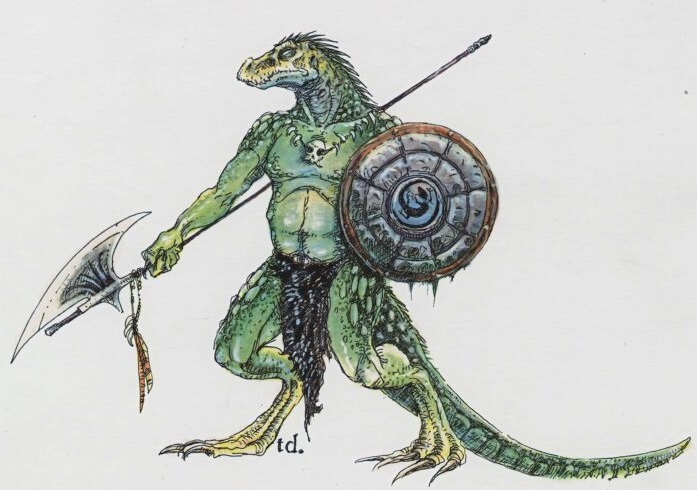
In the 1980 Rogues Gallery, Jeff Dee provided an illustration of a lizard man – or, rather, a human who was reincarnated as a lizard man by druidic magic. Aside from the additions of bracers and pirate boots, the latter of which are quite common in Dee's artwork, this looks pretty similar to the work of both Bell and Trampier. 
That same year, Grenadier Models acquired the AD&D miniatures license, producing numerous boxed sets of 25mm figures. One of these sets, Denizens of the Swamp, featured lizard men on its cover by Ray Rubin. The lead lizard man looks almost identical to Trampier's version from the Monster Manual. 
The Sinister Secret of Saltmarsh was published in 1981 and contains this piece by Harry Quinn. Once again, we can see the influence of both Bell and Trampier, though I'd say Trampier has the upper hand. Look, for example, at the skull necklaces the lizard men are wearing, as well as their shields.
The module's immediate sequel, Danger at Dunwater (1982), also features lizard man art, this time depicted by Timothy Truman. Truman's take on the monster is much more bestial and savage.
The same year, the AD&D Monster Cards appeared. Jim Roslof offereed us his take on the lizard man, which doesn't differ all that much from the one found in the Monster Manual. Note again the presence of the skull necklace.
The 1983 Dungeons & Dragons cartoon series featured lizard men several times during the course of its run. Here's a trio of them, one of which (again) wears a skull necklace.

Jim Holloway's depiction of lizardmen in the AD&D Second Edition Monstrous Compendium is notable for downsizing the head and back ridges while also extending them to the end of the tail. Holloway also shortened the snout and shrank the size of the mouth. 

Tony DiTerlizzi's interpretation of lizard men appeared in the 1993 Monstrous Manual. It's very distinctive in many ways, such as the legs. Interestingly, DiTerlizzi gave the lizard man a polearm that looks very similar to the one Greg Bell included in his original illustration. I wonder if this was intentional.
Lizard men are not monsters about which I think a great deal, so it was instructive to take a look at their depiction during the TSR era. While there are undoubtedly many I've not included here – feel free to post your favorites in the comments below – what strikes me most about the ones I have included is how similar they are. Greg Bell laid a foundation in 1975 that Dave Trampier then built upon; all subsequent artists have either directly copied or slightly altered their work. 

Monday, July 29, 2024

A (Very) Brief Pictorial History of Beholders

The creation of Terry Kuntz, brother of Rob Kuntz, the beholder first appeared in Supplement I to OD&D, Greyhawk in 1975. Since then, the eye tyrant (as it is sometimes known) has become a very strong contender for title of Most Iconic Monster of Dungeons & Dragons. It's also one of my favorite monsters in the game. The first illustration of a beholder appeared on the cover to Greyhawk and was drawn by Greg Bell. As you'll see from the artwork that follows, Bell's version of the beholder is quite distinctive, having a smooth body, a sleepy-looking central eye, and a comparatively small mouth.

Tom Wham, in the AD&D Monster Manual (1977), takes a slightly different tack. His beholder looks to be armor plated. Its central eye is large and bulbous, while its mouth is huge. This is the first version of the monster I ever saw, so it's my default image of it.
A couple of years later, in 1979, The Official Advanced Dungeons & Dragons Coloring Album was published by Troubador Press. The book contained this image of the beholder by Greg Irons. In general, I'd say it looks closer to Wham's illustration than Bell's.  

The next year, 1980, was when the first official AD&D miniatures appeared. Here's a beholder as painted by Ray Rubin, from the box art of the "Dwellers Below" set. Its appearance is quite close to that of Wham's illustration.
The actual beholder miniature from the set looks like this:
Issue #76 of Dragon (August 1983) includes the article, "The Ecology of the Beholder" by Ed Greenwood and Roger E. Moore. Accompanying it is this illustration of a beholder by Roger Raupp. Take note of its eye stalks, which looks a bit like the legs of a crab or spider.
A month later, in September 1983, the second episode of the Dungeons & Dragons cartoon series featured a beholder. Its eye stalks are snaky or wormy in appearance, while its mouth has the largest teeth of any version yet.
Citadel acquired the AD&D miniatures license in 1985 and produced a beholder figure. I don't know the precise year in which it was released. Though it's somewhat hard to tell from this image, the miniature looks pretty close to the Monster Manual depiction, right down to the plated body.
Also released in 1985 were the Dungeons & Dragons Master Rules, which included this picture of a beholder, as imagined by Jeff Easley. This illustration is interesting for its half-lidded appearance, something that's not really present in previous versions.

Toward the end of the 1e period, TSR released Waterdeep and the North (1987) for use with the Forgotten Realms setting. Its cover includes a beholder by Keith Parkinson. His version not only includes segmented eyestalks like Roger Raupp's but also upper and lower eye lids.
The cover to the Monstrous Compendium (1989) features a beholder by Jeff Easley. The armor plates are not present. Instead, the beholder appears to be very fleshy in appearance.
Meanwhile, the MC's interior gives us this illustration by Jim Holloway. The armor plates are back, as are the broad proportions of Wham's Monster Manual illustration (though the eye stalks look unique).
The Monstrous Manual (1993) gives us this very odd illustration by Tony DiTerlizzi, which may have the largest central eye-to-body proportions of any version of the beholder. 
I have intentionally excluded all the artwork of beholders found in the Spelljammer boxed sets and modules, both because there's so much of it and because it's intentionally varied in keeping with its idiosyncratic interpretation of beholders. Consequently, I'm not certain the extent to which they're at all representative of depictions of these monsters during the TSR era of D&D. On the other hand, it's quite possible these depictions were influential on those that followed in the '90s and into the 21st century. If anyone has any thoughts on this particular point, I'd be interested in hearing them.

As usual, I've no doubt left out a lot of illustrations, focusing primarily on those I either remembered clearly from my youth or those appearing in products to which I have ready access. If you feel like there are notable ones I've forgotten, I'd be interested in learning about those, too. 

Monday, July 15, 2024

A (Very) Brief Pictorial History of Halflings

For today's look at the art of TSR era Dungeons & Dragons, I've decided to step away from monsters and instead focus on something a little different: halflings. Halflings, as everyone knows, originate in the works of J.R.R. Tolkien and have little or no antecedents in real world myth or legend. Despite Gary Gygax's well-known dislike of The Lord of the Rings, he was, however, a fan of The Hobbit, which introduced halflings – or, rather, hobbits – to the world. Both books were very popular among fantasy aficionados during the early 1970s, when D&D was born, so it's not at all surprising that Tolkien's diminutive creations should find their way into the game (along with several of his monsters). Of course, this usage was completely unauthorized and legally dubious. Saul Zaentz's Middle-earth Enterprises threatened legal actions against TSR for its usage of "hobbit" (and "ent" and "Nazgûl," I believe) in OD&D. Subsequent printings of the game, such as the one I own, changed "hobbit" to "halfling" and that term then became the common one in Dungeons & Dragons. 

There are no clearly identified illustrations of halflings in OD&D. However, there is this piece of Greg Bell artwork that I think is supposed to be a halfling:

As you can see, the illustration is crude and looks more like the common depiction of a leprechaun – note the hat – than what we now expect of a hobbit or halfling. However, there are no leprechauns in OD&D, playable or otherwise. Further, if you look carefully, you can see the figure above is using a sling in his right hand, a signature weapon of halflings in both OD&D and the Fantasy Supplement to Chainmail. 

The earliest unambiguous illustration of a halfling comes in the AD&D Monster Manual by David Sutherland. Sutherland's depiction is broadly consonant with Tolkien's descriptions of hobbits, including their hairy feet.
The next year, in 1978, Sutherland illustrated module B1, In Search of the Unknown. One such illustration shows a short figure I assume is meant to be a halfling. Because he has no beard, I don't think he's supposed to be a dwarf, but there's no way of knowing for certain.
Next up is Bill Willingham's take on a halfling from the 1980 reprint of White Plume Mountain – even though it actually depicts a polymorphed efreeti masquerading as a halfling. Once again, furry feet à la Tolkien are visible.
1980 also saw the release of Slave Pits of the Undercity, whose cover features this towheaded halfling by Jeff Dee.
The Tom Moldvay D&D Basic Set (1981) includes this depiction of several different character classes by Dave LaForce. In the bottom right-hand corner, you can see a halfling, armed with a bow. 
The Cook-Marsh Expert Set (1981) includes one of my favorite depictions of a D&D halfling (by Jeff Dee). 
Frank Mentzer's 1983 revisions of the Basic and Expert Sets include many illustrations of halflings, probably the most of any TSR edition of Dungeons & Dragons. For the purposes of space, I'm including only a single example (by Larry Elmore), though there are many other excellent options to choose from.
The same year saw the release of The Shady Dragon Inn, a supplement filled with artistic renderings of every conceivable D&D character type, including halflings. It also features portraits of characters based on the LJN D&D toy line, such as Figgen the Halfling Thief (whose toy, ironically, was never actually produced as far as I know). This is Timothy Truman's version of Figgen:
In the third episode of the first season of the Dungeons & Dragons cartoon series (also 1983), we're introduced to a character called Hector the Halfling (who's actually bad guy Venger disguised by magic). He's the only halfling to appear in the series of looks quite different than all previous depictions of the race. He lacks hairy feet, but he wears peculiar pants that cover half of his oversized feet, leaving the toes visible. He also has pointed ears, an inconsistently portrayed aspect of D&D halflings.
The Forgotten Realms Campaign Set (1987) presents us with another slightly anomalous vision of halflings. Jeff Easley's halflings are skinny, goofy-looking little people with mildly larcenous demeanors. They still have big, slightly hairy feet, but otherwise strike me as quite unique.
Jim Holloway's version of halflings from 1989's Monstrous Compendium is, in my opinion, a little creepy, with his heavy eyebrows, half-lidded eyes, and languorous pose. He also boasts a veritable mane of hair that starts at his ankles and then drapes over the tops of his feet. To my eyes, the overall effect is suggestive of a satyr rather than a hobbit and I can't say I'm keen on it.
Tony DiTerlizzi's piece from the 1993 Monstrous Manual is better, exuding a kind of scrappy heroism that works well for halflings. 
As you can see from just this small sampling of illustrations, there's never been a fully consistent conception of halflings. I wouldn't be surprised if this was driven, at least in part, by a desire to legally distinguish D&D's diminutive race from Tolkien's hobbits. At the same time, there can be no question that, at base, halflings are hobbits in all but name. The presence of hairy feet – a characteristic derived from Tolkien – in nearly all of the above pieces of artwork demonstrates that. If the intention were to avoid comparisons to the denizens of Middle-earth, you'd think removing that feature would have been at the top of the art director's list. (Interestingly, the kender of Dragonlance pointedly wear shoes – take that, Saul Zaentz!).

There's a lot more to be said on this topic, I think, but I'll leave that to another day. For now, I'm interested in your thoughts about both the art and the place of halflings in your own D&D campaigns. Do you use them? Do you, like me, replace them with another race? Or you omit them entirely? 

Monday, July 1, 2024

A (Very) Partial Pictorial History of Gnolls

There's no use in fighting it. You'll be seeing more entries in what has inadvertently become a series for a few more weeks at least, perhaps longer. After last week's post on bugbears, which are a uniquely D&D monstrous humanoid, I knew I'd have to turn to gnolls this week, as they, too, are unique to the game. Perhaps I should clarify that a little. There is no precedent, mythological or literary, for the spelling "gnoll." However, the spelling "gnole" appears in "How Nuth Would Have Practised His Art Upon the Gnoles" from Lord Dunsany's 1912 short story collection, The Book of Wonder (as well as in Margaret St. Clair's "The Man Who Sold Rope to the Gnoles"). 

There can be no doubt that Dunsany's story served as the seeds for the gnolls of D&D. In their description in Book 1 of OD&D, gnolls are described as "a cross between Gnomes and Trolls (. . . perhaps, Lord Sunsany [sic] did not really make it all that clear." The original short story contains no description of the titular creature, leaving Gygax to advance his theory of gnolls being a weird hybrid monster. Artist Greg Bell interprets them thusly:

Sometime in the three years between their first appearance in OD&D (1974) and the publication of the Monster Manual (1977), someone at TSR decided that gnolls were, in fact, "low intelligence beings like hyena-men." That's how they're described in J. Eric Holmes's Dungeons & Dragons Basic Set, which is where I first encountered them, courtesy of this delightful illustration by Tom Wham:
Meanwhile, the Monster Manual itself, published the same year, gives us this illustration by Dave Sutherland.
The Monster Manual also includes another Sutherland gnoll-related piece, this time of Yeenoghu, the demon lord of gnolls. To my eyes, Yeenoghu looks a lot more hyena-like than does the illustration above, but, even so, they're still broadly similar.
Speaking of Yeenoghu, he reappears in the pages of Deities & Demigods, this time depicted by Dave LaForce. I've always found this version of the demon lord a bit goofy. I'm not sure if it's his grin or the strangeness of the arm that holds his infamous triple flail. 
The AD&D Monster Cards sets are a good source of unusual takes on many monsters and that's especially so in the case of gnolls. Artist Harry Quinn depicts them in a way that, to my eyes, looks decidedly feline. To anyone familiar with the weird phylogenetics of hyenas, that's inappropriate, but it still feels off somehow. Perhaps it's simply the weight of all the previous depictions that makes me think so. In any case, Quinn's version of the gnoll is quite distinctive.
The 2e Monstrous Compendium features what is probably the most hyena-like of all versions of the gnoll, courtesy of James Holloway.
Tony DiTerlizzi provides an even more hyena-like version of the gnoll in the Monstrous Manual, right down the spots on its fur. 
I feel like I have probably overlooked some illustrations of gnolls from the TSR era of D&D, but, if so, they must be fairly obscure, as these are the only ones I could easily find in my collection. What's most notable about the ones I did find is how closely they hew to the post-OD&D notion that gnolls are hyena-men. I'd chalk up most of the differences to artist skill and choice rather than a fundamental disagreement about this fact. In this respect, they're quite similar to bugbears, another distinctly D&D monster whose look stayed largely the same during TSR's stewardship of Dungeons & Dragons.

Monday, June 24, 2024

A (Very) Partial Pictorial History of Bugbears

Since my recent forays into the artistic evolution of both kobolds and goblins (not to mention orcs) have proved popular with readers, I thought I'd continue to look into other well-known Dungeons & Dragons monsters for a few more weeks. This time, I'm looking at the bugbear, both because it's completely unique to D&D, but also because, with one very important exception, its representation in artwork has been very consistent – far more so than any of the previous monstrous humanoids I've examined so far.

Of course, that one exception is a big one. More than that, it's the original illustration of the bugbear, as drawn by Greg Bell in OD&D's Supplement I (1975). Look upon his majesty!

I actually really like this illustration, because it's just so weird. That pumpkin head – the result of a miscommunication between Bell and Gygax – makes it quite clear that you're dealing with a wholly inhuman monster, despite its two arms, two legs, and upright stance. These days, this is how I prefer my monstrous humanoids, so I may be unduly biased toward it. Regardless, it's an oddity and an outlier that no subsequent TSR era D&D artist has ever used as inspiration for his interpretation of it – a pity!

With the AD&D Monster Manual (1977), we see the first examples of what will eventually become the iconic appearance of the bugbear – little wonder, since it's by Dave Sutherland, the artist most responsible in my opinion for the esthetic of old school D&D

Here's another instance of a bugbear from the Monster Manual, this time drawn by Dave Trampier. I find this second piece interesting, because it's clear that Tramp is using Sutherland's illustration above as a model. These are clearly the same monster drawn by two different artists.
Speaking of Tramp, he drew another early bugbear illustration, which appeared in 1978's Descent into the Depths of the Earth. Once again, this is clearly the same monster as those depicted in the MM, but, this time, they have a slightly more cartoonish look to them, almost like characters out of Trampier's Wormy comic. 
Next up are some Grendadier Model sculpts of bugbears from 1980. As you can see, these, too, are in keeping with the basic appearance laid down by Dave Sutherland a few years earlier – big, furry brutes with wide mouths full of sharp teeth and large ears.
1980 was also the year in which Deities & Demigods appeared. Though bugbears as such do not appear in the book, we do get a depiction of their deity, Hruggek, as drawn by Dave LaForce. I'm not fond of this illustration, which I've always found a bit goofy. Maybe it's the grin, I don't know. Still, it's broadly in keeping with what we've come to expect of bugbears up till now.
In 1982, the AD&D Monster Cards include a bugbear, its illustration done by Jim Holloway. This may be the first piece of color artwork for the monster in the history of the game. 
Second Edition's Monstrous Compendium (1989) includes this artwork, again by Jim Holloway. While still largely in keeping with its predecessors, I notice that the bugbear's face is now arranged more like that of a human being. Both its mouth and ears are smaller, for example, though its nose remains large and broad.  
Finally, there's Tony DiTerlizzi's take on bugbears from 2e's Monstrous Manual (1993). I'm not sure what to make of this illustration. While it retains the overall look of Sutherland's original, I feel like it continues down the path laid down by the Monstrous Compendium of giving bugbears human proportions, which undercuts their monstrousness, something I've come to see as a mistake in the portrayal of D&D's humanoid monsters. 
I am certain I've overlooked several other examples of bugbear illustrations from TSR era Dungeons & Dragons. Feel free to point me toward others that you've found. I'm particularly interested in any examples of bugbears that, like Greg Bell's OD&D version, deviate greatly from the model laid down by Sutherland. My suspicion is that there won't be many (or any) such examples, because, for whatever reason, most old school D&D illustrators more or less followed in the footsteps of their predecessors, something we don't see in quite the same way with many other monsters. I wonder why that is.