Showing posts sorted by date for query dwimmermount. Sort by relevance Show all posts

Wednesday, November 18, 2026

RIP Ken St. Andre (1947–2026)

It's been brought to my attention that Ken St. Andre, creator of Tunnels & Trolls, the second published roleplaying game, has died. That's a great loss for the hobby, as another of the founding generation passes on from this life.

Unlike many of the people I've eulogized on this blog over the years, I actually met Ken when he attended OSRCon in Toronto back in 2012. He even played in my Dwimmermount session at the convention, where his unorthodox style of play caused something of a stir among other attendees. Earlier that same year, I also interviewed him. Consequently, I feel this death a little more keenly than I do the deaths of other greats of our hobby. I'd never say Ken and I were friends, but we knew one another and occasionally exchanged emails. Ken was very much a real person to me. 

One of the interesting things about Ken is that, both in person and in our electronic communications, he frequently asked me some variation of "Why are you wasting your time with someone else's game?" By that, he meant "Why aren't you creating and playing your own game rather than expending all your creative energies on games others have created?" He asked me this again and again and, although I had answers of various sorts for him, they never seemed to satisfy him. I suppose that only makes sense coming from the man who, upon getting a copy of Dungeons & Dragons in 1974, looked at it and decided "I can do better."

Regardless of whether you think T&T is in any way better than D&D, the fact remains that Ken St. Andre always walked to the beat of his own drum. He was an imaginative, energetic, weird, wonderful, and, yes, often frustrating man who nevertheless left his mark upon this shared hobby of ours. That he and I fell out of contact over the last few years is all the sadder now that he is gone. We shall not see his like again.

Wednesday, October 28, 2026

The Art of the Con

Though I attended two conventions recently, I only refereed events at one of them – CleriCon. At Gamehole Con, I was there solely as a participant, playing in several games run by others. Partly, I did this out of superstition. The first time I signed up to referee at GHC was back in 2019, when I was hit by a car the day before my flight was scheduled to head to Wisconsin. Though I was able to literally) walk away from the accident with only some superficial lacerations and a non-displaced fracture of my fibula, I was forbidden from traveling for at least 48 hours out of concern that I might have suffered a concussion. Fortunately, I hadn't, but I was also unable to attend the con that year or run any of the events I'd signed up for. The incident left me with a strange worry that, were I ever to offer to run sessions at Gamehole Con again, misfortune might befall me.

CleriCon is a completely different matter. The reason I discovered the con in the first place was that I was trying – ultimately in vain, alas – to start up a small RPG gathering here in Toronto. In looking online for resources to aid me in my Quixotic quest, I learned about the existence of CleriCon, then entering its third year. As soon as I learned about it, I immediately offered to run some games there and did so without any injury to myself. So emboldened, I offered to do the same again this year, refereeing sessions on both Friday night and Saturday morning.

Though both sessions were well received and everyone involved had fun, it was the Saturday morning session that, in my opinion, was the better of the two. On that occasion, I ran the first level of my Dwimmermount megadungeon and provided the players not just with pregenerated characters but a very specific and narrow goal, namely, the location of the Dwarven cemetery reputed to be somewhere on that level. The players were able to do some exploration, fight some monsters, and eventually discover the cemetery, all in the course of the time slot. It was pretty much perfect.

On Friday night, though, I ran them through the revised version of The Cursed Chateau that I've been working on throughout this year (not as much as I'd hoped but that's another story). Once again, I gave the players pregenerated characters and a goal. However, the goal this time – determine what happened to previous groups of adventurers who'd entered the chateau and not returned – was much too broad. Combined with the fact that the adventure includes lots of random elements so that each playthrough is intentionally different and it was pretty much guaranteed the players wouldn't complete their mission in the time allotted.

Now, as I said, everyone enjoyed themselves. Indeed, some of the players from Friday night returned on Saturday morning to play with me again. Even so, I personally felt as if The Cursed Chateau session was not quite as "complete" or satisfying as the Dwimmermount one the next day. The former simply ended when the clock ran out, while the latter came to a conclusion that made sense, if you can understand the difference. In fact, the Dwimmermount session made so much sense that, while I was having lunch with some of the players later, one of them asked me how I'd arranged things in such a way to ensure the session ended on a "high note." I confessed that it was pure chance – a combination of good choices on the part of the players and the luck of the dice. I'd love to take credit for how well the session ended, but I can't.

This got me to thinking about what makes a good convention scenario and how best to write one. I most definitely plan to run more sessions at next year's CleriCon and, despite my superstition, I am also planning to submit sessions to next year's Gamehole Con (likely playtests of both the second edition of Thousand Suns and Secrets of sha-Arthan). But with only four hours to play, I find myself pondering how to ensure more satisfying sessions and fewer that just peter out when the time elapses. I had so much fun with the games I played this year that I'd like to do whatever I can to increase the odds that my own sessions will be just as enjoyable for potential players.

So, if anyone out there is more experienced with writing and refereeing con events, I'd love to hear what you have to say about this. For that matter, I'd love simply to hear the observations of anyone who regularly plays con games. What makes a good convention scenario? Are there any common elements that you think increase the odds of their being fun for everyone? Any insights you can offer in this matter would be greatly appreciated.

Tuesday, October 27, 2026

Post-Con Thoughts

As I've said innumerable times on this blog over the years, I am not a regular attendee of gaming conventions and yet, over the last couple of weeks, I've attended not one but two of them, specifically Gamehole Con in Madison, Wisconsin and CleriCon in Glen Williams, Ontario. 

I've attended both before and greatly enjoyed them, hence my return this year. Even so, my attendance, even after all these years, is somewhat contrary to my shy and introverted nature. I've never been all that comfortable in large gatherings full of strangers and that hasn't really changed since I have gotten older. What has changed is that I more fully recognize the need to leave my comfort zone and be social with people I previously didn't know. 

That's, frankly, one of the joys of conventions. After all, everyone attending the con is there because they share one thing in common: a love of roleplaying games. As such, you're probably more than halfway toward moving beyond any social awkwardness you might otherwise have with strangers. At least. that's what I have found and it was no less true this year, when I met lots of delightful fellow gamers at both conventions, to say nothing of the many others I already met and looked forward to seeing again.

Of the two, Gamehole Con is the larger, with an attendance of more than 6000 people. That's still much smaller than bigger, more well-known cons, like GenCon or Origins. 6000 attendees is, in my opinion, much more "human sized." I never felt lost or overwhelmed by the numbers of people present, but there were enough of them that there was a good variety of options when it came to events or just discussions in the convention center. 

Among the many people whom I met or spent time with were:

  • Michael Curtis: Old school blogger and director of product development for DCC RPG.
  • Joseph Goodman, head of Goodman Games and all-around great guy.
  • Matt Hildebrand: Goodman Games' art director and a frequent collaborator of mine.
  • Kenneth Hite: Renaissance man and master raconteur.
  • Jason Hobbs: Host of the Hobbs & Friends and Random Screed podcasts.
  • Brendan La Salle, writer for Goodman Games.
  • Sean Kelley: Podcaster and fun guy.
  • Jim Kitchen: RPG enthusiast and auctioneer.
  • Doug Kovacs, Artist extraordinaire.
  • Bill Meinhard: One of the most significant collectors of old school RPG materials in the world.
  • Jon Peterson: Author of Playing at the World and probably the premier historian of hobby.
  • Victor Raymond: An old and dear friend of mine, as well as my co-host on the defunct Halls of Blue Illumination podcast.
  • Harley Stroh: One of the best writers in Goodman Games' impressive stable of writers.
  • Ronin Wong: Actor and fellow lover of Holmes Basic. 
You might have noticed a lot of people associated with Goodman Games in my list. That's because this year marked the 25th anniversary of the company, which, therefore, had a sizable presence at Gamehole Con this year. I've long been an admirer of both Goodman Games and the Dungeon Crawl Classics RPG, so it was great having the chance to spend so much time with its staff and freelancers. I also was fortunate enough to play in a DCC RPG adventure refereed by Harley Stroh and Doug Kovacs. I had a blast playing a time-lost Buck Rogers-like space hero who'd been summoned by a wizard to act as her bodyguard. Later, I played in another DCC adventure inspired by the video game Deep Rock Galactic.

CleriCon, by contrast, was a much more modest affair. There were only 10 tables, spread across two buildings, with each table having 6-8 players and a referee. In many ways, it reminded me of the "games days" that the public libraries used to put on during my youth, which are among my fondest memories of those days. The con began with a shared dinner on Friday night, followed by a single session of play. On Saturday, there were three sessions and one more on Sunday. I refereed a couple of sessions, both using Old School Essentials. One was a rework of The Cursed Chateau and the other was a dungeon crawl on the first level of Dwimmermount. Both sessions went well and everyone involved had a fun time. 

One of the best parts about CleriCon was how local it was. Though there were a few attendees who came from far away – one traveled all the way from Alaska! – most of us were from southern Ontario and the Greater Toronto Area. One I met for the first time during a layover in Detroit on my way to Gamehole Con and we reconnected at CleriCon. Toronto is a big and often alienating city, so it's great to meet up with gamers from the area and be reminded that there are a lot more of us than it might appear. It's my understanding that the success of CleriCon has inspired at least one person to try something similar in another southern Ontario city next month. I think that's great and hope that it might encourage others to do the same.

At both conventions, I was told more than once that I ought to consider attending other conventions. Though I'm uncommitted on this question, I am thinking about it. The difficulty is timing and, honestly, the cost of it. Air travel is getting increasingly expensive, never mind the additional costs of lodging, food, etc. One of the benefits of smaller, more local cons, like CleriCon, is that I don't need to think about such things. On the other hand, there's a unique joy to traveling to another place and meeting up with people from all across the continent. I have so many online friends whom I've never met in person. It'd be wonderful to have the chance to do so at a common location, which is why I continue to ponder this matter.

If anyone has any thoughts of their own regarding conventions worth visiting, I'd love to hear your perspective. I had so much fun at Gamehole Con and CleriCon that part of me wishes I had some more RPG gatherings to look forward to in the next few months. 

Monday, July 20, 2026

Reconsiderations: Death and Resurrection

Needless to say, I've been very remiss in writing new posts for this blog, even within the context of the less rigorous schedule I proposed two months ago. I wish I had a better excuse beyond "I'm busy revising Thousand Suns for a second edition," except that's the truth. In fact. I've been so busy with that that I haven't even been posting as often at Grognardia Games Direct as I have been. On the plus side, the first draft of the second edition is nearly done, so I at least having something to show for my lack of attention here. With any luck, the first draft will be completed before September and external playtesting can begin in earnest.

Today, though, I want to return to my Reconsiderations series, since the first entry in it was very well received and generated a lot of good comments. My apologies for not responding to most of them, but, well, I've already explained that my attention was – and remains – elsewhere. 

Longtime readers may recall that the Dwimmermount campaign was predicated on several things, the most important of which was that it explicitly megadungeon-centric. At the time, which is to say the early days of the Old School Renaissance, there was a widespread belief that Dungeons & Dragons was born in the megadungeon – or the "campaign dungeon," as some preferred to call it – and that any attempt to play, let alone understand, old school D&D, as we were all attempting to do, required that you run a megadungeon campaign. And so I did, because I hoped that doing so would help me better understand aspects of D&D's history and design that had eluded me when I was a callow youth.

Another important foundation of the Dwimmermount campaign – and indeed my entire philosophy of coming to grips with OD&D – was the principle that "D&D is always right." By that, I simply meant that, despite the claims of its detractors over the decades, D&D's design was not haphazard but intentional. What's there in its rulebooks is there for a reason and we'd do well to understand this before tinkering with them unduly. This is not the same thing as saying that everything that's in D&D's rules always works to our satisfaction (or even the satisfaction of its designers), only that, before casting aside something about the game you don't like, consider for a moment the possibility that that something might, in fact, be a load-bearing wall.

That's why, during that campaign, I permitted the use of the spell raise dead, even though I was philosophically opposed to it. When I say "philosophically opposed," I mean that I initially accepted the idea, common in the early OSR, that old school Dungeons & Dragons was inherently and unalterably high lethality, with characters dying left and right. "Fantasy fucking Vietnam" was how it was sometimes described. Likewise, the renewed emphasis on pulp fantasy – strongly championed on this blog – was seen as requiring a style of play in which death was both omnipresent and permanent. 

Consequently, I wanted to embrace this ethos in the Dwimmermount campaign, but doing so contradicted "D&D is always right," so I, with some reluctance, allowed the use of raise dead. I vividly remember that there was some disappointment, among my readers that I'd "caved" on this point, since I'd previously written about my discomfort with the spell and how I felt it ran counter to the "mood" I was trying to bring to the Dwimmermount campaign. Even so, I permitted it, because the rules did and, as I already said repeatedly, I wanted wrestle with OD&D on its own terms – and, from the beginning, Dungeons & Dragons has had a spell that enabled the restoration of characters to life.

I adopted a similar mindsight when I refereeing my decade-plus Empire of the Petal Throne campaign, House of Worms. Because its underlying rules so closely mirror those of OD&D, EPT also includes several means to bring back the dead, including a spell accessible to player characters. During the course of the campaign, only one player character ever died – Aíthfo hiZnáyu – but he did so twice, which is certainly an unusual distinction! I permitted it, because the rules allowed it and also because the other players, knowing this, chose to make an effort to resurrect Aíthfo, in the process creating some very memorable adventures in Tékumel.

Still, I remained somewhat sheepish about all of this. My innate sense of consistency ensured I'd try to play by the principle ("D&D is always right") I'd laid down at the start of the Dwimmermount campaign, but I did so through gritted teeth. On some level, I shared the disappointment of readers who felt I'd "wimped out" by allowing the use of raise dead. Dwimmermount was, as I've noted, born out of my love of pulp fantasy of a particular kind that did not include easy resurrection in this fashion. Was I betraying its inspirations by being so casual about its use? At the time, I thought so. Even a few years ago, I groused about my decision.

Recently, though, I've come to accept my decision without any reservations. I've come to realize that I did the right thing in both cases by allowing the resurrections. My feeling increasingly is that there's altogether too much whining about how, on the one hand, "save-or-die is unfair" or "level drain is cruel" and, on the other hand, "healing is too commonplace" and "life restoration should be harder, if not impossible." My way of thinking nowadays is that these two extremes – which, to be fair, most players don't espouse – are mirror images of one another, each being founded in not taking Dungeons & Dragons as it is and has been from the beginning and instead substituting a different game in its place. 

That's not a unique sin; I'm as guilty of it as anyone. However, with the benefit of some distance, I've come to realize that many common complaints about D&D (or any roleplaying game) come from a failure in looking at the game design as a whole and instead fixating on only some of its parts. Is save-or-die really unfair? In a game where there are innumerable means of returning a character to life, I don't think so. In most cases, death in Dungeons & Dragons is just a setback and the rules provide a myriad of means by which to overcome it. Why not accept that?

That's more or less where I am right now on the question of death and resurrection in D&D and its derivatives and descendants.

Friday, February 20, 2026

Urheim

Some of you may recall that, shortly after I resumed blogging in the late Summer of 2020, I began a public project – the Urheim megadungeon. Though the posts relating to it were well received, I eventually lost interest in continuing it, largely because I wasn't running Urheim. Instead, it was a purely theoretical pursuit, an attempt to do what I had hoped to do with Dwimmermount. Because I was doing it without any intention of making use of it, I didn't feel a connection to the megadungeon and abandoned it.

Recently, though, an opportunity to correct this has arisen. The Metamorphosis Alpha campaign I began last year is on hold, owing to the departure of a couple of players for several months. That led to some discussions with the remaining players, who felt it might be worthwhile to play something else until the absent players returned. When one of them admitted that he had never played a megadungeon-based campaign, the conclusion was obvious: I should referee one for him and, rather than returning to Dwimmermount, I would pick up Urheim where I left off.

For this campaign, I'll be using Old-School Essentials as its base, modified with some house rules I've assembled over the years. The house rules bring it closer to OD&D + Supplements – what I have, in the past, referred to as D&D 0.75 – which is my preferred version of the game. It's closer to the simplicity of pure LBB-only OD&D while also possessing more of the flavor of AD&D that I think a lot of people have as the default frame for conceiving of Dungeons & Dragons. Also included in my house rules are some unique races like the Gargantuas and unique classes like the beggar.

Of course, what really excites me about this is the opportunity to continue my development of Urheim in the context of actual play. While I don't think it's absolutely necessary that every piece of game writing must arise out of regular campaign play, I do think that writing that does is generally better and more vital. This is, I think, especially so in the case of megadungeons, which are generally so large that the only way to build them is a couple of steps ahead of the player characters – or so I have come to believe (perhaps I'll write about that in another post).

It's been a while since I last regularly refereed a megadungeon, so this will be a good experience for me as well. As the campaign develops (assuming it lasts for any length of time), I'll no doubt have thoughts to share, including additional details about the Telluria setting in which Urheim exists.

Friday, November 21, 2025

And So It Begins

As I posted yesterday, my Barrett's Raiders Twilight: 2000 campaign, which started in December 2021, has ended. Though sad (and even a little disappointing), its conclusion opens up a slot in my weekly schedule for a new campaign and that's always exciting. Just what that new campaign will be is still very uncertain and depends, to a great extent, on the interests of the remaining players. We'll discuss the matter at some length at our next meeting, but, in order to get the ball rolling, I sent them a selection of four(ish) RPG I'd enjoy refereeing for them, which I thought I'd share with you as well.

Gamma World/Metamorphosis Alpha

I'm pretty sure I've mentioned, likely many times, that I've long been a huge fan of Gamma World. In my youth, it was one of my favorite games, just losing out of a spot in my Holy Trinity of RPGs to Call of Cthulhu. It's one of those games I find very easy to run, both from an ideas perspective and from a mechanical one. I have little trouble coming up with fun scenarios for Gamma World and its rules are straightforward and easy to use – two great boons when it comes to refereeing a roleplaying game. 

Notice that I've included Metamorphosis Alpha as a possibility too. That's because, while I have played MA, I have never actually run it myself and doing so has long been a dream of mine. In some ways, I actually prefer the campaign frame of Metamorphosis Alpha to that of Gamma World, perhaps because it appeals to my fascination with "secret sci-fi" settings. So, given my druthers, I would press for MA over Gamma World, but I'd be equally happy with either.

Secrets of sha-Arthan

This is a no-brainer. I've working sporadically on this project since June of 2021, during which time it's undergone a number of different changes and evolutions. Those of you who've subscribed to Grognardia Games Direct know about its current state, since that's where I post regularly about it. However, I've not yet had the chance to do anything more with it than run short scenarios. What it really needs is a proper campaign to take its development to the next level and this might be the perfect time to do that.

I considered starting a SosA campaign after the conclusion of House of Worms last month, but opted not to due to its very broad similarities to Tékumel. It's a baroque, exotic fantasy setting with a secret sci-fi substratum – I'm sensing a theme here – albeit one based on very different historical/cultural influences than those of Tékumel. However, my Monday night group includes a different set of players, so the comparisons to Tékumel wouldn't be a problem.

Thousand Suns

In a similar fashion, Thousand Suns is another good option. Like Secrets of sha-Arthan, I'm currently in the midst of revising and reorganizing it in preparation for the released of a second edition. Also like SosA, I'm chronicling my work on this project over at Grognardia Games Direct. This is a game that's very near and dear to my heart and one I haven't run for some years now, so it'd be great to have the opportunity to do so again.

Furthermore, one of the goals of the second edition is to make the rules of Thousand Suns clearer and easier to use. They're already pretty good in this regard, I think, but I hope to make them even better. I also want to do a better job of highlighting those aspects of the game that distinguish it from its competitors and inspirations. Refereeing a campaign would give me lots of opportunities to do just that.

Urheim

Urheim was my second attempt (after Dwimmermount) to produce a megadungeon suitable as the foundation for an entire old school D&D campaign. I got fairly far into constructing it before moving on to other projects, but it's still something I think about from time to time. 

Consequently, I thought now might be a good time to return to it as a replacement for Barrett's Raiders. A megadungeon campaign is very straightforward and easy to maintain. It's also got the potential to spin off in a variety of different fun directions, so it's a good fit for my personal refereeing style. If I did return to Urheim, I'd almost certainly use Old School Essentials, probably of the advanced variety, for the rules, though part of me wants to dive back into OD&D + Supplements.  

And that's where things stand at the moment. Which of these options will be chosen is (mostly) up to my players. I'm very curious as to what they'll chose.

Saturday, June 14, 2025

Rich and Creamy

 A couple of weeks ago, I mentioned that, after so many years of refereeing Empire of the Petal Throne, I found myself craving a vanilla fantasy setting – something simpler and more straightforward than Tékumel but that was nevertheless very well done. I received a lot of good suggestions in the comments to that post, but one of the best ones came directly from Rob Conley, a fellow blogger who's done some truly excellent work over the years, especially regarding the subject of sandbox settings, both for fantasy and for Traveller. If you're at all interested in sandboxes, I highly recommend you check out those series of posts. In my opinion, they're pretty close to definitive.

Rob has done a lot of other great stuff worthy of your attention, like Blackmarsh, a free hexcrawl setting in the tradition of the Outdoor Survival map OD&D suggested the referee use for adjudicating wilderness travel and exploration. Blackmarsh is one of my favorite things from the first few years of the Old School Renaissance. I made use of it in my Dwimmermount campaign to represent the region immediately to the north of the main campaign area. It's a great example of well-done vanilla fantasy, providing a referee with just enough material to spark his own imagination without limiting his options.

Now, Rob is preparing to release another sandbox, one built on the foundation of Blackmarsh and related projects: Into the Majestic Fantasy Realms: The Northern Marches. As its title suggests, The Northern Marches is connected to Rob's Majestic Fantasy RPG, but is completely usable with your preferred old school fantasy rules. In that respect, it's a lot like Judges Guild's old Wilderlands of High Fantasy material in that it sketches out a huge amount of real estate that can be adopted and adapted as the referee sees fit. Rob has a long history with the Wilderlands setting, so I doubt he'd argue against saying his Majestic Fantasy Realms setting has been inspired by it, even if it's very much its own unique thing.

Rob very kindly shared with me his latest draft of The Northern Marches, which is an immense document of over 100,000 words. Don't be put off by its length. Though there are some high-level discussions of history, geography, politics, and religion, the vast majority of this text is devoted to short but evocative descriptions of the notable hexes of the four regional maps included with the book. Just as useful is the section devoted to traveling within the setting and all that that entails – caravans, ships, exhaustion, rates of travel, and more. This is, after all, a sandbox setting, so these sorts of things are absolutely essential to make full use of it. 

You can see the full table of contents, along with a preview of the setting here. Another overview of the setting and this project can be found in this post on Rob's blog. It's really well done and very much in keeping not just with the excellent material Rob has made before, but also with his work on creating and running sandbox campaigns. I was very impressed by the scope of The Northern Marches, not to mention the obvious work Rob has put into making it accessible and usable. While it's still too early to say how I might eventually decide to sate my craving for vanilla fantasy, I can say there's a very good chance I'll make use of The Northern Marches in one way or another. If that sounds like something you might be interested in, I highly recommend checking it out.

Tuesday, May 6, 2025

REPOST: The Articles of Dragon: "And now, the Psionicist"

Psionics in AD&D is a strangely contentious topic and not just because the rules presented for it in the Players Handbook leave a lot to be desired. For many gamers, psionics belong to the realm of science fiction and are thus inappropriate to a fantasy game like Dungeons & Dragons. I can understand that point of view, but it's not one I share, since D&D is a "fantasy" game in the broadest sense, which is why it can readily incorporate "science fiction" elements without difficulty. That said, I never used psionics much back in my AD&D days nor have I attempted to add it to my Dwimmermount campaign. The reason for this has nothing to do with maintaining the "purity" of my fantasy worlds so much as the fact that, as written, the rules for psionics are a mess.

This unsuitability of the psionics rules was widely acknowledged by nearly every gamer I knew back in the day. Consequently, many of us greeted issue #78 of Dragon (October 1983) with some pleasure, as it was largely devoted to psionics and its problems. Of the articles in that issue my hands-down favorite was "And now, the psionicist" by Arthur Collins. Collins was one of those authors, like Roger E. Moore and Ed Greenwood, whose stuff was always good. He wasn't as prolific as Moore or Greenwood, but he never failed to impress me. Indeed, if I were to be completely honest, I think Arthur Collins was my favorite old school Dragon writer and "And now, the psionicist" reveals part of why I think so.

The article takes the then-bold step of introducing a new character class -- the psionicist of the title -- as a way to make the psionics rules both workable and enjoyable. More than that, though, Collins also does something even more remarkable: he makes the AD&D psionics rules intelligible. He does this through his explanation of the psionicist's class abilities, such as its acquisition of attack and defense modes and psionic disciplines. It's a small thing, really, but it had a profound effect on me as a younger person. For the first time, I began to feel as if I understood how psionics was supposed to work. Likewise, the notion of making psionics the purview of a unique class rather than an add-on to existing classes was a revelation to me. It made so much sense that I couldn't believe no one had thought of it before. (Someone had, of course -- Steve Marsh -- but their version of psionics never made it into OD&D as written).

"And now, the psionicist" is fairly typical of Collins's work. Rather than wholly rewrite AD&D, he instead clarifies and expands upon the rules as written, in the process making the original rules both understandable and stronger. It's a talent all the best Dragon writers had in those days, but Collins, in my opinion, made it into a high art. Moreso than any other writer, he showed me that, strangely organized and presented as it was, AD&D's rules weren't wholly arbitrary; indeed, they often made sense if you actually took the time to look at them objectively and think about the logic behind them. The proper attitude when encountering a rule that seems "broken" is to step back and consider it carefully before deciding to excise it from the game. That's an attitude that has stuck with me after all these years and one I continue to recommend to others.

Monday, June 17, 2024

A (Very) Partial Pictorial History of Goblins

During the course of looking into the pictorial history of kobolds last week, I noticed that, starting in the late First Edition AD&D era and extending into early Second Edition, kobolds started looking more goblin-like in illustrations. This was particularly striking in light of Dave Sutherland's original depiction of them as short, horned, scaly dog-men, a depiction unique to old school Dungeons & Dragons. Thinking further on the matter, I began to ponder just what I meant by "goblin-like." Had my notion of a goblin in D&D been similarly influenced by the depictions of them to which I'd been first exposed during my entrance into the hobby of roleplaying? Given the popularity of my kobold post last week, I thought this a question worth investigating.

So far as I can tell, the very first depiction of a goblin in any Dungeons & Dragons product is this one from the original 1974 release of the game. Drawn by Greg Bell, this early goblin looks to me more like a deranged dwarf than a monster in the usual sense of the term:

Dave Trampier provided the illustration for goblins in the AD&D Monster Manual (1977) and I suspect this is the ultimate source for my own imagining of what they look like:
In the same year, Minifigs in the UK produced a series of Dungeons & Dragons miniatures that included goblins among them. Here's one that looks to be quite similar to Trampier's art, right down to the little horned helmet:
In 1980, Grenadier Models produced its own take on goblins, which, again, are broadly consonant with Trampier's depiction, though, to my eyes anyway, they seem slightly more feral. 

1981 is the year Tom Moldvay's D&D Basic Set is released. Though the rulebook does not include artwork for any of the game's traditional humanoid enemies, it does include this Dave LaForce – were all of TSR's early artists named Dave – piece from the alignment section in which there's a bound and gagged figure whom my childhood friends and I assumed was a goblin. He certainly matches many of the characteristics associated with goblins, though he seems to be taller and less stocky than previous depictions.
Like the Moldvay Basic Set, Frank Mentzer's 1983 revision does not include any illustrations of its monstrous humanoids. However, in its solo adventure, there is the following piece of artwork (by Jeff Easley) that, from context, would seem to depict goblins. Once again, they wear horned helmets.
The same year, the Doug Niles D&D Basic adventure, Horror on the Hill, was published. The adventure's primary antagonists are goblins and hobgoblins. Jim Holloway provides numerous illustrations throughout the module, but, aside from a couple of contextual clues, it's not at all clear (to me anyway) when he's depicting a goblin and when he's depicting a hobgoblin. A big of why that's the case is that the two races look very similar to one another. Are these two goblins or hobgoblins? Regardless, I think they're representative of Holloway's broader take on these humanoids.
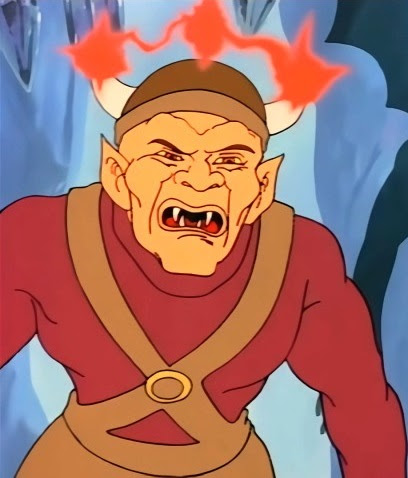
In the third and final season of the D&D cartoon, there's an episode entitled "The Dungeon at the Heart of Dawn" that features a character who looks very much like Dave Trampier's original Monster Manual illustration of a goblin, though he's not explicitly called a goblin. He even has – yet again – a horned helmet, although, in this story, the horns serve to focus a magical blast that he shoots from his helmet. 
Second Edition's Monstrous Monstrous Compendium (1989) gives us a different Jim Holloway take on goblins. You can definitely see in this piece an evolution of Trampier's original, right down to his pose. He still wears a small helmet, albeit one without horns. This goblin is a bit more wizened in appearance than his 1e counterpart, which, strangely, calls to mind Greg Bell's dwarf-like OD&D version.
Finally, there's this goblin image from the 2e Monstrous Manual (1993) by an artist I can't quite identify. He's vaguely reminiscent of Holloway's goblins from Horror on the Hill, but also seems vaguely "fairy tale-ish" in his attire, particularly the oversized shoes. 

As the title of this post implies, this is an incomplete examination of the evolution of goblins in TSR era Dungeons & Dragons. I am sure there are other illustrations depicting this classic evil humanoid to be found during the period between 1974 and 2000, but I've presented here only those with which I am most familiar. If there are other examples from this period you think are particularly relevant to this discussion, please feel free to post them in the comments. This is especially true if the depiction differs radically from what we see above. My own take on goblins from the Dwimmermount and Urheim setting of Telluria owe a lot, I think, to the illustrations I saw in the TSR products of my youth, which just goes to show how important evocative artwork is in bringing a game and/or setting to life.

Monday, June 10, 2024

A (Very) Partial Pictorial History of Kobolds

One of the things I've long appreciated about early Dungeons & Dragons is the way that it took vaguely defined folkloric, mythological, and literary monsters and made them distinctive to the game. The pig-faced orcs of the Monster Manual are a good example of what I'm talking about, though there are many others, like kobolds. In folklore, kobolds don't have a clear and universally accepted description. From what I recall, they're short and vaguely dwarfish. That's probably why Holmes, in his Basic Set, calls them "evil dwarf-like beings" (and why I opted for something similar in my Dwimmermount and Urheim setting).

Within the history of D&D, however, the image immediately below is (I think) the very first time we're shown a kobold. It's from the AD&D Monster Manual (1977) and is drawn by Dave Sutherland, based on an exceptionally vague description that speaks only of their coloration, small horns, lack of hair, and red eyes. 

The MM also includes a second Sutherland kobold illustration, this one a full-page piece.
I like this second illustration a lot, because it gives a sense of how, despite having only 1–4 hit points each, kobolds could nevertheless be dangerous foes, because of their numbers. The illustration is also useful in showing the little monsters from several different angles. I suspect, more than any other, this piece is responsible for my early conception of kobolds and their physical characteristics – short, scaly dog-men with horns. Precisely why Sutherland settled on this appearance, I have no idea, since there's nothing in either folklore or the Monster Manual's own description to suggest it.

That same year (1977), Minifigs in the UK picked up the license to produce official Dungeons & Dragons miniatures. Though the company didn't produce as many figures as did Grenadier later (more on that below), it produced enough that they're often worth examining for insight into the beginnings of D&D as a product line. Take, for example, this figure of a kobold, which looks rather similar to the creatures depicted in Sutherland's illustrations, particularly the second, full-page one, right down to the harness he's wearing.
1980's Rogues Gallery features a very memorable depiction of kobolds by Jeff Dee. As you can see, Dee's kobolds look very similar to Sutherland's – almost identical, in fact. In this rendering, they're still short, scaly dog-men.

Deities & Demigods was published the same year as the Rogues Gallery, but offers up a somewhat different depiction of kobolds. The entry for Kurtulmak, the supreme deity of the kobolds, is accompanied by an illustration drawn by Erol Otus. He's described as looking like a "giant kobold (5½' tall) with scales of steel and a tail with a poisonous stinger). This suggests that what we see below is, more or less, what a kobold looks like. Though there's a very broad similarity with the Sutherland/Dee illustrations, we can see that his face has been flattened into more humanoid proportions, thereby lessening its canine associations.
Just below the Otus illustration in the DDG is another one featuring Kurtulmak, this time by Dave LaForce. As you can see, the four kobolds depicted in it look like smaller versions of their god, albeit without horns or scales. To me, LaForce's kobolds look almost simian in apperance. 
Interestingly, 1980 is also the year that Grenadier Models first started producing official Advanced Dungeons & Dragons miniatures under license from TSR. If you look carefully at this photo, what you see are three kobold miniatures whose appearance is not too dissimilar to what we see in the art of Otus and LaForce above. Pay close attention to their flat, humanoid faces and lack of horns.
The next year (1981), Otus provides a different illustration for a kobold, this time appearing in Tom Moldvay's D&D Basic Set. This illustration accompanies an entry that describes kobolds as "small, evil dog-like men ... [that] have scaly rust-brown skin and no hair."
This version has neither horns nor a tail, but its canine head is unmistakable. I find it notable that the module Keep on the Borderlands, included with the '81 Basic Set, has a rumor table that makes mention not just of "hordes of tiny dog-men" (i.e. kobolds), but also "big dog-men" or gnolls, suggesting a connection between these two monsters that I don't believe I've ever seen developed in the entire history of D&D. 
Above, we can see Jim Roslof's illustration of a kobold from 1982's AD&D Monster Cards. This illustration looks to me to be a further development of the Otus/LaForce version of kobolds – flat faces, no horns, no visible tail. In fact, they look rather like the goblins depicted in that same product, which makes for an interesting call-back to OD&D (and Chainmail before it), which seems to treat kobolds as if they were simply a species of goblin, or at least a closely related type of monster.

The first appearance of kobolds in AD&D Second Edition is in the Monstrous Compendium (1989), with this illustration by Jim Holloway:
Holloway's kobold is a kind of two-steps-forward-one-step-back version – broadly consonant with Otus/LaForce/Roslof one but regaining the horns of Sutherland/Dee. Though there's no visible tail, the description in the Monstrous Compendium suggests that they do indeed possess "non-prehensile rat-like tails." It also notes that they "sound like small dogs yapping" and smell like "a cross between damp dogs and stagnant water." This perhaps suggests that the writer (David Cook, Steve Winter, or Jon Pickens) was attempting to restore a bit of the canine connection of early 1e while retaining the overall look established by its later artists.
Lastly, there's this illustration from the 2e Monstrous Manual (1993), provided by Tony DiTerlizzi, who's probably best known for his distinctive contributions to the Planescape setting. This version restores the elongated, muzzle-like face of early AD&D, though, to my eyes, it looks more rat-like than canine. The accompanying description is the same as in the earlier Monstrous Compendium, so it's not as if any of DiTerlizzi's alterations were required by a revised text.

Despite my recent musings about Third Edition, the post-TSR editions of Dungeons & Dragons are beyond the scope of this blog, so I won't be discussing the subsequent development of kobolds. That's probably just as well, since I'm not a fan of their metamorphosis into small lizard/dragon-men. Nevertheless, looking over the pictorial history of this low-level monster has opened my eyes to just how ill-defined the kobold actually is. My own preferred version is heavily indebted to that of the first version I ever saw and I suspect that's probably true of most other D&D players. 

Do you have a default vision of kobolds? If so, what does it look like?

Monday, June 3, 2024

Yet More Thoughts about Skills

Last month, I presented a draft of a proposed new character class for inclusion in Secrets of sha-Arthan, the tomb robber. A common question about the class, both in the comments and in separate emails, concerned my inclusion of skills among the tomb robber's abilities. Long-time readers will no doubt remember that, in the early days of this blog, I was a fairly strong opponent of the inclusion of a skill system into class-based RPGs like Dungeons & Dragons. I was likewise an opponent of the thief class introduced in Greyhawk, viewing it as a self-justifying class for which there is no real need.

In the early days of the Old School Renaissance, such positions were pretty common, maybe even normative. This was, after all, the beginning of the re-evaluation of the virtues of Original D&D (1974), when a lot of us who'd either never played OD&D (raises hand) or who had long ago abandoned it in favor of later elaborations upon it, embraced it with zeal. Remember, too, that the OSR grew up amid the wreckage of Third Edition, whose mechanical excesses served as negative examples of what could happen when D&D's design "strays" too far from the foundations laid down by Arneson and Gygax in 1974. And one of 3e innovations was the addition of a skill system separate from class abilities.

Looking back on it now, I can see that my desire to avoid what I perceived as the flaws of Third Edition often led me to rhetorical intemperance. That's certainly the case with regards to skills, though, in my defense, I started to moderate my stance relatively early. That moderation was the result of play, particularly in my Dwimmermount megadungeon campaign, where I came to recognize just why the thief class and skill systems had organically evolved. Even so, I retained a certain wariness about both, since I continued to feel, as I still do, that character skills should never become a crutch for lazy play, which is to say, interacting with the game world solely through the game mechanic of skill rolls. 

That said, what ultimately changed my opinion for good was my House of Worms Empire of the Petal Throne campaign (take a drink). EPT, as many of you probably know, includes a skill system – the first, I believe, to appear in any roleplaying game. The skill system is certainly primitive by comparison to those in later RPGs, like Traveller or RuneQuest, of course. Indeed, the skill mechanic is vague and not very well integrated into EPT's overall play, but it's there. Consequently, when refereeing House of Worms, I made regular use of it.

What I discovered is that none of my earlier, hyperbolic concerns proved true at all. Skills never dominated play, nor did they encourage lazy play. The players rarely initiated skill rolls as a means to avoid having to think in-character or grapple with a problem presented to them. Instead, they might ask, "Does my character's Scholar skill give him any idea about the architectural style of this ruin?" or "Might my Jeweler-Goldsmith skill give me some idea of the value of this gemstone?" Sometimes, I'll call for an actual percentile roll to determine whether the skill grants the character the requested knowledge or not, but many times I'll simply make a judgment as to whether or not the skill is sufficiently expansive to grant it. Ultimately, the decision of how to adjudicate skills rested with me, the referee.

For me, that's the key. I dislike skill systems that demand a referee do something in response to a player-initiated successful roll. I much prefer those where skill use is a negotiation between player and referee and the final decision of whether a skill is relevant – or whether a roll is even needed – lies with the referee. Maybe that's common sense, but it's not the way I've often seen skill rolls used. Instead, they're more likely to be something a player employs to ensure a referee does (or does not) do a given thing within the context of the game. "I made a successful Stealth roll, so my character can sneak across the room without being seen by the guards" or "I got a success on my Persuasion roll and convince him not to report this to his superiors."

Skills – or perhaps competencies might be a better term – can be a good way for players and referees to cooperate in interacting with the setting and events within it. That's how I've been handling skills in House of Worms and I've taken that experience into Secrets of sha-Arthan as well – or at least I hope to do so.

Tuesday, March 19, 2024

Dice for Accumulative Hits

Recently, an acquaintance of mine asked a question about original, pre-Greyhawk OD&D (1974) for which I had no immediate answer: how are hit points determined when a character gains a level? That may seem like a very simple question, but consider the following chart from Men & Magic:

If you look at the second column, you'll see there's an uneven progression of "dice for accumulative hits" – 1+1, 2, 3, 4, 5+1, etc. Though the chart above is for the fighting man, both the magic-user and cleric charts are quite similar in this regard, which is why I was asked the question about how hit points are determined upon gaining a level.

If the player of a first-level fighting man rolls 1d6+1 to determine his character's hit points, what does he do when his character acquires the 2000 experience points necessary to gain level 2? How many dice does he roll and add to the total? OD&D's rules are not especially clear on this point, as we can see:

The example in the text is rather unhelpful as it does not describe the process of rolling additional hit points upon gaining a level. Instead, it simply presents how to roll the hit points of Level 8 fighting man divorced from any other context. 

Empire of the Petal Throne was first published in 1975 and its rules are clearly a variant of pre-Greyhawk OD&D. Consequently, when I have some question about how the rules of OD&D are to be interpreted, I often take a look at EPT. There's no guarantee that EPT's presentation is necessarily representative of the original intention (if any) of OD&D's rules, but, if nothing else, they usually offer some insight into how one person chose to interpret those rules, which is better than nothing. 

In this case, EPT suggests that, upon gaining a level, the player rolls the number of dice prescribed by the rules and totals the result. If the total is higher than his character's previous hit point total, the new total is used. If it's lower, then the previous total is retained. This approach makes a lot of sense to me, since, among other things, it helps to ameliorate bad rolls for hit points over time (provided the character survives, of course). It also provides a simple way to deal with the uneven progression of hit dice. Whether this approach is what was intended in OD&D, I simply have no idea.

Of course, it's possible I'm simply missing something very obvious or that this topic has been well explained elsewhere. If so, I'd love to be corrected, since it's a question that really stumped me when I was asked about it. Back when I was playing OD&D in my Dwimmermount campaign, I had already come under the sway of the EPT interpretation and made ready use of it. Later, we adopted Greyhawk's one additional hit die per level approach, so I never had to grapple with this area of ambiguity. 

Thinking about it now, I can't help but assume it's a topic that's been examined thoroughly by better exegetes than myself, but perhaps not. Please let me know what, if anything, I've been missing in the comments.

Friday, May 26, 2023

Secrets (Again)

Earlier this month, I posted about my fumbling attempts to come up with an alternative to D&D-style abstract experience points for use in Secrets of sha-Arthan. I received a lot of helpful comments and they, along with private discussions and internal playtesting of the game's draft rules, have begun to bring me closer to a satisfactory solution. That said, there's still a lot of work to be done to get it just right, but then that's the sort of thing with which wider playtesting should help.

It is by now a truism, I think, to state that a roleplaying game's experience/advancement system, whatever form it takes, encourages certain activities and approaches to play by rewarding them. For example, Dungeons & Dragons awards experience points primarily on the basis of treasure, with a smaller but still more significant amount of XP given for defeating opponents. Consequently, D&D, at least in its classical form, is a game where treasure hunting and monster slaying take center stage, since those are the activities by which experience points are earned and characters can advance in levels. Advancement comes through different activities in other games, such as skill use in those derived from Basic Role-Playing. 

If you're involved with any RPG long enough, you may notice that players sometimes begin to modify the way they play in accordance with what nets their characters the most in-game rewards. When I was a kid, I distinctly remember occasions when my friends would actively seek out "a few more experience points" by having their characters wander through the wilderness hoping that a random encounter would bring enough XP to achieve the next level. Players of BRP games are, of course, familiar with the phenomenon of "check mongering," in which players seek excuses to make skill checks for their characters, in the hopes of improving them. 

I don't necessarily see anything wrong with this kind of emergent behavior. At base, RPGs are games and it's only natural – rational even – that players will try to find ways to use a game's rules to their advantage. Rather than attempting to find ways to disincentivize this behavior in Secrets of sha-Arthan, my instinct is to find ways to harness it to encourage the kind of adventures and campaigns that I enjoy, hence the shift to the accumulation of secrets rather than XP as the method of advancement.

But what qualifies as a secret? There are two kinds of secrets. The first is mundane, namely, a fact about the setting that the character does not yet know. For example, encountering Unmaker cultists for the first time would certainly qualify as a secret in this first sense. For that matter, encountering almost any "monster" for the first time is also a secret. There are many other secrets in this sense – traveling to a far-off city, locating the entrance to a Vault, becoming aligned with a faction or cult, even coming into possession of a magic item.

However, there's a second type of secret, one that's closer to the usual sense in which the word is used. A secret of this type is something genuinely hidden or unknown, knowledge of which is rare within the setting. It's one thing simply to encounter the aforementioned Unmaker cultists, but it's another thing entirely to understand their origins and the nature of their beliefs. Likewise, many creatures, magic items, and spells tie into obscure aspects of sha-Arthan. These are the "true" secrets of the game.

I opted for this approach to character advancement because I hope it will encourage the kind of gameplay I most enjoy. Both my earlier Dwimmermount OD&D campaign and my ongoing House of Worms Empire of the Petal Throne campaigns are rooted in the uncovering of secrets of their respective settings. Refereeing House of Worms in particular has taught me that piecing together disparate pieces of knowledge about a setting can be very compelling to players. Indeed, it can become a powerful driver of both player and character engagement. 

As the players could tell you, House of Worms is comparatively light on combat and treasure seeking; its main focus is and always has been on exploration of its setting and wrestling with the secrets thereof. The campaign's recent shift is toward an even greater focus on these matters and there is (as yet) no sign that this has in any way made the campaign less compelling – quite the opposite, in fact. It's my hope that I can "bottle" this approach in Secrets of sha-Arthan by not only being very explicit about its emphasis on exploration of its setting but also by rewarding such exploration in its advancement system. I can't pretend that it will be easy to do this well, but, armed with more than eight years of experience in this arena, I feel I have as good a chance as anyone to succeed.

Onward!