Showing posts sorted by relevance for query slave pits. Sort by date Show all posts

Wednesday, November 10, 2010

Retrospective: Slave Pits of the Undercity

I have a very complicated relationship with the A-series of AD&D modules, starting with the premier offering, Slave Pits of the Undercity by David Cook. Released in 1980, it kicks off what is probably, after the Giants/Drow adventures by Gary Gygax, the most well known series of Dungeons & Dragons modules released during the Golden Age. Once upon a time, I owned all four modules in the series and used them extensively as the basis for many adventures, inspired less by their actual content than by the ideas behind it all. Even now, a cabal of evil slave lords strikes me as great recurring antagonists in a D&D campaign, so it's no wonder these modules struck my fancy way back when.

Unfortunately, Slave Pits of the Undercity itself is not a particularly great module. Its premise is that the characters have been sent into the dilapidated city of Highport, now home to all manner of disreputable outlaws, where, beneath a ruined temple, a band of slavers have their headquarters. It's the characters' job to find that headquarters and strike a blow against the slavers in retaliation for their recent depredations in civilized lands. It's not a bad set-up for an adventure, but, as written, it's a lot less interesting -- or challenging -- than one might expect.

There are a number of memorable "set piece" encounters in Slave Pits, it's true, and the new creatures introduced in its pages, the ant-like aspis and the giant sundew, are a nice change of pace. Unfortunately, the bulk of the module fails to follow through on the promise suggested by either its premise or the atmosphere it evokes. The result is a fairly lackluster adventure made up primarily of combat encounters, with very little problem solving, exploration, or opportunities to roleplay.

This is probably because the A-series were originally created a modules for use in AD&D tournaments at GenCon. Indeed, a significant part of the adventure's page count is taken up with details pertaining to its use in tournaments, including pregenerated characters (like Eljayess, a half-elf cleric/fighter whose name is clearly a play on the initials of designer Lawrence J. Schick). Viewed in this light, the limited nature of Slave Pits becomes more understandable, if not necessarily more forgivable. Once again, I find myself reflecting unhappily on how often TSR repackaged material produced for tournaments to sell to gamers for use in their home campaigns. It's little wonder that the subsequent development of the game turned out as it did, given the impression so many of D&D's official modules gave about what constituted a "good" adventure.

And yet, as I said above, I still have fond feelings for Slave Pits of the Undercity. I don't believe I ever used the module as written, instead taking it as a springboard for my own ideas. I took the maps, the basic premise, and the new monsters, and then went off in my own directions with them. That says very little about the actual module itself, of course, but there's still a part of me that wants to impute some of my own youthful creativity to what David Cook presented in A1's pages. Without it, Morgan Just and his compatriots would never have embarked on some of their greatest adventures, adventures I still remember 30 years later. That's got to be worth something, right?

Wednesday, December 29, 2021

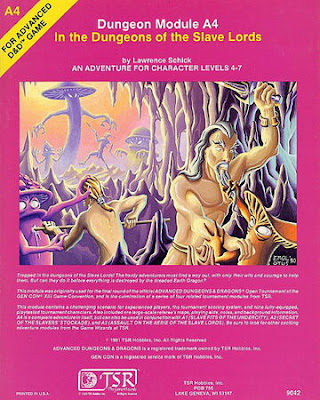
Retrospective: In the Dungeons of the Slave Lords

I'll briefly reiterate what I wrote in my retrospective post of Slave Pits of the Undercity: I have conflicting feelings about the entirety of the "Slave Lords" series of modules. On the one hand, the central conceit of these adventures – taking down a cabal of slavers – is a terrific one very much in keeping with the pulp fantasy roots of Dungeons & Dragons. It's not hard to imagine Conan or Fafhrd and the Gray Mouser engaged in such an endeavor. On the other hand, the modules, as published, feel very contrived and formulaic, owing no doubt to their origins as GenCon tournament modules. There's good stuff in all four of the A-series modules, but none of them quite achieve their full potential in my opinion, which is a shame.

That's especially so in the case of the final module in the series, In the Dungeons of the Slave Lords. Written by Lawrence Schick, the adventure is geared toward characters of levels 4–7, like all of its predecessors, though its introductory "Notes for the Dungeon Master" repeatedly points out that "the player's skill, not the character's level, will determine success." That's because it assumes the characters failed in their assault on the aerie of the slave lords (in the module of this name) and were taken captive. Rather than slay the PCs, the slave lords instead throw them into their dungeons, "totally bereft of equipment and spells." Schick comments on this initial situation as follows:

Many players think of their characters in terms of their powers and possessions, rather than as people. Such players will probably be totally at a loss for the first few minutes of play. It is likely that they will be angry at the DM for putting them in such an "unfair" situation. They will demand or beg concessions. DO NOT GIVE THEM ANY HELP, even if they make you feel sorry for them. Inform the players that they must rely on what they have, not what they used to have, and that this includes their brains and their five senses. Good players will actually welcome the challenge of this scenario. All players will ultimately enjoy the module much more if they out on their own resources, rather than with what hints and clues the DM gives them.

Schick accurately predicted the reactions of my friends with whom I played; they were incensed to have had all their characters' gear taken away. I suspect this reaction was commoner if the module was used as part of regular campaign play, as it was in mine, than in a tournament situation, whose players, in my limited experience, are more accepting of such contrivances. Much more interesting, though, is Schick's insistence that the referee neither give the players any help nor feel sorry for them. "Good players," he intones, "will … welcome the challenge." He was accurate in that prediction as well. Once they got past the initial shock of their characters being tossed, nearly naked and unarmed, into dark, dank, caverns, they started to have fun figuring out how best to survive. 

That's the main reason why I consider In the Dungeons of the Slave Lords perhaps the most interesting of the A-series modules: it does something unique, namely force the players to use their wits to keep their characters alive. Of course, it probably helps that many of the opponents in the eponymous dungeons are fairly weak – kobolds and giant insects of various kinds – but there are still enough genuine threats to keep them on their toes. This is no cakewalk.

And then there are the myconids, for which I have an inordinate fondness. There's just something about mushrooms and fungi generally that I not only find weirdly appealing but that screams "fantasy!" to me. I suppose my boyhood reading of Lewis Carroll played a role in this peculiar fixation of mine. Regardless, I love the myconids, who are not wholly indifferent to the characters' plight. Indeed, if they agree to perform a service to the myconid king, it will reveal to them an easier means of escaping the dungeons. I have always liked the inclusion of neutral factions in dungeons and Schick does a good job, I think, of showing the potential inherent in such encounters.

The conclusion of the module involves a final confrontation with the slave lords amidst a volcanic eruption that is destroying the villains' home base. Like many aspects of the module, it's all rather contrived and, in my opinion, something of an anticlimax not just to this module but to the whole series. Mind you, disappointment is my overall feeling about these adventures. There's unquestionable potential in them, along with a number of genuinely clever sections and elements, but, in the end, the whole winds up being much less than its parts. I can't help but think that, with a bit more work, the A-series could have been truly memorable, on par with the truly great modules of D&D's past. 

Wednesday, September 9, 2009

D&D/AD&D Product Chronology

Chris Tichenor compiled an excellent list of all the products released by TSR for Dungeons & Dragons and Advanced Dungeons & Dragons between 1974 and 1988, which I've reproduced below. What I like most about this list is the way it reveals trends in both the kinds of products TSR was publishing and the way that D&D was conceived of by the company. Tomorrow sometime, I'll post my own year-by-year thoughts about this list, but do feel free to make your own comments about it beforehand. I'm curious to see how much intersection there is between my own opinions on this matter and that of my readers.

1974:
Boxed Sets:
Dungeons & Dragons (original 3-volume set)

1975:
Accessories:
Supplement I: Greyhawk
Supplement II: Blackmoor

1976:
Accessories:
Supplement III: Eldritch Wizardry
Supplement IV: Gods, Demi-Gods & Heroes
Swords & Spells
Dungeon Geomorphs Set One

1977:
Hardbacks:
Monster Manual

Boxed Sets:
Dungeons & Dragons Basic Set (Holmes ed. Sutherland cover art)

Accessories:
Character Record Sheets (Tom Wham cover art)
Dungeon Geomorphs Set Two
Dungeon Geomorphs Set Three
Outdoor Geomorphs Set One: Walled City
Monster & Treasure Assortment Set One
Monster & Treasure Assortment Set Two

1978:
Hardbacks:
Players Handbook

Accessories:
Monster & Treasure Assortment Set Three

Adventures:
B1 In Search of the Unknown
D1 Descent into the Depths of the Earth
D2 The Shrine of the Kuo-Toa
D3 Vault of the Drow
G1 Steading of the Hill Giant Chief
G2 The Glacial Rift of the Front Giant Jarl
G3 Hall of the Fire Giant King
S1 Tomb of Horrors

1979:
Hardbacks:
Dungeon Masters Guide

Accessories:
Character Record Sheets (golden-rod w/ pink/purple Erol Otus art, later blue Jeff Dee art)
DM Screen (Yellow/Gold Erol Otus cover)
NPC Records Folder
Permanent Character Folders
Official AD&D Coloring Book

Adventures:
B2 Keep on the Borderlands
S2 White Plume Mountain
T1 Village of Hommlet

1980:
Hardbacks:
Deities & Demigods (Reprinted in 1983 as Legends & Lore)

Acessories:
DM's Adventure Log
The Rogue's Gallery
World of Greyhawk campaign folio
Dungeon Geomorphs Set One-Three (re-print)
Monster & Treasure Assortment Set One-Three (re-print)

Adventures:
A1 Slave Pits of the Undercity
C1 The Hidden Shrine of Tomoachan
C2 Ghost Tower of Inverness
Q1 Queen of the Demonweb Pits
S3 Expedition to Barrier Peak

1981:
Hardbacks:
Fiend Folio

Boxed Sets:
Dungeons & Dragons Basic Set (Moldvay ed. Otus cover art)
Dungeons & Dragons Expert Set (Cook w/ Marsh ed. Otus cover art)

Accessories:
Player Character Record Sheets (Roslof cover art)

Adventures:
A2 Secret of the Slavers Stockade
A3 Assault on the Aerie of the Slave Lords
A4 In the Dungeon of the Slave Lords
B3 Palace of the Silver Princess
D1-2 Descent into the Depths of the Earth (re-print)
G1-2-3 Against the Giants (re-print)
I1 Dwellers of the Forbidden City
L1 The Secret of Bone Hill
U1 The Sinister Secret of Saltmarsh
X1 The Isle of Dread

1982:
Accessories:
Monster Cards, Sets 1-4

Adventures:
B4 The Lost City
I2 Tomb of the Lizard King
I3 Pharoah
N1 Against the Cult of the Reptile God
S4 Lost Caverns of Tsojcanth
U2 Danger at Dunwater
WG4 The Forgotten Temple of Tharizdun
X2 Castle Amber (Chateau d’ Amberville)
X3 Curse of Xanathon

1983:
Hardbacks:
Monster Manual II

Boxed Sets:
Dungeons & Dragons Set 1: Basic Rules (Mentzer ed. Elmore cover art)
Dungeons & Dragons Set 2: Expert Rules (Mentzer ed. Elmore cover art)
World of Greyhawk

Accessories:
AC1 The Shady Dragon Inn

Adventures:
B5 Horror on the Hill
EX1 Dungeonland
EX2 The Land Beyond the Magic Mirror
I4 Oasis of the White Palm
I5 Lost Tomb of Martek
I6 Ravenloft
L2 The Assassin’s Knot
M1 Blizzard Pass
M2 Maze of the Riddling Minotaur
O1 The Gem and the Staff
U3 The Final Enemy
UK1 Beyond the Crystal Cave
UK2 The Sentinel
X4 Master of the Desert Nomads
X5 Temple of Death

1984:
Boxed Sets:
Dungeons & Dragons Set 3: Companion Rules

Accessories:
AC2 Combat Shield & Mini-adventure
AC3 3-D Dragon Tiles featuring The Kidnapping of Princess Arlena
AC4 The Book of Marvelous Magic
AC5 Player Character Record Sheets (same format, different cover art as 1981 sheets)

Adventures:
B6 The Veiled Society
B7 Rahasia
B8 Journey to the Rock
BSOLO Ghost of Lion Castle
C3 The Lost Island of Castanamir
C4 To Find a King
CB1 Conan Unchained!
CB2 Conan Against Darkness!
CM1 Test of the Warlords
CM2 Death’s Ride
CM3 Sabre River
DL1 Dragons of Despair
DL2 Dragons of Flame
DL3 Dragons of Hope
DL4 Dragons of Desolation
DL5 Dragons of Mystery
MV1 Midnight on Dagger Alley
N2 The Forest Oracle
O2 Blade of Vengeance
UK3 The Gauntlet
UK4 When a Star Falls
UK5 Eye of the Serpent
UK6 All that Glitters…
WG5 Mordenkainen’s Fantastic Adventure
X6 Quagmire!
X7 The War Rafts of Kron
X8 Drums on Fire Mountain
XL1 Quest for the Heartstone
XSOLO Lathan’s Gold

1985:
Hardbacks:
Oriental Adventures
Unearthed Arcana

Boxed Sets:
Battlesystem
Dungeons & Dragons Set 4: Master Rules

Accessories:
Lankhmar: City of Adventure
AC6 Player Character Record Sheets
AC7 Master Player Screen featuring The Spindle
AC8 3-D Dragon Tiles featuring The Revenge of Rusak (a/k/a AC3, a/k/a AC5)
REF1 DM Screen

Adventures:
B9 Castle Caldwell and Beyond
C5 The Bane of Llywelyn
CA1 Swords of the Undercity
CM4 Earthshaker!
CM5 Mystery of the Snow Pearls
CM6 Where Chaos Reigns
DL6 Dragons of Ice
DL7 Dragons of Light
DL8 Dragons of War
DL9 Dragons of Deceit
DL10 Dragons of Dreams
DL11 Dragons of Glory
H1 Bloodstone Pass
I7 Baltron’s Beacon
M1 Into the Maelstrom
T1-4 The Temple of Elemental Evil
UK7 Dark Clouds Gather
WG6 Isle of the Ape
X9 The Savage Coast
X10 Red Arrow, Black Shield
XS2 Thunderdelve Mountain,

1986:
Hardbacks:
Dungeoneer’s Survival Guide
Wilderness Survival Guide

Boxed Sets:
Dungeons & Dragons Set 5: Immortal Rules

Accessories:
AC9 Creature Catalogue
REF2 Character Record Sheets
REF3 Book of Lairs

Adventures:
A1-4 Scourge of the Slavelords (re-print)
B10 Night’s Dark Terror
CA2 Swords of Deceit
CM7 The Tree of Life
DA1 Adventures in Blackmoor
DA2 Temple of the Frog
DL12 Dragons of Faith
DL13 Dragons of Truth
DL14 Dragons of Triumph
GDQ1-7 Queen of the Spiders (re-print)
H2 The Mines of Bloodstone
I8 Ravager of Time
I9 Day of Al’Akbar
I10 Ravenloft II: The House on Griffon Hill
IM1 Immortal Storm
M2 Vengeance of Alphaks
M3 Twilight Calling
N3 Destiny of Kings
N4 Treasure Hunt
OA1 Swords of Daimyo
OA2 Night of the Seven Swords
RS1 Red Sonya Unconquered
X11 Saga of the Shadow Lord

1987:
Hardbacks:
Dragonlance Adventures
Manual of the Planes

Boxed Sets:
Forgotten Realms Campaign
Kara Tur, the Eastern Lands

Acessories:
AC10 Bestiary of Dragons and Giants
AC11 The Book of Wondrous Inventions
FR1 Waterdeep and the North
FR2 Moonshae
GAZ1 The Grand Duchy of Karameikos
GAZ2 The Emirates of Ylaruam
GAZ3 The Principalities of Glantri
GAZ4 The Kingdom of Ierendi
REF4 Book of Lairs II

Adventures:
B1-9 In Search of Adventure (re-print)
C6 Official RPGA Tourney Handbook
CM8 The Endless Stair
CM9 Legacy of Blood
DA3 City of the Gods
DA4 Duchy of Ten
DQ1 The Shattered Statue
H3 The Bloodstone Wars
I3-5 Desert of Desolation
I11 Needle
I12 Egg of the Phoenix
I13 Adventure Pack I
IM2 The Wrath of Olympus
IM3 The Best of Intentions
M4 Five Coins for a Kingdom
M5 Talons of Night
N5 Under Illefarn
OA3 Ochimo: The Spirit Warrior
OA4 Blood of the Yakuza
S1-4 Realms of Horror (re-print)
X12 Skarda’s Mirror
X13 Crown of Ancient Glory

1988:
Hardbacks:
Greyhawk Adventures

Boxed Sets:
City System (orange box Waterdeep set)

Accessories:
DM's Design Kit
FR3 Empires of the Sands
FR4 The Magister
FR5 The Savage Frontier
FR6 Dreams of the Red Wizards
GAZ5 The Elves of Alfhiem
GAZ6 The Dwarves of Rockhome
GAZ7 The Northern Reaches
GAZ8 The Five Shires
GAZ9 The Minrothad Guilds
GAZ10 The Orcs of Thar
REF5 Lords of Darkness

Adventures:
DL15 Mists of Krynn
DL16 World of Krynn
FRC1 Ruins of Adventure
H4 Throne of Bloodstone
I14 Swords of the Iron Legion
OA5 Mad Monkey vs. the Dragon Claw
OP1 Tales of the Outer Planes
WG7 Castle Greyhawk

Wednesday, May 5, 2021

Retrospective: To the Aid of Falx

Though I participated in not a single RPGA-sponsored tournament, I was nevertheless a member of the Role Playing Game Association from 1982 to 1986. I initially joined in the hope that I would one day participate in such tournaments, which fascinated me, but I stayed because I enjoyed reading Polyhedron. I was equally fascinated by the exclusive items that the RPGA sold to its members, like the three AD&D adventure modules written by Frank Mentzer.

The first of the modules, To the Aid of Falx, was published in 1982 and is written for characters of levels 5–9. Its premise is that the characters have been "selected from many applicants" to assist the silver dragon, Falx Templamut, and "grandson of old Bahamut himself." Falx is concerned by the recent theft of five potions of silver dragon control from a merchant caravan, fearing they'll be used against him. He asks the characters to enter the lair of the thieves, one of whom is a vampire, since, being a dragon, he is too large to enter. 

Given this set-up, it should come as little surprise that To the Aid of Falx is a contrived, forgettable adventure, filled with traps and monsters (like 32 wererats and 8 wights) intended to "challenge" the characters rather than make sense within the context of the adventure. Normally, I wouldn't have written about a scenario like this, but it include an interesting preface by Frank Mentzer. Pay particular attention to the second paragraph.
Mentzer's comment about "dungeons that could exist as given a for length of game time" is broadly in line with Gygaxian naturalism and, I think, generally laudable. There's nothing inherently wrong with funhouse dungeons, but my personal preference is generally for dungeons that make sense. Based on what he says in the preface, Mentzer feels similarly, though I'm not sure that To the Aid of Falx fits the bill.

Even more intriguing is Mentzer's comment that he is "much opposed to non-standard AD&D games." He elaborates on what he means by this is noting that his own campaign, which apparently began in 1976, contains only two new monsters and no new character classes, spells, or "procedures," by which I assume he means rules procedures. He even offers an aside in which he denigrates the introduction of such new material as "so-called 'improvements.'" 

I'm not quite sure what to make of these statements. On the one hand, I fully understand the desire to play a RPG without any variant materials. On the other hand, nearly every AD&D module ever published, starting with Gygax's own G and D-series adventures, has included new monsters. What then was Mentzer's point in voicing this opinion in To the Aid of Falx? My guess is that it was part of the movement, starting in the early 1980s, to promote the standardization of AD&D first through the RPGA and then through Gygax's columns in the pages of Dragon. 

To the Aid of Falx is not the worst module I've ever read, but it's far from a good one. Compared even to other re-purposed tournament modules, like Slave Pits of the Undercity, it's an uninspired effort. Its main appeal to me is its amusing artwork by the late, great James Holloway, such as the cover image depicted above. If it's at all representative of the kind of scenarios used by the RPGA, I can't say I missed out on much by never participating in their tournemants.

Monday, November 19, 2012

Reprint Musings

Back at the start of last month, it was discovered that Wizards of the Coast would follow up its apparently-successful reprints of the Advanced Dungeons & Dragons core rulebooks with a couple of adventure compilations. The first is Dungeons of Dread in March of next year, which collects all of the S-series modules under one cover. The second, to be released in June 2013, is Against the Slave Lords, which puts all four A-series adventures into a single volume.

The mere fact that, more than 30 years after they were first published, WotC is once again making available classic AD&D material should be cause enough to warm an old schooler's cold heart. It's even more impressive when you consider what a turnabout it is from WotC's approach over the last several years with regards to D&D products published before 2008. I'd almost go so far as to say it's "miraculous."

But the miracles don't stop there. In the description to Against the Slave Lords linked to above, you'll see this paragraph:
Added to the collection is an all-new fifth adventure -- A0: Danger at Darkshelf Quarry -- that you can use to kick off an AD&D campaign that pits a group of adventurers against the evil Slave Lords! Module A0, designed for levels 1-3, sets the stage for events that unfold throughout the remainder of the "A" series.
An "all-new" AD&D adventure? That's the first time since 1999 that Wizards of the Coast has published something new for AD&D (someone can correct me if I'm mistaken in this). So far as I know, we don't have any details about module A0 at this stage beyond what's included in the quoted blurb. I'm sure there are some crotchety grognards (do I repeat myself?) out there who will find some way to find fault with this -- "Who at WotC even knows how to write an AD&D adventure?" "How dare they bundle their faux module into a collection of such hallowed classics?" etc. -- but, to my mind, this is something worth cheering and I sincerely hope I am not alone in applauding it. Kudos to WotC!

Comments to this post can be made here.

Monday, July 26, 2021

A (Very) Partial Pictorial History of Orcs

Whatever one thinks of Gary Gygax's claims about the influence of J.R.R. Tolkien on the creation and development of Dungeons & Dragons, there can be little question that the orc is one of the game's iconic monsters. Despite this, D&D has never provided a consistent picture of just what an orc looks like. The earliest illustration of them in the game is this one by Greg Bell, appearing in Volume 1 of OD&D (1974):
Leaving aside its lack technical skill, what stands out to me is that this orc looks little very human in appearance – a little more bestial perhaps but not that different from some crazed barbarian. The orcs of the Monster Manual (1977) look very different, being the pig-faced humanoids of which I am so fond.
This depiction of orcs by David C. Sutherland III was very influential and can found throughout the AD&D line, as well as on the title page of the Holmes rulebook (one of my all-time favorite pieces in all of D&D) from the same year as the Monster Manual
Interestingly – and oddly – the Games Workshop version of the Holmes rulebook includes a different interpretation of this scene, one with idiosyncratically one-eyed orcs, something I don't believe I've ever seen anywhere else.
Dave Trampier drew some orcs in module G1 (1978) and clearly took his cue from Sutherland.
Sometime around 1980, the pig-faced orc seems to have fallen into disfavor, as we begin to see a variety of other types, such as this one drawn by Jeff Dee for Slave Pits of the Undercity
Just a short time later, Grenadier Models depicts orcs on one of its boxed miniatures sets in yet another style.
These orcs are green-skinned and more generically monstrous. Interestingly, Timothy Truman seems to have taken elements from several of these depictions with this illustration, which served as the basis for the LJN orc toy.
This in turn influenced the design of the orcs that appeared in the Dungeons & Dragons cartoon.
Since we're on the subject of cartoon-y orcs, I would be remiss if I did not include Clyde Caldwell's cover to the 1988 The Orcs of Thar.
The foregoing only barely scratches the surface of this topic, which reveals, I think, that TSR had no consistent idea of what orcs looked like. Each artist had his own interpretation of them and, while certain characteristics sometimes carried over between the depictions, there is hardly enough continuity to settle on a "canonical" notion of these monsters' appearance. 

Had I the time and patience to do so, I could no doubt have found many, many more illustrations of orcs in TSR products. Instead, I'll leave that to you. Do you have any favorite orc artwork from the days of TSR? 

Monday, July 15, 2024

A (Very) Brief Pictorial History of Halflings

For today's look at the art of TSR era Dungeons & Dragons, I've decided to step away from monsters and instead focus on something a little different: halflings. Halflings, as everyone knows, originate in the works of J.R.R. Tolkien and have little or no antecedents in real world myth or legend. Despite Gary Gygax's well-known dislike of The Lord of the Rings, he was, however, a fan of The Hobbit, which introduced halflings – or, rather, hobbits – to the world. Both books were very popular among fantasy aficionados during the early 1970s, when D&D was born, so it's not at all surprising that Tolkien's diminutive creations should find their way into the game (along with several of his monsters). Of course, this usage was completely unauthorized and legally dubious. Saul Zaentz's Middle-earth Enterprises threatened legal actions against TSR for its usage of "hobbit" (and "ent" and "Nazgûl," I believe) in OD&D. Subsequent printings of the game, such as the one I own, changed "hobbit" to "halfling" and that term then became the common one in Dungeons & Dragons. 

There are no clearly identified illustrations of halflings in OD&D. However, there is this piece of Greg Bell artwork that I think is supposed to be a halfling:

As you can see, the illustration is crude and looks more like the common depiction of a leprechaun – note the hat – than what we now expect of a hobbit or halfling. However, there are no leprechauns in OD&D, playable or otherwise. Further, if you look carefully, you can see the figure above is using a sling in his right hand, a signature weapon of halflings in both OD&D and the Fantasy Supplement to Chainmail. 

The earliest unambiguous illustration of a halfling comes in the AD&D Monster Manual by David Sutherland. Sutherland's depiction is broadly consonant with Tolkien's descriptions of hobbits, including their hairy feet.
The next year, in 1978, Sutherland illustrated module B1, In Search of the Unknown. One such illustration shows a short figure I assume is meant to be a halfling. Because he has no beard, I don't think he's supposed to be a dwarf, but there's no way of knowing for certain.
Next up is Bill Willingham's take on a halfling from the 1980 reprint of White Plume Mountain – even though it actually depicts a polymorphed efreeti masquerading as a halfling. Once again, furry feet à la Tolkien are visible.
1980 also saw the release of Slave Pits of the Undercity, whose cover features this towheaded halfling by Jeff Dee.
The Tom Moldvay D&D Basic Set (1981) includes this depiction of several different character classes by Dave LaForce. In the bottom right-hand corner, you can see a halfling, armed with a bow. 
The Cook-Marsh Expert Set (1981) includes one of my favorite depictions of a D&D halfling (by Jeff Dee). 
Frank Mentzer's 1983 revisions of the Basic and Expert Sets include many illustrations of halflings, probably the most of any TSR edition of Dungeons & Dragons. For the purposes of space, I'm including only a single example (by Larry Elmore), though there are many other excellent options to choose from.
The same year saw the release of The Shady Dragon Inn, a supplement filled with artistic renderings of every conceivable D&D character type, including halflings. It also features portraits of characters based on the LJN D&D toy line, such as Figgen the Halfling Thief (whose toy, ironically, was never actually produced as far as I know). This is Timothy Truman's version of Figgen:
In the third episode of the first season of the Dungeons & Dragons cartoon series (also 1983), we're introduced to a character called Hector the Halfling (who's actually bad guy Venger disguised by magic). He's the only halfling to appear in the series of looks quite different than all previous depictions of the race. He lacks hairy feet, but he wears peculiar pants that cover half of his oversized feet, leaving the toes visible. He also has pointed ears, an inconsistently portrayed aspect of D&D halflings.
The Forgotten Realms Campaign Set (1987) presents us with another slightly anomalous vision of halflings. Jeff Easley's halflings are skinny, goofy-looking little people with mildly larcenous demeanors. They still have big, slightly hairy feet, but otherwise strike me as quite unique.
Jim Holloway's version of halflings from 1989's Monstrous Compendium is, in my opinion, a little creepy, with his heavy eyebrows, half-lidded eyes, and languorous pose. He also boasts a veritable mane of hair that starts at his ankles and then drapes over the tops of his feet. To my eyes, the overall effect is suggestive of a satyr rather than a hobbit and I can't say I'm keen on it.
Tony DiTerlizzi's piece from the 1993 Monstrous Manual is better, exuding a kind of scrappy heroism that works well for halflings. 
As you can see from just this small sampling of illustrations, there's never been a fully consistent conception of halflings. I wouldn't be surprised if this was driven, at least in part, by a desire to legally distinguish D&D's diminutive race from Tolkien's hobbits. At the same time, there can be no question that, at base, halflings are hobbits in all but name. The presence of hairy feet – a characteristic derived from Tolkien – in nearly all of the above pieces of artwork demonstrates that. If the intention were to avoid comparisons to the denizens of Middle-earth, you'd think removing that feature would have been at the top of the art director's list. (Interestingly, the kender of Dragonlance pointedly wear shoes – take that, Saul Zaentz!).

There's a lot more to be said on this topic, I think, but I'll leave that to another day. For now, I'm interested in your thoughts about both the art and the place of halflings in your own D&D campaigns. Do you use them? Do you, like me, replace them with another race? Or you omit them entirely? 

Thursday, February 9, 2023

Thoroughly

From Dungeons & Dragons module B2, Keep on the Borderlands:

The use of this module requires a working familiarity with its layout and design. Therefore, the first step is to completely read through the module, referring to the maps provided to learn the locations of the various features. A second (and third!) reading will be helpful in learning the nature of the monsters, their methods of attack and defense, and the treasures provided.

From module B3, Palace of the Silver Princess:

Before beginning the adventure, the DM should read this module thoroughly to become familiar with its details.  

From module B4, The Lost City:

Before beginning the adventure, please read the module thoroughly to become familiar with the Lost City. 

From Advanced Dungeons & Dragons module A1, Slave Pits of the Undercity:

Before commencing play, it is recommended that the DM read the module thoroughly and become familiar with the information given. 

From module A2, Secret of the Slavers Stockade:

Before beginning play, the DM must read all parts of the module thoroughly. 

From module C1, The Hidden Shrine of Tamoachan:

It is recommended that the DM read the module thoroughly several times before play starts, making notes in the margins where useful.

From module C2, The Ghost Tower of Inverness:

It is necessary that the DM read the module thoroughly before play. It may be useful to make notes in the margins at some points. 

From module S1, Tomb of Horrors:

Please read and review all of the material herein, and become thoroughly familiar with it before beginning the module. 

From module S2, White Plume Mountain:

Please read the entire module through and thoroughly familiarize yourself with complex areas before beginning play. 

From module S3, Expedition to the Barrier Peaks:

Be certain that you are quite familiar with the entire module, and read each encounter section carefully.  

 etc. etc.

Wednesday, March 23, 2011

Retrospective: Jim Roslof's TSR Covers

In keeping with this week's remembrance of the recently deceased artist Jim Roslof, I've decided to do a different kind of retrospective today: a look at the covers illustrations Roslof did during his time at TSR. In preparing this post, what I immediately noticed was how few covers he actually did. On the other hand, the covers he did do include some of the ones I most vividly remember, even excluding those for modules B2 and D1-2, both of which I've already highlighted.

Take, for example, this cover, from 1980, Queen of the Demonweb Pits.
A reminder that spider-queens aren't always sexy.
I've noted before that Dave Sutherland's sole example of game design isn't one of my favorite modules, but it does sport one of my favorite covers. This piece sports all the usual Roslof hallmarks, such as a largely (or entirely) human cast of adventurers wearing "realistic" gear, but what has always stuck with me is his portrayal of Lolth in her spider form. Like the drow who serve her, all too often Lolth is presented as an ebon-skinned seductress rather than as a hideous demon, which is what she actually is. Granted, I suffer from a powerful arachnophobia, but, even so, there ought to be something creepy about any being one of whose physical forms is that of a spider with a humanoid head. Roslof perfectly captured that creepiness in this cover illustration, which is never far from my mind when I think of the drow.
Boo!
Another cover from 1980 is The Ghost Tower of Inverness. Though I remember playing this module back in the day (several times, in fact), it's not a favorite of mine, since its structure is clearly geared more toward tournament rather than campaign play. The cover, though, is burned into my memory. It doesn't depict anything that actually occurs in the module so far as I can recall (someone will no doubt correct me if I'm mistaken), but it nicely encapsulates the idea of a "ghost tower" in a single image.
Nothing says "super spy" like firearms and SCUBA gear.
Roslof illustrated more than D&D module covers, such as 1980's Operation: Rapidstrike! for Top Secret. I remember nothing at all about this module (which is sadly the case for almost all the Top Secret adventures), but I do remember its cover. Being a fan of the movie Thunderball, there's always been a strong association in my mind between armed frogmen and spies, so this cover really spoke to my imagination. The cover's also noteworthy in depicting a team of agents rather than a single one, which better matched what the actual play of Top Secret was like.
Is that Gollum?
1981's Secret of the Slavers Stockade is another module I don't think much of, but, like all the Slave Lords adventures, it played an important part in my Greyhawk campaign of old. Of all those modules' covers, this is the one that sticks most in my mind, for two reasons. First, there's the purple boggle on a leash. Like the module itself, the boggle is not a particularly memorable D&D monster, even when compared to other creatures introduced in the A-series, like the aspis or myconids. Yet, I remember it very strongly, perhaps because there's something mildly unnerving about humanoid being used as a bloodhound by other humanoids, I don't know. The second feature I like is the stance of the adventurers. Like a lot of the best old school art, we're seeing the moments before something exciting is about to happen. This cover doesn't tell a story of its own; it invites us to imagine for ourselves what that story will be.
Where it all began for me.
Though the 1981 edition of Dungeon! was not the one I first played, it is the one I eventually owned, whose cover image was this rather funky piece by Roslof. Unlike a lot of Roslof's work, this one isn't as "realistic," instead being fanciful and "sketchy" in appearance. If I wasn't already given to calling Erol Otus's work "dreamlike," I might use that adjective here as well. Even so, the illustration is classic Roslof, depicting adventurers on the verge of engaging an enemy, in this case a strange gargoyle-like creature whose exact nature occupied my thoughts as a younger man.
Conquistadors vs. Cave Men
I have a lot of personal fondness for 1983's Horror on the Hill, even though, by most measures, it's just another variation on the theme indelibly established by The Keep on the Borderlands. But my friends and I had a lot of fun with this adventure, so it's hard for my to be completely objective about its virtues and flaws, including its cover, which I really like. Again, we get human adventurers wearing historical armor -- including, this time, some very late medieval, early modern gear -- as they're about to do something. That they're opponents are Neanderthals only adds to its charm in my opinion, as their presence lends a pulp fantasy vibe to the whole thing that I find charming.
Yo Ho!
1984's Lathan's Gold is a module I don't remember very well. It's a solo adventure in which the player character must travel across many locales (mostly islands) to find enough gold to buy the freedom of your fiancée, who's been kidnapped by an evil nobleman. The illustration is something of a departure from Roslof's other pieces, in that it shows a number of non-humans in more fantastical attire. On the other hand, his eye for foliage is in evidence here, just as it was on the cover for The Keep on the Borderlands.

And there you have it -- all the TSR covers by Roslof that I could recall (and that I haven't already discussed). If I've forgotten any, please let me know in the comments, so I can expand and correct this entry.